Updated November 2026 for 2027: rechecked every tool's pricing and features on its own site, dropped two unsourced statistics, added new figures from Kantar BrandZ 2026, and moved Koji out of the ranking into its own section.
The short answer: for an always-on brand tracker a marketing team can run itself, look at Tracksuit (consumer brands, from $19,500 a year) or Latana (from €7,900 per market a year). For daily data on thousands of brands across many countries, YouGov BrandIndex and Morning Consult are the syndicated options. For brand equity work you can take to a board, Kantar is the long-standing choice. Qualtrics, quantilope and Attest suit teams that want to design their own tracker and pick their own sample. None of these tells you why a number moved, so most brand teams pair a tracker with a few interviews each time a metric shifts.
Brand tracking is a measure of how people see your brand over time: awareness, consideration, preference, the associations they hold. It matters because brand value is a large share of what companies are worth. Kantar's 2026 BrandZ ranking puts the combined value of the world's 100 most valuable brands at $13.1 trillion, up 22% on 2025 (Kantar BrandZ 2026). And the long-run case for building brand, not only running promotions, still rests on the IPA Databank: Les Binet and Peter Field found the best budget split was about 60:40 between brand building and activation in The Long and the Short of It (2013), and 62:38 in the 2018 follow-up Effectiveness in Context (IPA). If you spend 60% of a budget on brand, you need a way to see whether it is working.
How we chose
We compared the tools on five criteria a brand or insights team weighs before buying:
- Method: syndicated panel data, a custom survey you design, or both.
- Cadence: daily, monthly, quarterly or set by you.
- Coverage: how many markets, brands and audience segments.
- Who runs it: a self-serve dashboard, or a research team or vendor consultants.
- Pricing model: whether the price is public, and how it scales (per market, per brand, per response).
Every price and feature below was checked on the vendor's own site in November 2026. Where a vendor doesn't publish a price, we say "not public". For the method behind any tracker, see our guide to brand tracking studies.
1. Tracksuit: best always-on tracker for consumer brands
Tracksuit is a self-serve, always-on brand tracker built for marketing teams that don't have a research department. The base plan covers one category, your brand plus five competitors, and 2,400+ consumers surveyed in your category, with funnel metrics, brand perceptions and category attributes. Tracksuit lists the base plan at $19,500 a year (around £15,000 in the UK), with add-ons such as unprompted awareness and extra competitors. It doesn't track B2B brands.
Best for: growth-stage consumer brands that want a tracker the marketing team owns.
2. Latana: best for tracking specific audience segments
Latana publishes its prices: Essential from €7,900 per market a year (awareness for 4 brands across 2 custom segments, updated monthly) and Pro from €18,900 per market a year (6 brands, 3 segments), with custom setups on request. Contracts start at 12 months. Its pitch is reliable reads on narrow audiences, such as Gen Z women in one country, rather than only the general population.
Best for: brands that care about how a few precise segments see them, market by market.
3. YouGov BrandIndex: best for daily competitive benchmarks
BrandIndex tracks 16 brand health metrics every day, grouped into media and communication, purchase funnel and brand perception, including YouGov's Index and Buzz scores. YouGov's pages describe coverage of 56 markets and more than 27,000 brands, with history going back over 15 years. Access comes through subscriptions, data snapshots or an API, and a free BrandIndex Lite version shows one metric with monthly updates. Price: not public.
Best for: larger brands that need daily data on themselves and competitors, and want to react to news within days.
4. Morning Consult: best for reputation and trust tracking
Morning Consult Intelligence tracks thousands of brands daily on awareness, favorability, consideration, trust and usage, plus a Reputation Score, across 40+ countries on its higher tiers. It is strong where a brand's reputation moves with news, policy or public debate. Price: not public; tiers differ by the number of brands and countries.
Best for: brands whose reputation is exposed to news cycles and public affairs.
5. Kantar: best for brand equity measurement at board level
Kantar Brand Guidance is built on the Meaningful, Different and Salient (MDS) framework, which the Marketing Accountability Standards Board has certified. Kantar's own analysis says that, on average, being meaningful and different accounts for 94% of a brand's pricing power, and salience for 6% (Kantar). That is why Kantar urges teams to track difference, not only awareness. Programs come with consulting support. Price: not public.
Best for: multinationals that need equity data a CFO will accept.
6. Qualtrics BrandXM: best inside an existing Qualtrics setup
Qualtrics sells brand tracking as part of its Brand and Communication Research products, alongside creative testing and access to panel partners. Its marketplace lists the Brand Tracking solution as included with a Research Core licence, while deeper brand diagnostics are a paid add-on. Price: not public, quoted per contract.
Best for: enterprises already on Qualtrics that want brand, customer and employee data in one place.
7. quantilope: best for automated advanced methods
quantilope automates survey methods such as conjoint, Van Westendorp and mental availability tracking, and its tracking product runs waves automatically. Its pricing page lists a Business plan from $2,300 a month for 3 users, with Pro and Enterprise on request.
Best for: insights teams that want advanced quantitative methods without a statistician on every wave.
8. Attest: best for flexible brand reads with your own design
Attest's brand tracker runs in 59 countries and 70 languages on a panel it puts at 150 million+ people. You design the questions and the sample. Pricing is per response: Attest's comparison pages list its Professional plan at $0.50 per response, with the same price in every market.
Best for: growth teams that want to set up their own tracker in many markets and control cost per wave.
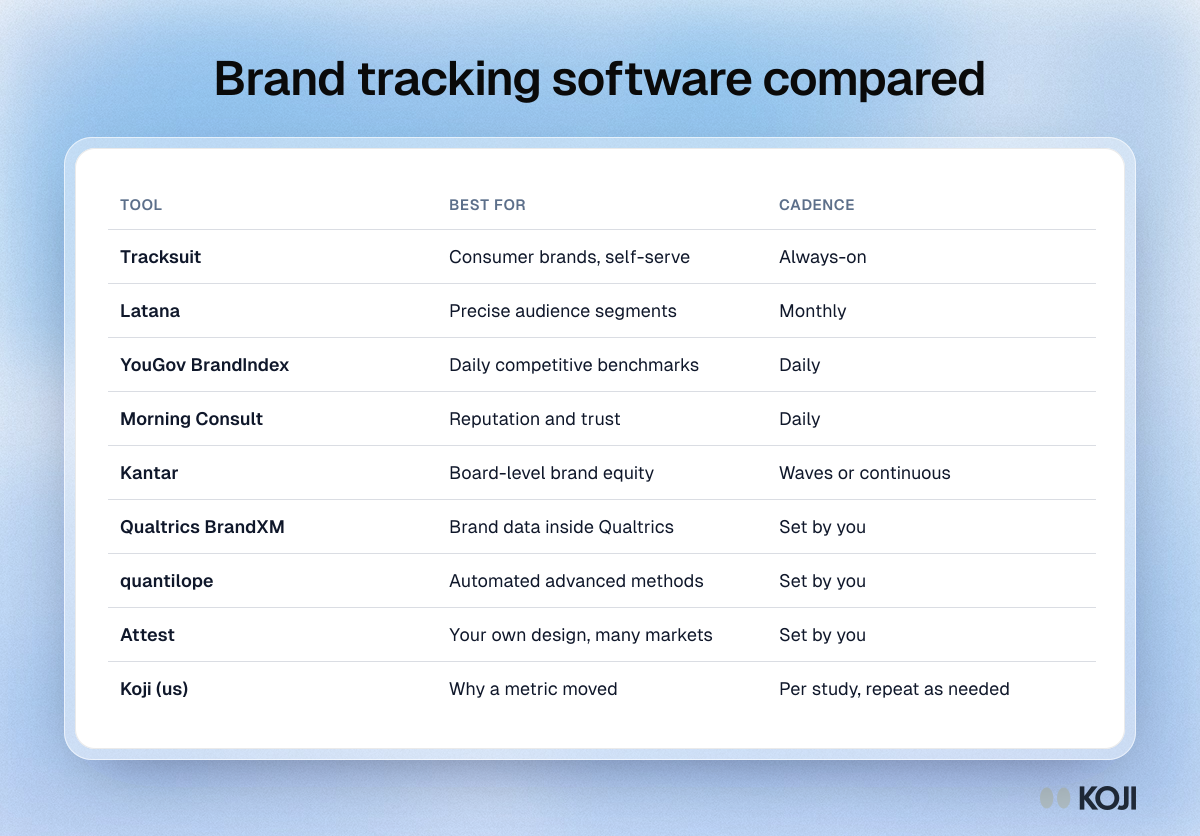
Brand tracking software compared
| Tool | Best for | Cadence | Starting price |
|---|---|---|---|
| Tracksuit | Consumer brands, self-serve | Always-on | $19,500 a year |
| Latana | Precise audience segments | Monthly | €7,900 per market a year |
| YouGov BrandIndex | Daily competitive benchmarks | Daily | Not public (free Lite version) |
| Morning Consult | Reputation and trust | Daily | Not public |
| Kantar | Board-level brand equity | Waves or continuous | Not public |
| Qualtrics BrandXM | Brand data inside Qualtrics | Set by you | Not public |
| quantilope | Automated advanced methods | Set by you | $2,300 a month |
| Attest | Your own design, many markets | Set by you | $0.50 per response |
| Koji (us) | Why a metric moved, in people's own words | Per study, repeat as needed | Free to start; €29 or €79 a month |
Checked November 2026 on each vendor's site. Prices change; confirm with the vendor before you budget.
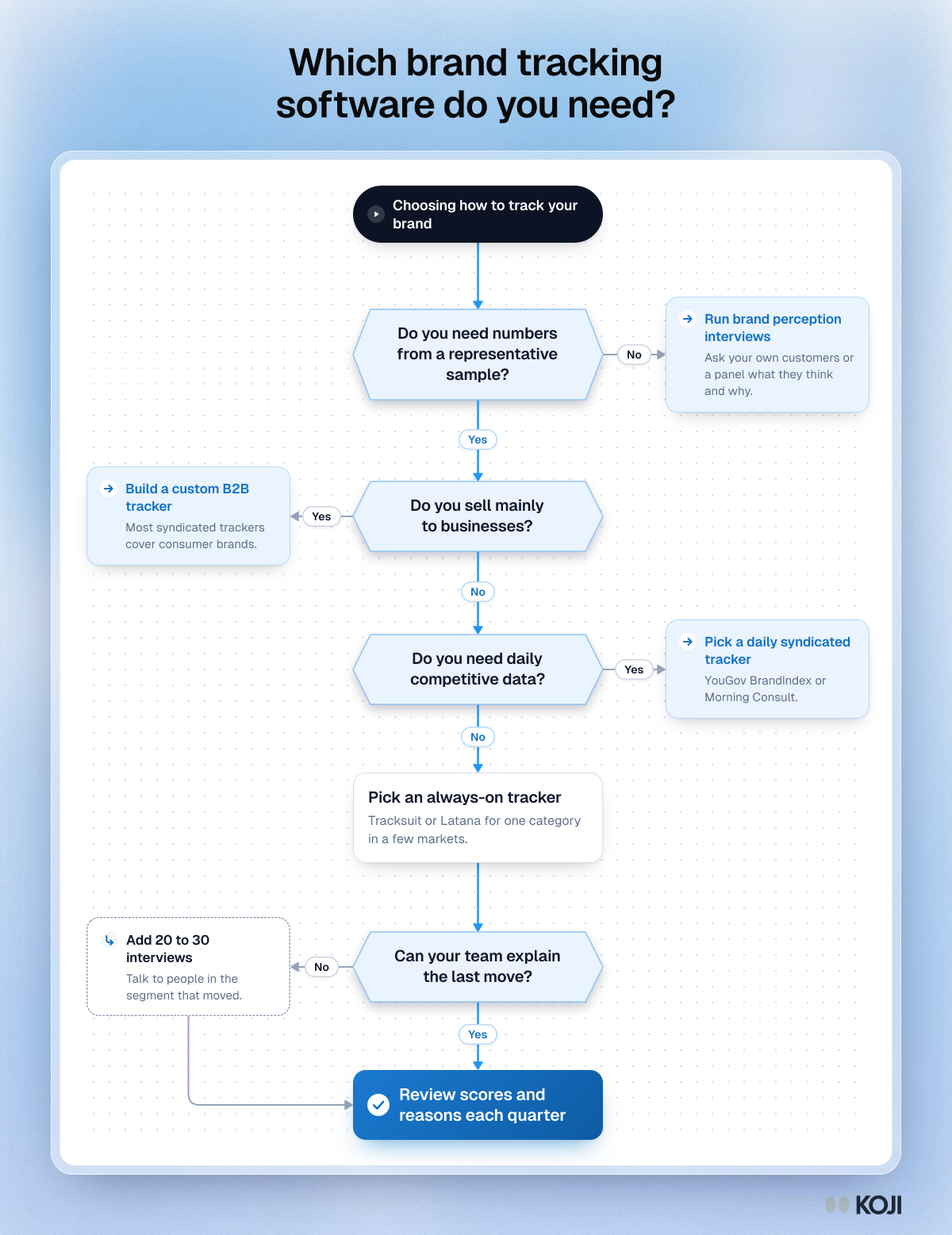
Which tracker do you need?
Start with the decision the data has to support, not the dashboard:
- You need numbers from a representative sample (awareness up or down, share of consideration against rivals): pick a tracker from the list above.
- You sell mainly to businesses: most syndicated trackers cover consumer brands, so build a custom tracker in Qualtrics or Attest with a B2B sample.
- You need daily competitive data: YouGov BrandIndex or Morning Consult.
- You want one category in a few markets, run by the marketing team: Tracksuit or Latana.
- Your tracker shows a move and nobody can say why: add interviews. Twenty to thirty conversations with people in the segment that moved usually show the reason.
Quarterly reporting is a sensible default for most brands: often enough to catch a slide before it reaches sales, rare enough to see real change rather than noise.
When the number moves: finding out why
A tracker will tell you consideration fell four points among 25 to 34 year olds. It won't tell you that a price rise, a weak ad or a competitor's launch changed what people think you stand for. That gap is why brand teams run qualitative research beside the tracker: a short round of interviews with people in the segment that moved, asking what they think of the brand now, what they compared it with, and what they heard recently.

Photo by Kaleidico on Unsplash
The interviews work best when they reuse the tracker's language. Ask the same scaled question the tracker asks, then ask why. For question wording, see our guides to brand perception surveys and brand research interviews.
Where Koji fits (our product)
Koji publishes this page, so we left it out of the ranking. Koji is not a brand tracker. It runs AI-moderated interviews by voice or text, and brand teams use it for the why behind tracker movements, for positioning and message tests, and for concept and ad first impressions. If you work in brand or marketing, our page for marketing teams shows the setups people use.
What it does for brand research, checked in the product:
- Scaled questions with follow-ups. Mix scale, single choice, multiple choice, ranking and yes/no questions with open questions, and the AI interviewer asks a follow-up on every answer. Choice options can be shuffled for each participant so the first option isn't favoured.
- Image and first-impression tests. Attach an ad, logo, pack or concept to a question. It can be shown once, full screen, for 3, 5, 10 or 15 seconds, then hidden, and Koji asks what people remember.
- Your customers or a panel. Share a link or email your own customers, or recruit from Koji's research panel on paid plans.
- 33 languages, with each interview opening in the participant's language.
- Reports you can hand on. Themes with the quotes behind them, downloadable as an editable PowerPoint deck or a PDF. Duplicate a study to run the next wave with the same questions.
What it costs: a free account comes with 10 credits and no card. Insights is €29 a month (29 credits) and Interviews is €79 a month (79 credits, adds voice interviews). A text interview uses 1 credit and a voice interview 3, and only interviews that score 3 or more out of 5 for quality use credits. Enterprise starts from €500 a month.
When Koji is the wrong choice: if you need statistically representative awareness figures for a population, daily data on competitors, or a long benchmark history, use one of the trackers above. Koji's numbers come from the people you interview, not a weighted sample.
Next step: if your tracker has shown a move you can't explain, set up a brand perception study and interview the segment that changed.
Related reading
- Koji vs YouGov: what a standing panel can and can't explain when a metric moves.
- Koji vs Attest: consumer survey panel or customer interviews.
- Category entry points: what a tracker should measure in the first place.