

Short answer: Knit is an AI-powered research partner for enterprise insights teams. It builds the survey with you, fields it to its panel partners, adds AI-moderated video follow-ups to quantitative questions, and its researchers shape the final report. You buy it like an agency: an annual subscription or per project, priced by quote. Koji is a self-serve AI research platform. You write the question, an AI interviewer runs voice or text conversations with your customers or panel participants, and the report builds itself as interviews come in. Prices are public and you can start free. Choose Knit for a large, survey-led consumer study with researcher support. Choose Koji when you want qualitative depth from real conversations, run by your own team, this week.
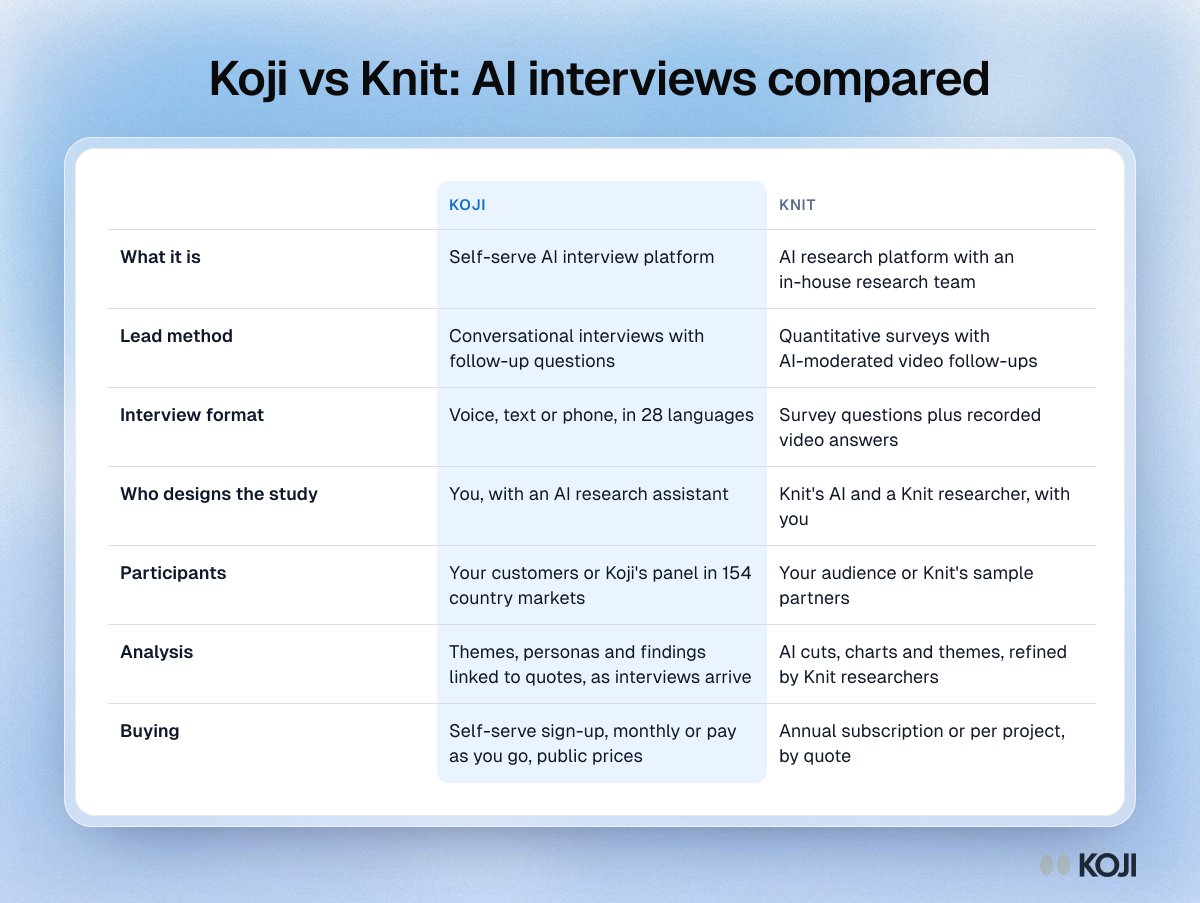
Koji vs Knit at a glance
| Koji | Knit | |
|---|---|---|
| What it is | Self-serve AI interview platform | AI research platform with an in-house research team |
| Lead method | Conversational interviews with follow-up questions | Quantitative surveys with AI-moderated video follow-ups |
| Interview format | Voice, text or phone, in 28 languages | Survey questions plus recorded video answers |
| Who designs the study | You, with an AI research assistant | Knit's AI and a Knit researcher, with you |
| Participants | Your customers or Koji's panel in 154 country markets | Your audience or Knit's sample partners |
| Analysis | Themes, personas and findings linked to quotes, as interviews arrive | AI cuts, charts and themes, refined by Knit researchers |
| Buying | Self-serve sign-up, monthly or pay as you go, public prices | Annual subscription or per project, by quote |
What Knit is
Knit describes itself as an AI-native research partner for consumer insights teams. A study typically runs like this, according to Knit's own pages:
- Knit's AI drafts an editable questionnaire and a custom analysis plan, and a Knit researcher reviews the design.
- The survey fields to your own audience or to Knit's sample partners, which Knit says give access to more than 65 million respondents.
- Inside the survey, AI-moderated video questions ask open-ended follow-ups and record answers on camera. Knit says this produces two to three times deeper responses than standard open-ends; that is the company's own figure.
- After fielding, its AI produces cuts, charts and themes across quant and qual, with an AI-generated report within about 24 hours that researchers then refine.
Knit raised a $16.1 million Series A in July 2025 and lists enterprise brands such as Mars among its clients. It does not publish prices. Greenbook's directory describes Knit as available by annual subscription or by project.
This model fits a wider shift in the industry. Greenbook's 2025 GRIT Business Outlook found that 67% of research suppliers now embed generative AI in their client deliverables. Knit is part of a group of AI-powered agencies selling research as a service.
What Koji is
Koji is an AI-native research platform built around the interview rather than the survey. You don't hand a brief to a vendor. You run the study yourself, and the AI does the heavy lifting.
You ask, the assistant drafts. Type what you want to learn and the research assistant builds a brief: goal, questions, screening questions and how deeply to follow up. Mix open questions with structured ones such as 1 to 10 scales and single or multiple choice, and use templates for churn, Jobs to Be Done, concept testing and more.
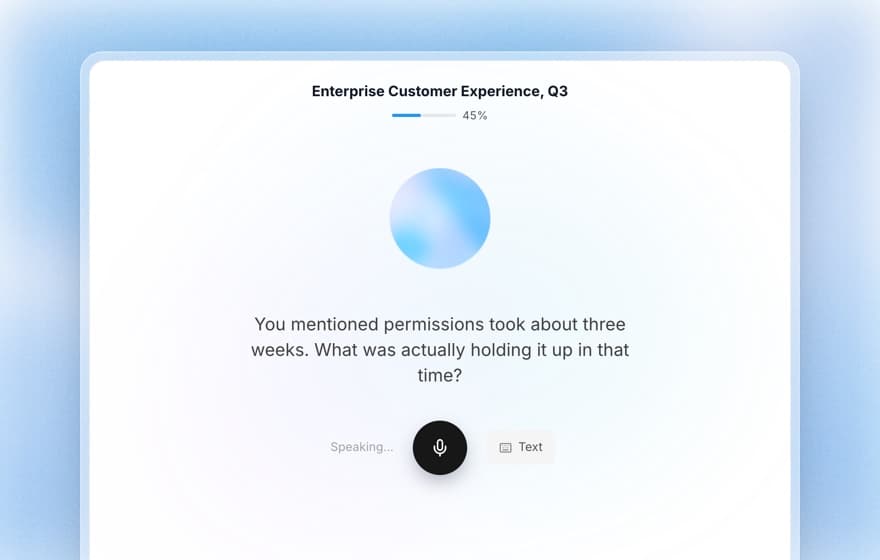
An AI interviewer runs every conversation. Participants talk or type in their own language, from 28 supported, and the interviewer asks follow-ups the way a good moderator would. You can also reach people by phone. Preview the interview yourself first, for free.
Recruit your way. Send a link, embed the interview in your product, import a CSV so every customer gets a personal invite link (Interviews and Enterprise plans), or recruit from Koji's panel. On the Panel recruit tab you describe the audience, see the price per interview in credits before launch, and soft-launch to check quality before releasing the rest. Building an audience and seeing the price works on any plan; launching needs a paid plan (panel recruitment guide).
Analysis as interviews arrive. Every interview gets a summary and a quality score. Only interviews scoring 3 or more out of 5 use credits or enter the report, so low-effort answers stay out of your findings and your bill. That filter matters for any online sample: Pew Research Center found that 4% to 7% of respondents in opt-in online polls were bogus. The report shows themes, personas and findings, each linked to the quotes behind it.
Survey-led or conversation-led?
This is the real difference, more than any feature.
Knit starts from a questionnaire and adds open-ended depth through video follow-ups. That suits studies where you need statistically readable numbers first (brand tracking, concept scoring across markets) with qualitative colour on top.
Koji starts from the conversation. The interviewer follows the participant's answer, asks why, and keeps going until it has the story. It suits the questions numbers can't answer: why customers churn, how they chose a competitor, what job your product is really doing for them. And it doesn't need anyone to be on camera, which lowers the barrier for B2B participants and for sensitive topics.
The research backs the conversational format. In a field study of about 600 people published in ACM Transactions on Computer-Human Interaction in 2020, Xiao and colleagues found that an AI chatbot asking open-ended questions drew significantly more engagement and more informative, relevant and specific answers than the same questions in a standard online survey.
Who does the work?
With Knit, Knit does much of it: its researchers review the design, refine the report and sit alongside your team. That is valuable when you lack in-house researchers or need agency-grade outputs for executives.

Photo by Jonas Leupe on Unsplash
With Koji, your team owns the study, and the AI handles moderation, transcription and synthesis. A product manager or founder can go from question to report without briefing a vendor, waiting for a proposal or scheduling a single call. Teams that want more control can shape the interviewer with screening questions, context documents and topics to avoid.
Pricing
Knit. No public pricing. Greenbook's directory lists annual subscriptions and per-project work; expect a sales conversation and a quote.
Koji. Free with 10 credits. Insights is €29 a month with 29 credits, Interviews is €79 a month with 79 credits, and Enterprise is custom. A text interview uses 1 credit and a voice interview 3, with extra credits at €1. Panel interviews are priced per interview in credits, shown before you launch, and unused held credits are returned.
That gap matters for how often you research. Qualtrics' 2025 Market Research Trends report found that 71% of market researchers expect synthetic responses to make up more than half of data collection within three years. As AI makes research cheaper to produce, the teams that keep talking to real customers often are the ones whose insight stays grounded. A tool you can open on a Tuesday, without a contract, makes that habit easier.
Which should you choose?
Choose Knit if you're an enterprise consumer insights team running survey-led studies across large samples, you want video responses, and you'd rather have Knit's researchers shape the work with you.
Choose Koji if you want real conversations at scale, run by your own team: churn interviews, discovery, win-loss, pricing or concept feedback. Pick it too if you want to start today without a sales call and pay only for interviews that meet the quality bar.
Try Koji
Write your research question, preview the interview and send the link in minutes. Recruit your own customers or build a panel audience and see the price before you spend a credit. Start free on Koji with 10 credits, or read the panel recruitment guide first.
Sources: Knit website and capability pages (goknit.com); Knit, Series A announcement (July 2025); Greenbook company directory, Knit; Greenbook, 2025 GRIT Business Outlook summary; Qualtrics, 2025 Market Research Trends report; Pew Research Center, "Assessing the Risks to Online Polls From Bogus Respondents" (2020); Xiao et al., "Tell Me About Yourself", ACM TOCHI 27(3), 2020.


