Value vs. Effort Matrix: The 2x2 Prioritization Guide (2026)
How to use the value vs. effort matrix to prioritize features and roadmap decisions — the four quadrants, how to score each axis, common pitfalls, and how to source the value axis from real customer research instead of guesswork.
What Is the Value vs. Effort Matrix? (Short Answer)
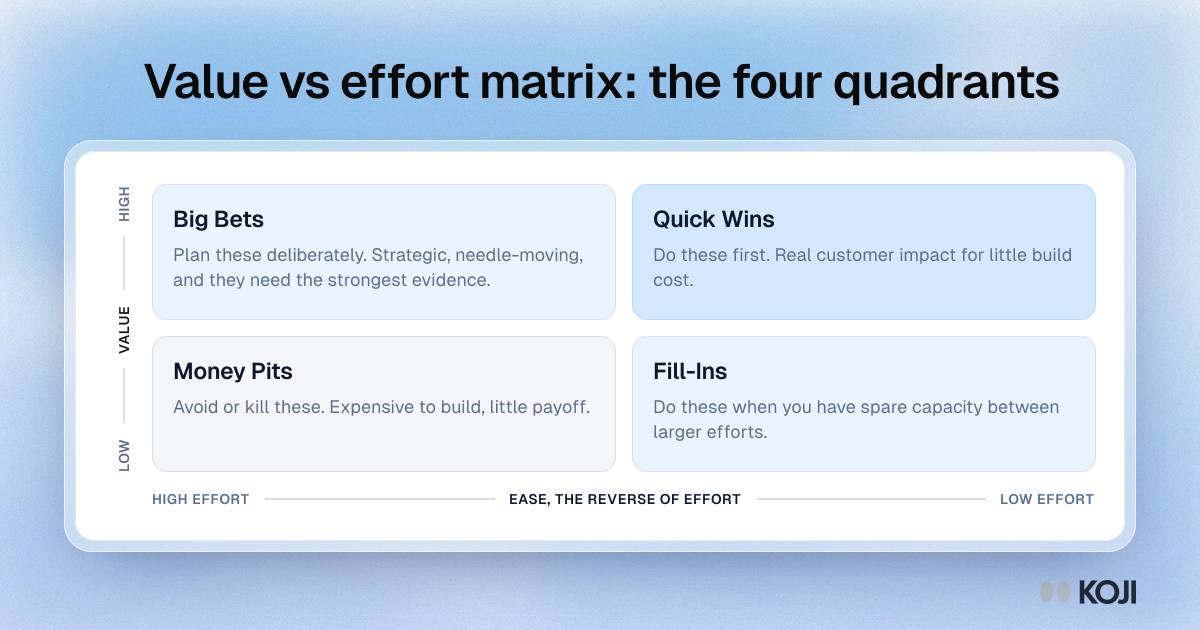
The value vs. effort matrix is a 2x2 prioritization framework that plots initiatives by the value they deliver (vertical axis) against the effort required to build them (horizontal axis). The result is four quadrants — Quick Wins (high value, low effort), Big Bets (high value, high effort), Fill-Ins (low value, low effort), and Money Pits / Time Sinks (low value, high effort). You do the Quick Wins first, schedule the Big Bets deliberately, drop the Money Pits, and use Fill-Ins only when you have spare capacity.
It is the fastest, most widely used prioritization tool in product management because it forces a brutally simple question on every idea: is the juice worth the squeeze? But it has one fatal weakness that this guide exists to fix — teams usually invent the "value" score based on internal opinion. A matrix built on guessed value is just a guess in a nicer grid. The fix is to source the value axis from real customer evidence.
"We need a product that our customers love, yet also works for our business." — Marty Cagan, Inspired
The Four Quadrants Explained
Picture value increasing as you go up, and effort increasing as you go right.
Quadrant 1 — Quick Wins (High Value, Low Effort)
Do these first. These are the highest-ROI items on your roadmap: meaningful customer impact for minimal build cost. They build momentum, free up goodwill, and often unblock other work. The danger is not having enough of them — most teams over-index here and starve their long-term bets.
Quadrant 2 — Big Bets (High Value, High Effort)
Plan these deliberately. These are your strategic, needle-moving initiatives — the new product line, the platform rebuild, the differentiating capability. They require sequencing, cross-team coordination, and the strongest evidence, because a wrong Big Bet is the most expensive mistake on the board.
Quadrant 3 — Fill-Ins / Maybes (Low Value, Low Effort)
Do these opportunistically. Nice-to-haves that are cheap but not impactful. Slot them in to fill capacity between larger efforts. Beware the trap of stacking so many small Fill-Ins that you have no room for a Big Bet.
Quadrant 4 — Money Pits / Time Sinks (Low Value, High Effort)
Avoid or kill these. Expensive to build, little payoff. These are usually pet projects, gold-plating, or "because a big customer asked" features that no one validated. The single most valuable thing a roadmap process does is keep this quadrant empty.
How to Score the Two Axes
The matrix is only as good as the inputs. Define both axes explicitly before you place a single sticky note.
Value should combine customer value and business value. Useful sub-criteria:
- Reach — how many customers does this affect?
- Impact — how much does it improve their experience or outcome?
- Strategic fit — does it advance the company's direction?
- Confidence — how sure are you the value is real?
Effort should go beyond engineering days:
- Engineering complexity and unknowns
- Design and research time
- Operational and support cost
- Dependencies and risk
A common practice is to score each item 1-10 (or T-shirt sizes) on value and effort, then plot. Atlassian and other product orgs recommend keeping the two axes focused on the criteria most relevant to the decision at hand, inviting input from stakeholders with different perspectives, and updating the matrix whenever priorities, capacity, or assumptions change — weekly or each sprint for agile teams, monthly or quarterly for strategic portfolios.
The Fatal Flaw: Where Does "Value" Come From?
Here is the uncomfortable truth about most value vs. effort matrices: the effort axis is estimated by the people who do the work (engineers, who are reasonably accurate), while the value axis is estimated by the people in the room (often the loudest stakeholder, who is frequently wrong).
The data on this is sobering. Industry analyses repeatedly find that a large share of shipped software features go barely used or unused — Pendo's product benchmarks have famously suggested that roughly 80% of features in the average software product are rarely or never used. Every one of those features was once placed in a "high value" quadrant by someone confident in their judgment. They were not malicious estimates; they were unvalidated ones.
Pendo's State of Product Leadership research adds the structural reason: more than 74% of product professionals spend fewer than five hours per month with customers, and product leaders consistently name roadmap prioritization as their single greatest challenge. You cannot accurately score customer value if you are not talking to customers.
"Fall in love with the problem, not the solution." — Marty Cagan
When value is opinion, the matrix simply launders that opinion into a confident-looking chart. The fix is not a better framework — RICE, ICE, and weighted scoring all share the same dependency. The fix is better value inputs.
The Modern Approach: Source the Value Axis from Customer Research
To prioritize honestly, the "value" score for every candidate needs to be grounded in what customers actually want, how often they hit the underlying problem, and how much it matters to them. Historically that meant a research backlog that moved far slower than the roadmap — so PMs defaulted to gut feel. AI-native research closes that gap.
Koji turns the value axis into evidence in three ways:
-
Quantify demand and intensity with structured questions. Koji supports six structured question types —
open_ended,scale,single_choice,multiple_choice,ranking, andyes_no. Arankingquestion makes customers force-rank your candidate features against each other, which is far more honest than asking "is this important?" (where everything scores high). Ascalequestion measures intensity of need. Together they produce a real, comparable value score per item instead of a stakeholder opinion. -
Understand the "why" with AI-moderated interviews. Numbers tell you what to prioritize; conversations tell you why. Koji's AI moderator runs discovery interviews by voice or text and probes follow-ups automatically, uncovering whether a "high value" feature solves a frequent, painful problem or just a hypothetical one. Its automatic thematic analysis clusters these signals across dozens of interviews in minutes.
-
Keep the matrix live. Because Koji generates real-time reports and can run continuously, you can re-score the value axis every cycle with fresh evidence — exactly the cadence the matrix needs. You do not need a dedicated research team; the AI consultant builds the plan, moderates, and aggregates results.
A practical workflow: brainstorm candidates → estimate the effort axis with engineering → score the value axis with a Koji ranking-and-scale study plus a handful of discovery interviews → plot the matrix → revisit each sprint. Now the grid reflects reality, and the Quick Wins are genuinely quick wins.
Value vs. Effort vs. RICE vs. ICE
- Value vs. Effort (2x2): Fastest, most visual, best for quick team alignment and small-to-mid backlogs. Weakness: two coarse axes can oversimplify.
- RICE (Reach, Impact, Confidence, Effort): More granular, adds a confidence multiplier that explicitly accounts for uncertainty — useful when you have data to feed it.
- ICE (Impact, Confidence, Ease): A lighter cousin of RICE for rapid scoring.
All three depend on a trustworthy value/impact input. Start with the value vs. effort matrix for speed; graduate to RICE when you need finer resolution. Whichever you choose, validate the value with research — the framework cannot do that for you.
Common Pitfalls to Avoid
- Treating estimates as facts. Plot with ranges or confidence levels; revisit often.
- Letting the loudest voice set value. Use evidence, not seniority.
- Vague axis definitions. Decide what "value" and "effort" mean for your org before scoring.
- Set-and-forget. Capacity and assumptions change; a stale matrix misleads.
- Ignoring effort hidden in support, ops, and maintenance. Effort is not just dev days.
Key Takeaways
- The value vs. effort matrix sorts work into Quick Wins, Big Bets, Fill-Ins, and Money Pits.
- Do Quick Wins first, plan Big Bets deliberately, keep the Money Pit quadrant empty.
- The framework's weak point is the value axis — usually estimated from opinion, not evidence.
- Up to ~80% of features go barely used; nearly all were once scored "high value" by someone.
- Use Koji's structured questions and AI interviews to ground the value axis in real customer demand, then re-score every cycle.
Related Resources
- RICE Prioritization Framework — add reach and confidence to your scoring
- ICE Prioritization Framework — lightweight rapid scoring
- How to Prioritize Customer Feedback — turn raw feedback into ranked priorities
- Feature Prioritization Survey Guide — quantify demand at scale
- Opportunity Solution Tree — connect prioritized work to validated opportunities
- Structured Questions Guide — use ranking and scale questions to score value with evidence
Related Articles
How to Prioritize Customer Feedback: A Framework for Product Teams
A complete guide to triaging, scoring, and acting on customer feedback. Compare RICE, MoSCoW, Kano, and the Opportunity Solution Tree — and learn how AI-native research turns raw feedback into prioritized opportunities in minutes.
ICE Prioritization Framework: Score Impact, Confidence & Ease
A complete guide to the ICE prioritization framework — how to score ideas by Impact, Confidence, and Ease, run an ICE session, and use customer research to defend your Confidence scores.
Kano Model: How to Prioritize Features Using Customer Research
A complete guide to the Kano Model — the feature prioritization framework that maps customer emotions to product decisions. Learn how to run Kano surveys, classify features, and build products customers love.
MoSCoW Method: How to Prioritize Features with Must, Should, Could, and Won't Have
Master the MoSCoW prioritization method. Learn the 60-20-20 effort rule from DSDM, how to run a MoSCoW workshop, and how customer research validates which features truly belong in Must Have.
Opportunity Solution Tree: The Complete Guide to Continuous Product Discovery
Learn how to build and use the Opportunity Solution Tree (OST) framework — Teresa Torres' visual map for connecting business outcomes to validated customer solutions through continuous discovery. Includes step-by-step instructions, templates, and how Koji automates the evidence-collection process.
RICE Prioritization Framework: How to Score and Rank Product Ideas
Master the RICE scoring framework (Reach, Impact, Confidence, Effort) for product prioritization. Includes the formula, worked examples, free template, and how customer research transforms Confidence scores.
Structured Questions in AI Interviews
Mix quantitative data collection — scales, ratings, multiple choice, ranking — with AI-powered conversational follow-up in a single interview.