Weighted Scoring Model: How to Prioritize with a Decision Matrix
A weighted scoring model ranks options by scoring each against weighted criteria. Learn how to build a decision matrix step by step, avoid its pitfalls, and ground the scores in real customer evidence with Koji.
A weighted scoring model is a prioritization method that ranks options — features, projects, vendors — by scoring each one against a set of criteria, where each criterion carries a weight reflecting how much it matters. You multiply each score by its criterion's weight, sum the results, and the highest total wins. Laid out as a grid of options versus criteria, it is also called a decision matrix or weighted decision matrix. Its strength is that it makes trade-offs explicit and defensible; its weakness is that the scores can be pulled out of thin air. The difference between a useful weighted scoring model and a false-precision spreadsheet is whether the inputs are grounded in evidence — and that is where customer research from tools like Koji earns its keep.
This guide walks through what a weighted scoring model is, how to build one in six steps, a worked example, where it beats simpler frameworks, and how to keep the scores honest.
When to use a weighted scoring model
A weighted scoring model shines when:
- You have several viable options and limited resources — a backlog of features, a shortlist of vendors, a set of market opportunities.
- The decision involves multiple competing criteria — value, effort, risk, strategic fit — that pull in different directions.
- You need a defensible, transparent decision — stakeholders can see exactly why one option ranked above another.
- Gut feel keeps winning arguments — a scoring model forces the conversation onto explicit criteria instead of charisma.
It is overkill for a binary yes/no or a single obvious priority. For those, a lighter framework like RICE, ICE, or MoSCoW is faster. The weighted model is the tool when the criteria themselves are debated and the trade-offs are genuinely close.
How to build a weighted scoring model in six steps
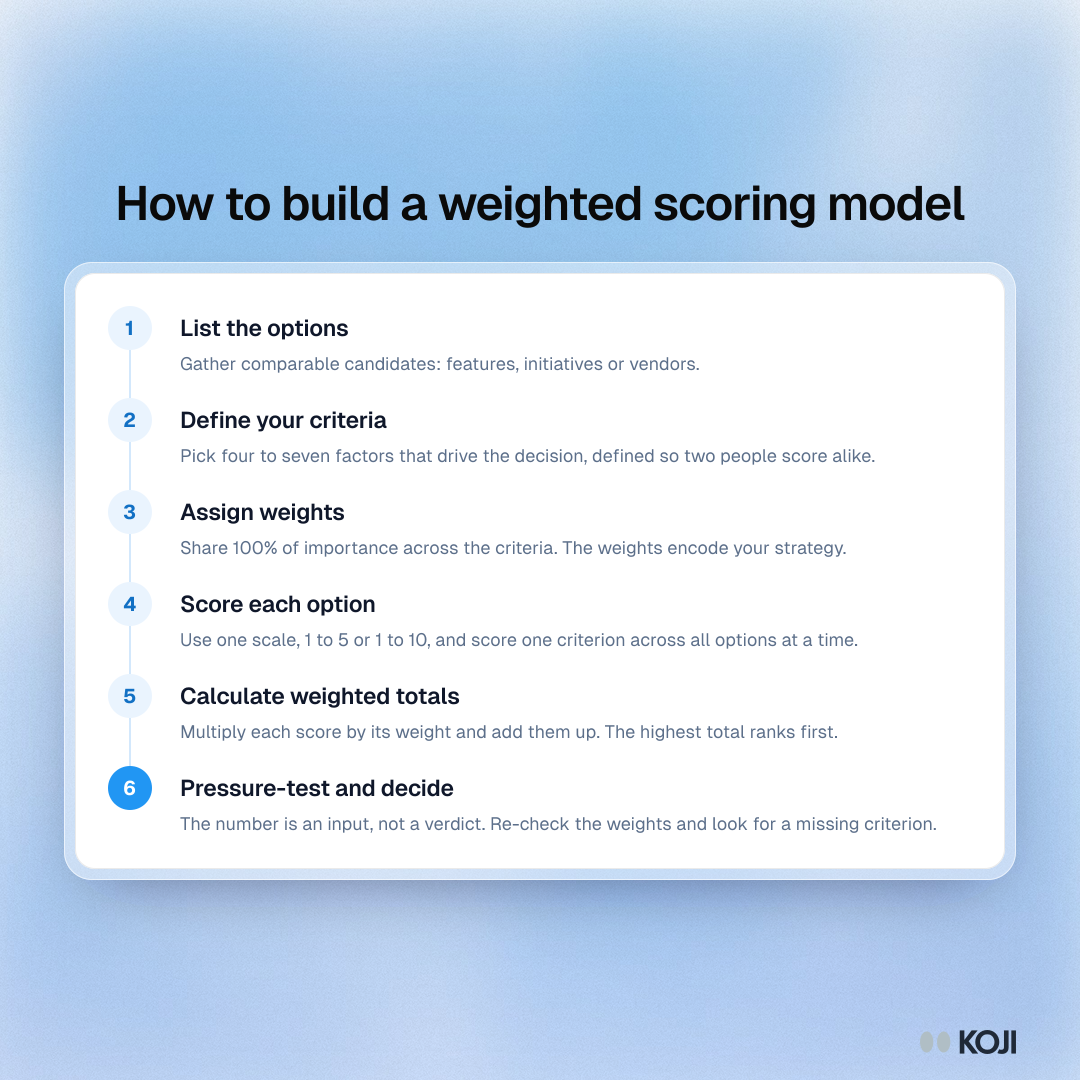
1. List the options
Gather the candidates you are ranking — features, initiatives, vendors. Keep the list to a comparable set; scoring twenty wildly different items at once produces noise.
2. Define your criteria
Choose the factors that actually drive the decision. For a product backlog, common criteria are customer value, revenue impact, strategic alignment, effort, and risk. Aim for four to seven — too few oversimplifies, too many dilutes. Define each precisely so two people would score it the same way.
3. Assign weights
Distribute importance across the criteria, typically as percentages that sum to 100 (or weights of 1–5). If customer value matters twice as much as effort, its weight should be twice as large. This is the most consequential step: the weights encode your strategy, so set them deliberately, ideally with leadership aligned.
4. Score each option against each criterion
Use a consistent scale — 1–5 or 1–10 — for every cell. Score one criterion across all options before moving to the next; this keeps the scale calibrated and reduces a halo effect where one strong attribute inflates the rest.
5. Calculate weighted totals
For each option, multiply every score by its criterion's weight and sum. The totals rank your options. A simple formula: total = Σ (score × weight).
6. Pressure-test and decide
The number is an input, not a verdict. If the top-ranked option feels wrong, interrogate why — often a missing criterion or a mis-set weight. Adjust, re-score, and use the model to structure judgment, not replace it.
A worked example
Suppose you are prioritizing three features with four criteria:
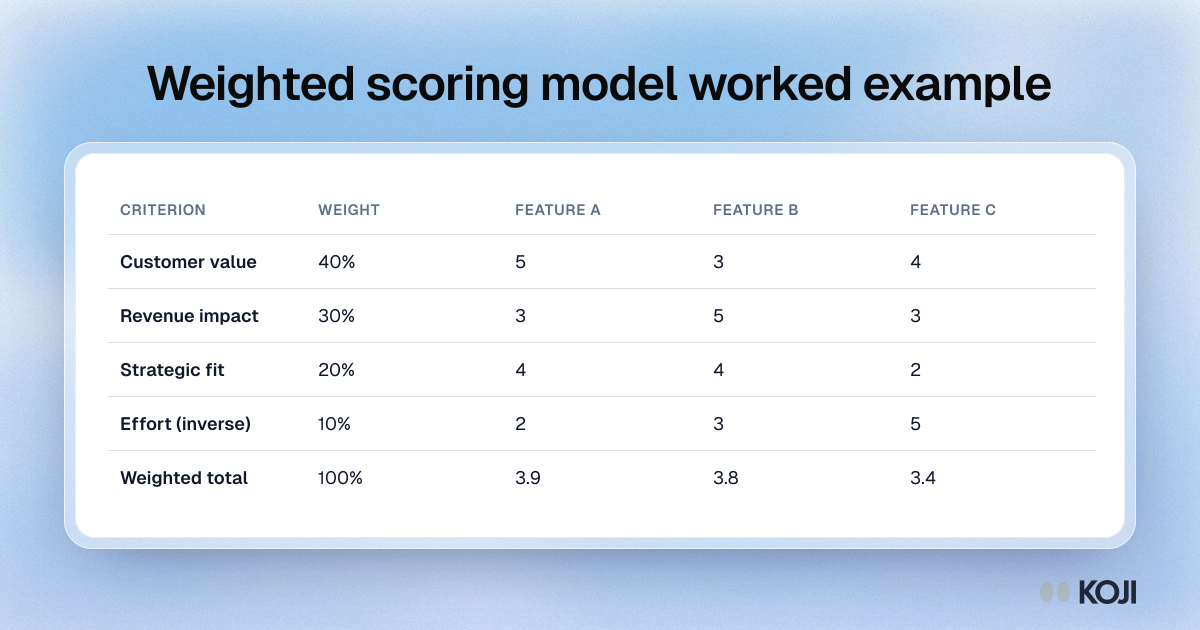
| Criterion | Weight | Feature A | Feature B | Feature C |
|---|---|---|---|---|
| Customer value | 40% | 5 | 3 | 4 |
| Revenue impact | 30% | 3 | 5 | 3 |
| Strategic fit | 20% | 4 | 4 | 2 |
| Effort (inverse) | 10% | 2 | 3 | 5 |
Feature A: (5×.4)+(3×.3)+(4×.2)+(2×.1) = 2.0+0.9+0.8+0.2 = 3.9 Feature B: (3×.4)+(5×.3)+(4×.2)+(3×.1) = 1.2+1.5+0.8+0.3 = 3.8 Feature C: (4×.4)+(3×.3)+(2×.2)+(5×.1) = 1.6+0.9+0.4+0.5 = 3.4
Feature A wins narrowly — but A and B are within a rounding error, which is the model telling you the customer-value scores deserve real scrutiny before you commit.
The hidden weakness: where do the scores come from?
A weighted scoring model is only as good as the numbers you feed it, and "customer value = 5" is too often a guess dressed up as data. When the inputs are opinion, the model launders that opinion into a confident-looking decimal — false precision that feels objective but isn't. This is the single biggest reason scoring exercises mislead.
The fix is to ground the most subjective criteria — customer value, demand, willingness to pay — in actual customer evidence. This is where Koji turns a fragile spreadsheet into a defensible decision:
- Score customer value from real demand. Instead of guessing, run AI interviews and structured questions to measure how much customers actually want each option. Koji's AI conducts voice or text conversations 24/7, probes each answer, and analyzes every transcript automatically.
- Quantify importance. Use scale and ranking questions to get a real distribution of how much each option matters to your audience, not a single PM's hunch.
- Capture the why. Open-ended answers explain why a score is high or low, so the model's inputs come with evidence attached.
Koji's six structured question types map directly onto scoring inputs: open_ended (the reason behind a score), scale (rate importance or value), single_choice (the top priority), multiple_choice (which needs apply), ranking (order the options), and yes_no (would they use it). See the structured questions guide to design them. Feed those measured values into your matrix and the weighted total reflects customers, not the conference room.
Weighted scoring vs. RICE, ICE, and MoSCoW
A weighted scoring model is the most flexible of the prioritization frameworks because you choose the criteria and weights. RICE and ICE are essentially fixed-criteria weighted models (Reach, Impact, Confidence, Effort), faster to apply but less tailored. MoSCoW is a qualitative bucketing method, not a numeric score. Use the lighter frameworks for speed; use a full weighted scoring model when the criteria are specific to your decision and the stakes justify the rigor.
Common mistakes
- Invented scores — the fatal flaw; ground subjective criteria in customer evidence.
- Too many criteria — past seven, the weights dilute and the model stops discriminating.
- Equal weights by default — if everything is weighted the same, you haven't expressed a strategy.
- Treating the total as gospel — the model structures judgment; it doesn't replace it.
- Scoring options one-by-one — score each criterion across all options to keep the scale calibrated.
Running it as a team workshop
A weighted scoring model is most powerful as a shared exercise, not a solo spreadsheet. Get the criteria and weights agreed by the group before anyone sees the options — fixing the rules first prevents people from reverse-engineering weights to favor a pet feature. Then have each participant score independently and compare. Where scores diverge sharply on a cell, that disagreement is a signal: usually it means the criterion is ill-defined or the team lacks evidence about that option. Resolve it by tightening the definition or, better, by pointing a Koji AI interview at the question so the next round of scoring rests on customer data instead of debate. Capture the final matrix with its weights and rationale so the decision is auditable months later when someone asks why a feature ranked where it did.
Related Resources
- Structured Questions Guide — turn scoring inputs into measured customer data
- RICE Prioritization Framework — a fixed-criteria weighted model for speed
- ICE Prioritization Framework — the lightweight three-factor cousin
- MoSCoW Prioritization Method — qualitative bucketing when scoring is overkill
- Now-Next-Later Roadmap — where scored priorities land on the roadmap
- Feature Validation Guide — validate the option before you build it
Related Articles
Constant-Sum Questions: How to Measure Trade-Offs by Asking People to Allocate
Constant-sum questions ask respondents to divide a fixed total — usually 100 points — across a set of options, revealing the relative weight of each. Learn how to design them, avoid math errors, and capture the reasoning behind every allocation.
Feature Validation: How to Validate a Feature Before You Build It
Feature validation is the practice of testing demand and usability for a feature before committing engineering time. Learn a five-step validation process and how Koji's AI interviews validate ideas with real customers in days, not weeks.
ICE Prioritization Framework: Score Impact, Confidence & Ease
A complete guide to the ICE prioritization framework — how to score ideas by Impact, Confidence, and Ease, run an ICE session, and use customer research to defend your Confidence scores.
MoSCoW Method: How to Prioritize Features with Must, Should, Could, and Won't Have
Master the MoSCoW prioritization method. Learn the 60-20-20 effort rule from DSDM, how to run a MoSCoW workshop, and how customer research validates which features truly belong in Must Have.
The Now-Next-Later Roadmap: A Simpler Way to Plan Product
The Now-Next-Later roadmap replaces rigid date-based timelines with three flexible horizons. Learn how to build one, what goes in each column, and how customer research from Koji decides what earns a slot.
RICE Prioritization Framework: How to Score and Rank Product Ideas
Master the RICE scoring framework (Reach, Impact, Confidence, Effort) for product prioritization. Includes the formula, worked examples, free template, and how customer research transforms Confidence scores.
Structured Questions in AI Interviews
Mix quantitative data collection — scales, ratings, multiple choice, ranking — with AI-powered conversational follow-up in a single interview.
WSJF Prioritization: Weighted Shortest Job First Explained (2026 Guide)
A complete guide to Weighted Shortest Job First (WSJF): Cost of Delay divided by job size, the three CoD components, a worked example, and how customer research turns WSJF scores from guesswork into defensible estimates.