Reference table
How examples in questions change student answers
From no examples to atypical ones, and when to use each
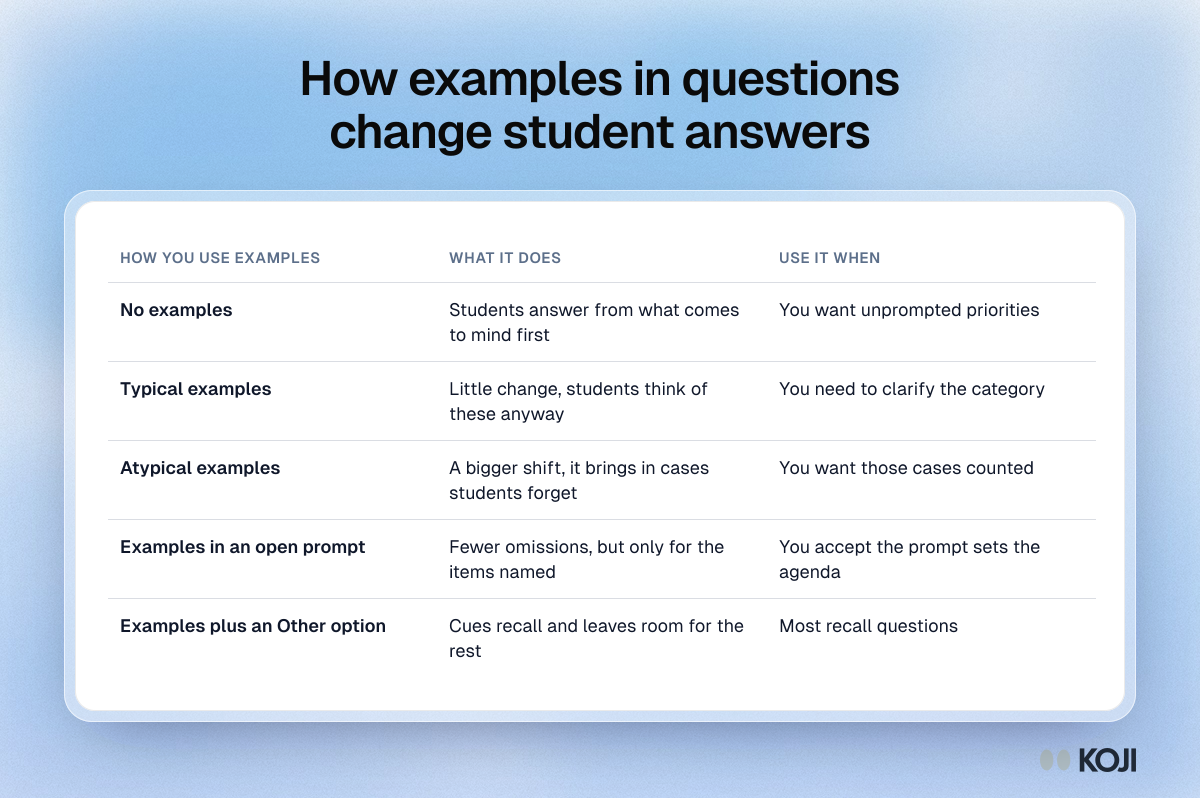
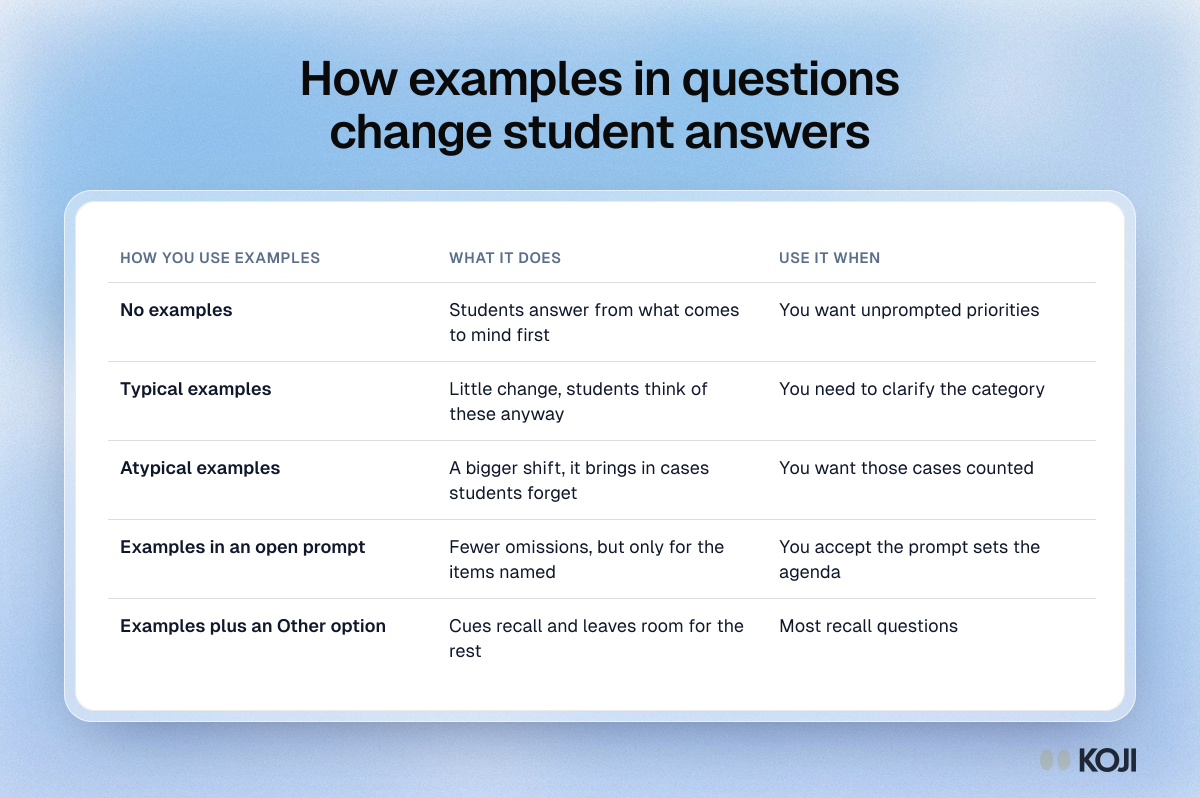
A table summarising how examples in survey questions change answers, based on experiments by Tourangeau, Conrad, Couper and Ye. It is for people writing course evaluation items and comment prompts. Use it to decide whether an example will clarify a question or steer it, and when to add an Other option. In Koji, follow-up questions ask students for their own examples after an unprompted first answer.
What's in this reference table
| How you use examples | What it does | Use it when |
|---|---|---|
| No examples | Students answer from what comes to mind first | You want unprompted priorities |
| Typical examples | Little change, students think of these anyway | You need to clarify the category |
| Atypical examples | A bigger shift, it brings in cases students forget | You want those cases counted |
| Examples in an open prompt | Fewer omissions, but only for the items named | You accept the prompt sets the agenda |
| Examples plus an Other option | Cues recall and leaves room for the rest | Most recall questions |
Use this image
Free to use in your docs, decks and posts under CC BY 4.0, as long as you credit Koji with a link to this page. To embed it, paste this into your page:
html
<a href="https://www.koji.so/visuals/examples-in-course-evaluation-questions-effects-table"><img src="https://www.koji.so/visuals/examples-in-course-evaluation-questions-effects-table/examples-in-course-evaluation-questions-effects-table.png" alt="Table showing what each way of using examples in a course evaluation question does to student answers, from no examples to atypical examples." width="1200" height="798" /></a>
<p>Source: <a href="https://www.koji.so/visuals/examples-in-course-evaluation-questions-effects-table">How examples in questions change student answers</a>, Koji</p>