Process
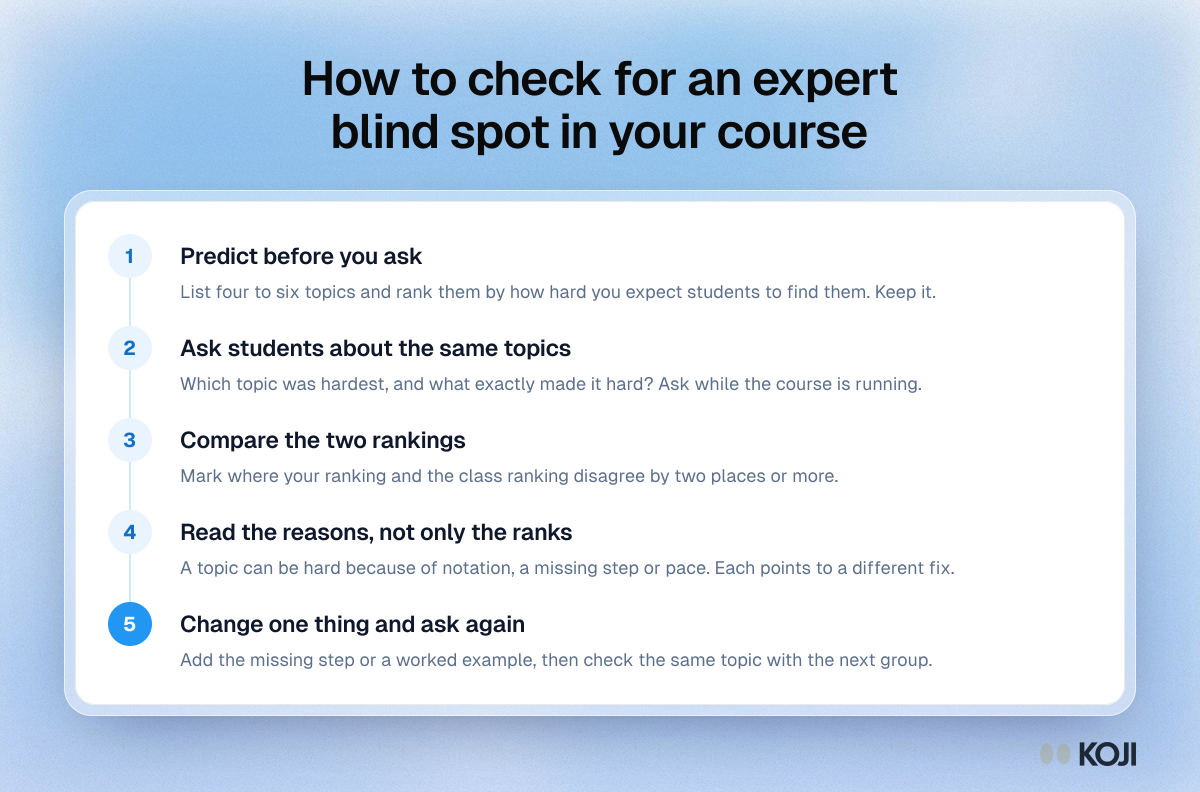
How to check for an expert blind spot in your course
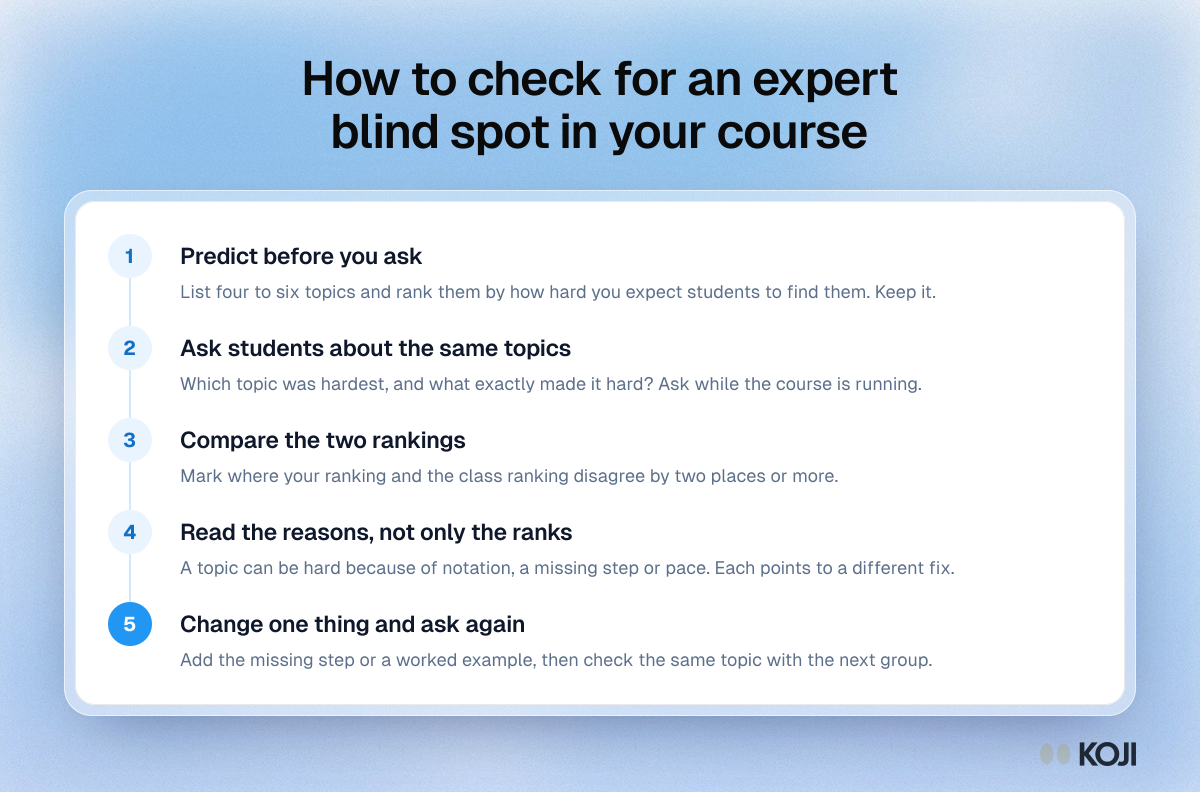
A five-step process for lecturers and programme teams who want to know whether their sense of what is hard in a course matches what students find hard. It follows the expert blind spot research of Nathan and Petrosino and of Koedinger and Nathan, where teachers with more subject expertise misjudged which algebra problems students would find easier. Use it once per term on a few topics. Koji can run the student side as short interviews that ask what was hard and why.
What's in this process
- Predict before you ask: List four to six topics and rank them by how hard you expect students to find them. Keep it.
- Ask students about the same topics: Which topic was hardest, and what exactly made it hard? Ask while the course is running.
- Compare the two rankings: Mark where your ranking and the class ranking disagree by two places or more.
- Read the reasons, not only the ranks: A topic can be hard because of notation, a missing step or pace. Each points to a different fix.
- Change one thing and ask again: Add the missing step or a worked example, then check the same topic with the next group.
Use this image
Free to use in your docs, decks and posts under CC BY 4.0, as long as you credit Koji with a link to this page. To embed it, paste this into your page:
html
<a href="https://www.koji.so/visuals/expert-blind-spot-check-with-course-feedback"><img src="https://www.koji.so/visuals/expert-blind-spot-check-with-course-feedback/expert-blind-spot-check-with-course-feedback.png" alt="Process in five steps for checking an expert blind spot: predict difficulty, ask students, compare, look at the gaps, change one thing." width="1200" height="792" /></a>
<p>Source: <a href="https://www.koji.so/visuals/expert-blind-spot-check-with-course-feedback">How to check for an expert blind spot in your course</a>, Koji</p>