Matrix
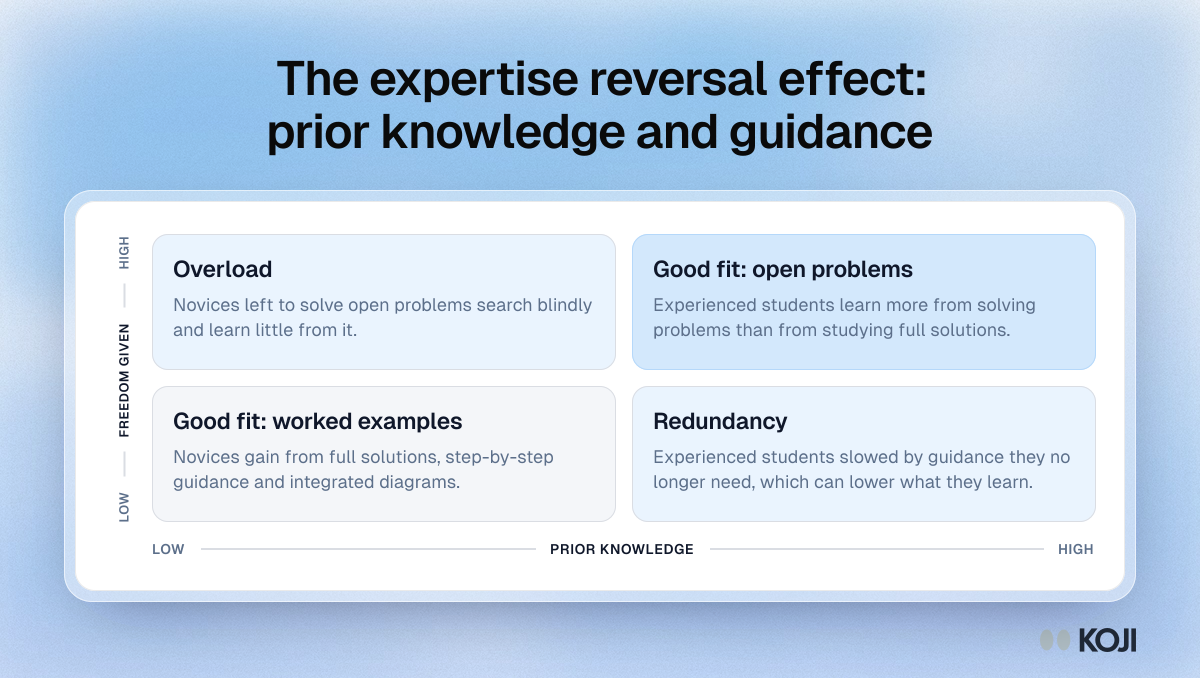
The expertise reversal effect: prior knowledge and guidance
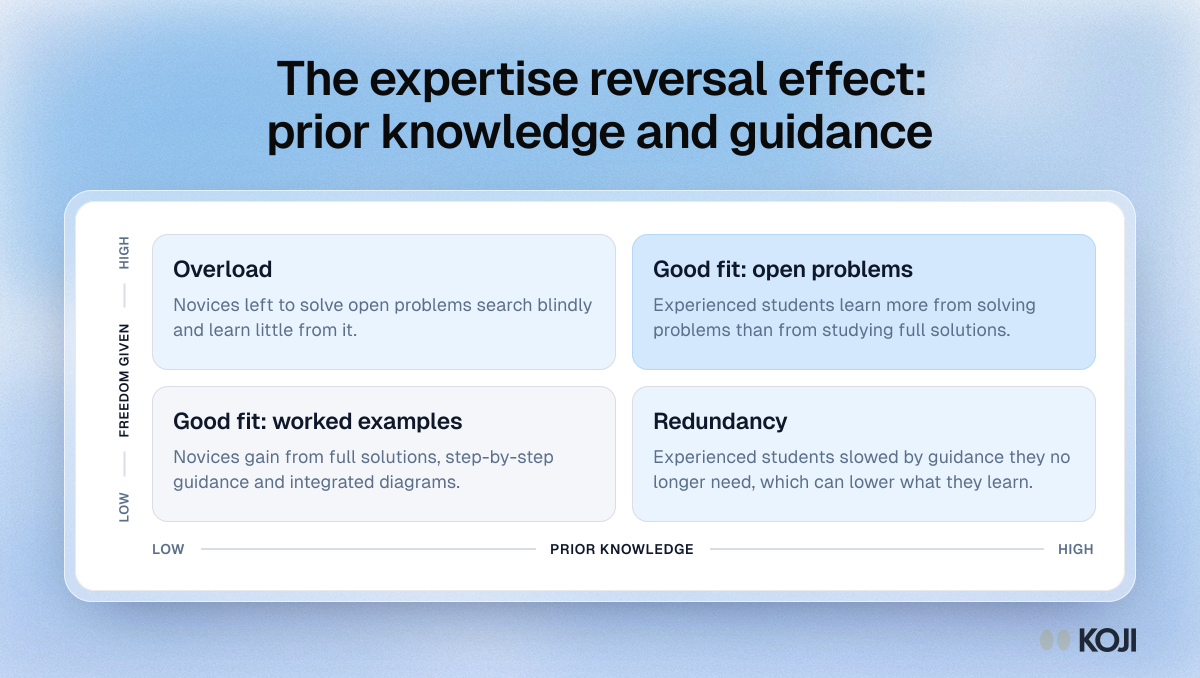
A two-by-two matrix of the expertise reversal effect described by Kalyuga, Ayres, Chandler and Sweller. It sets the prior knowledge of learners against how much freedom the teaching gives them and names what happens in each case. It is for programme teams reading split course evaluation results from cohorts with mixed backgrounds, such as conversion masters or shared first-year modules. Koji interviews can ask students about their background so the comments can be read by group.
What's in this matrix
Vertical axis: Freedom given (Low to High). Horizontal axis: Prior knowledge (Low to High).
- Overload (High freedom given, Low prior knowledge): Novices left to solve open problems search blindly and learn little from it.
- Good fit: open problems (High freedom given, High prior knowledge): Experienced students learn more from solving problems than from studying full solutions.
- Good fit: worked examples (Low freedom given, Low prior knowledge): Novices gain from full solutions, step-by-step guidance and integrated diagrams.
- Redundancy (Low freedom given, High prior knowledge): Experienced students slowed by guidance they no longer need, which can lower what they learn.
Use this image
Free to use in your docs, decks and posts under CC BY 4.0, as long as you credit Koji with a link to this page. To embed it, paste this into your page:
html
<a href="https://www.koji.so/visuals/expertise-reversal-prior-knowledge-guidance-matrix"><img src="https://www.koji.so/visuals/expertise-reversal-prior-knowledge-guidance-matrix/expertise-reversal-prior-knowledge-guidance-matrix.png" alt="Matrix of prior knowledge against freedom given: full guidance suits novices, open problems suit experienced students, mismatches cause overload or redundancy." width="1200" height="678" /></a>
<p>Source: <a href="https://www.koji.so/visuals/expertise-reversal-prior-knowledge-guidance-matrix">The expertise reversal effect: prior knowledge and guidance</a>, Koji</p>