Process
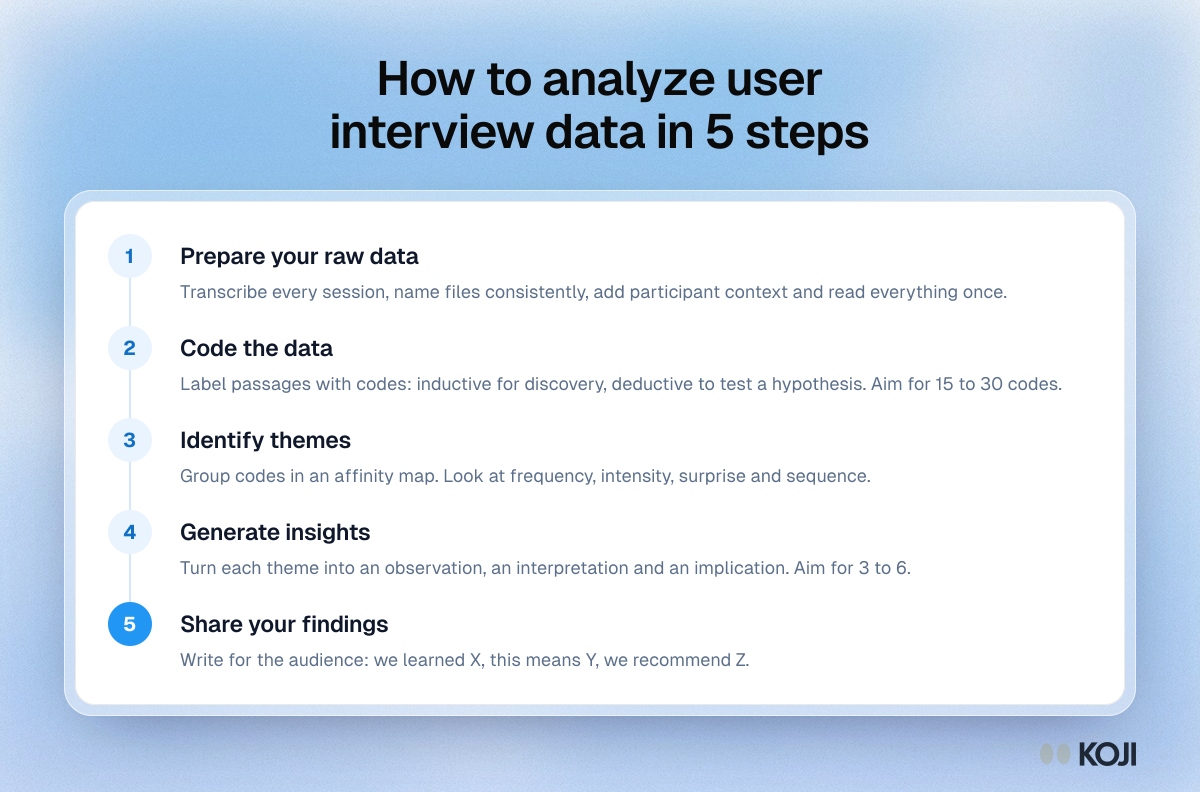
How to analyze user interview data in 5 steps
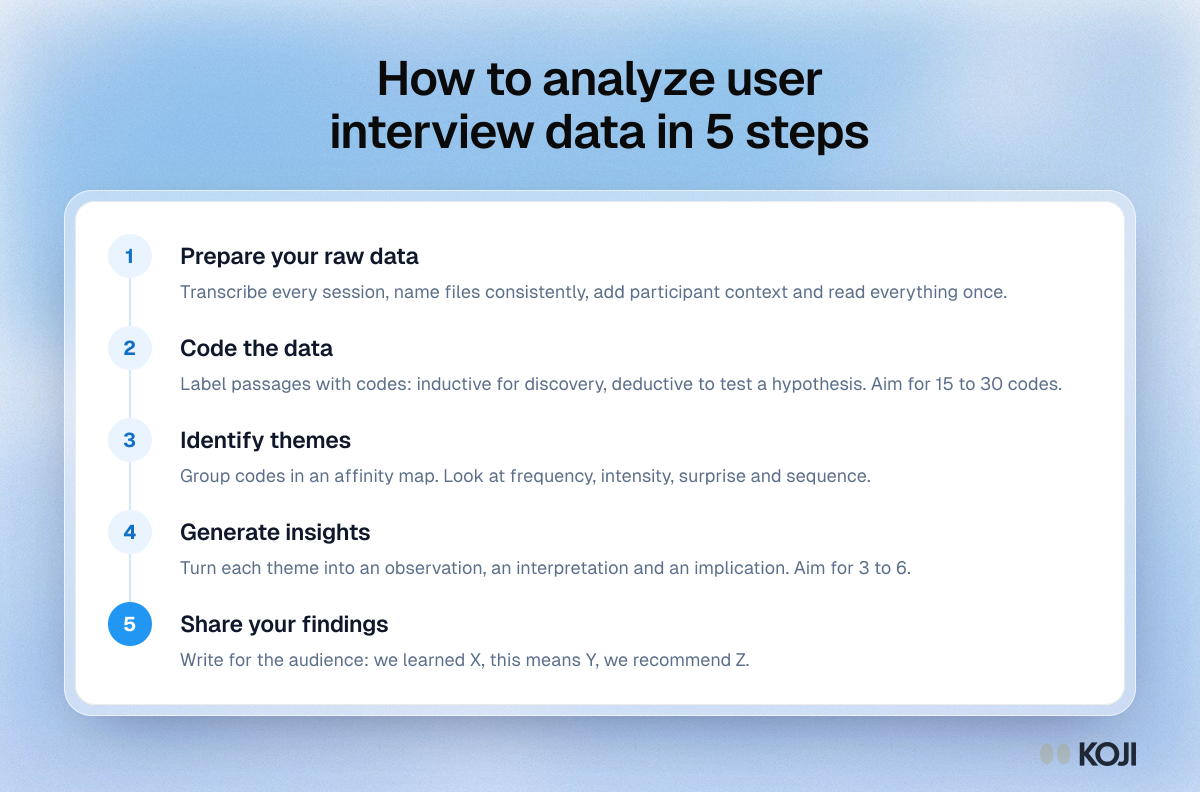
A five-step process for analyzing qualitative interview data, from raw transcripts to findings people act on. It covers data prep, inductive and deductive coding, affinity mapping by frequency, intensity, surprise and sequence, insight writing and readouts for different audiences. Koji does the transcription, coding and theme steps for you as interviews come in, which leaves the interpretation to the team.
Where this appears
What's in this process
- Prepare your raw data: Transcribe every session, name files consistently, add participant context and read everything once.
- Code the data: Label passages with codes: inductive for discovery, deductive to test a hypothesis. Aim for 15 to 30 codes.
- Identify themes: Group codes in an affinity map. Look at frequency, intensity, surprise and sequence.
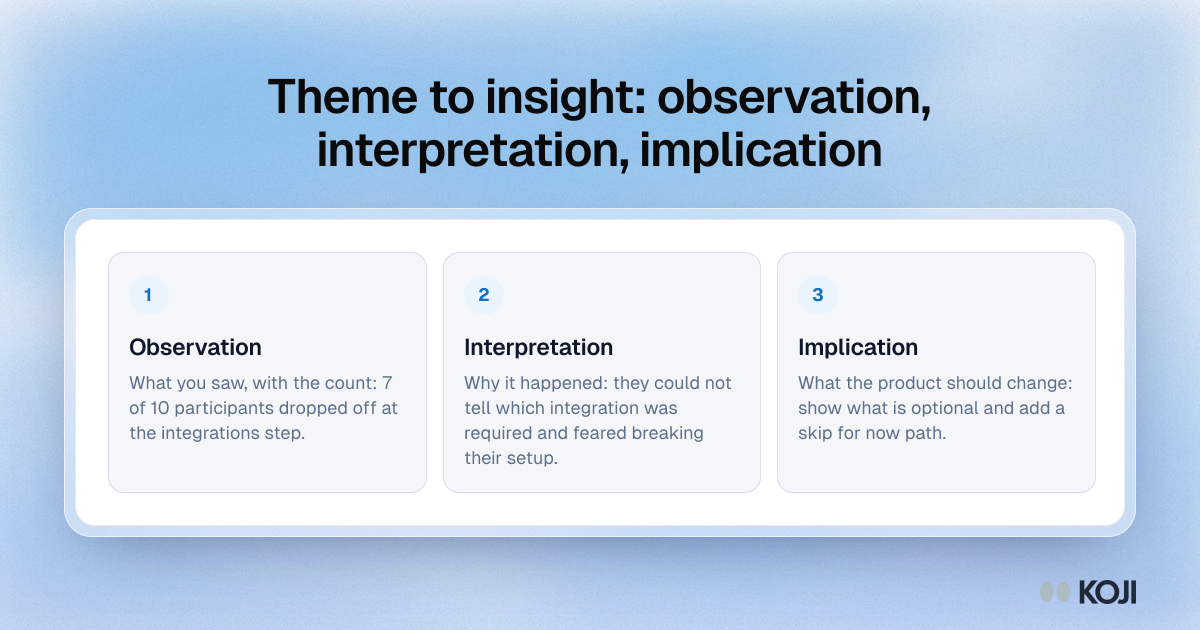
- Generate insights: Turn each theme into an observation, an interpretation and an implication. Aim for 3 to 6.
- Share your findings: Write for the audience: we learned X, this means Y, we recommend Z.
Use this image
Free to use in your docs, decks and posts under CC BY 4.0, as long as you credit Koji with a link to this page. To embed it, paste this into your page:
html
<a href="https://www.koji.so/visuals/how-to-analyze-user-interview-data-five-steps"><img src="https://www.koji.so/visuals/how-to-analyze-user-interview-data-five-steps/how-to-analyze-user-interview-data-five-steps.png" alt="Process of five steps to analyze user interview data: prepare transcripts, code passages, group codes into themes, write insights and share findings." width="1200" height="792" /></a>
<p>Source: <a href="https://www.koji.so/visuals/how-to-analyze-user-interview-data-five-steps">How to analyze user interview data in 5 steps</a>, Koji</p>