Process
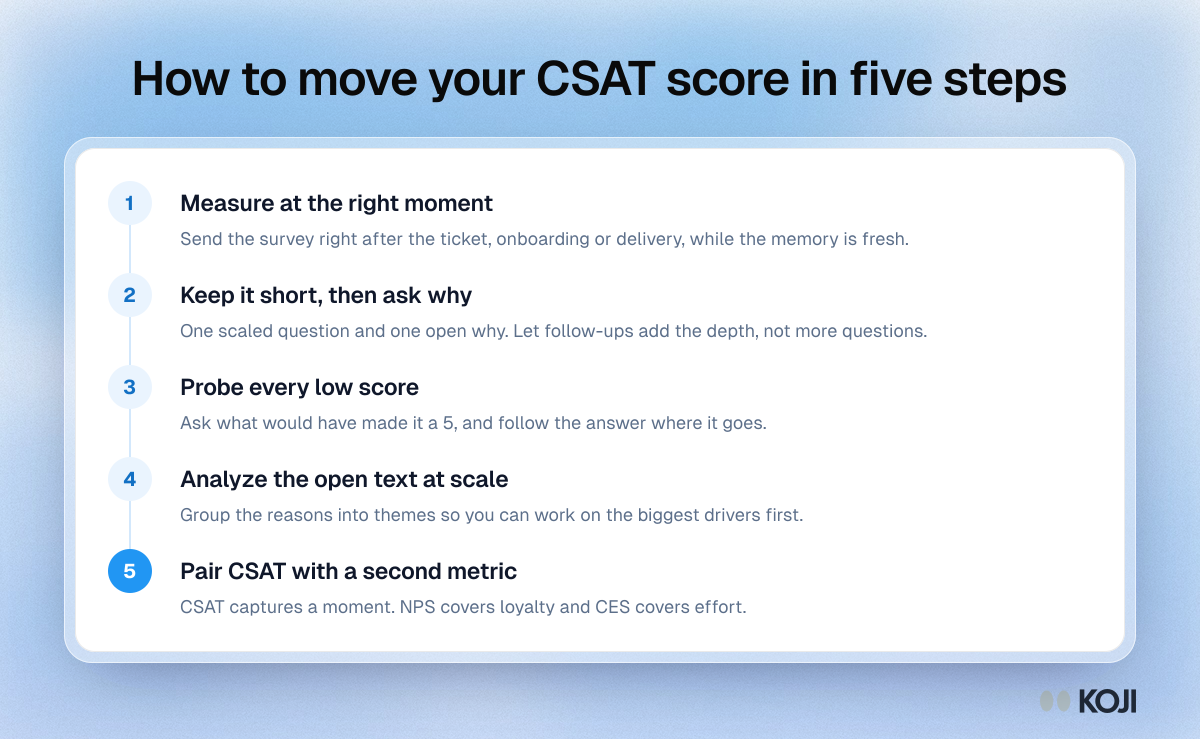
How to move your CSAT score in five steps
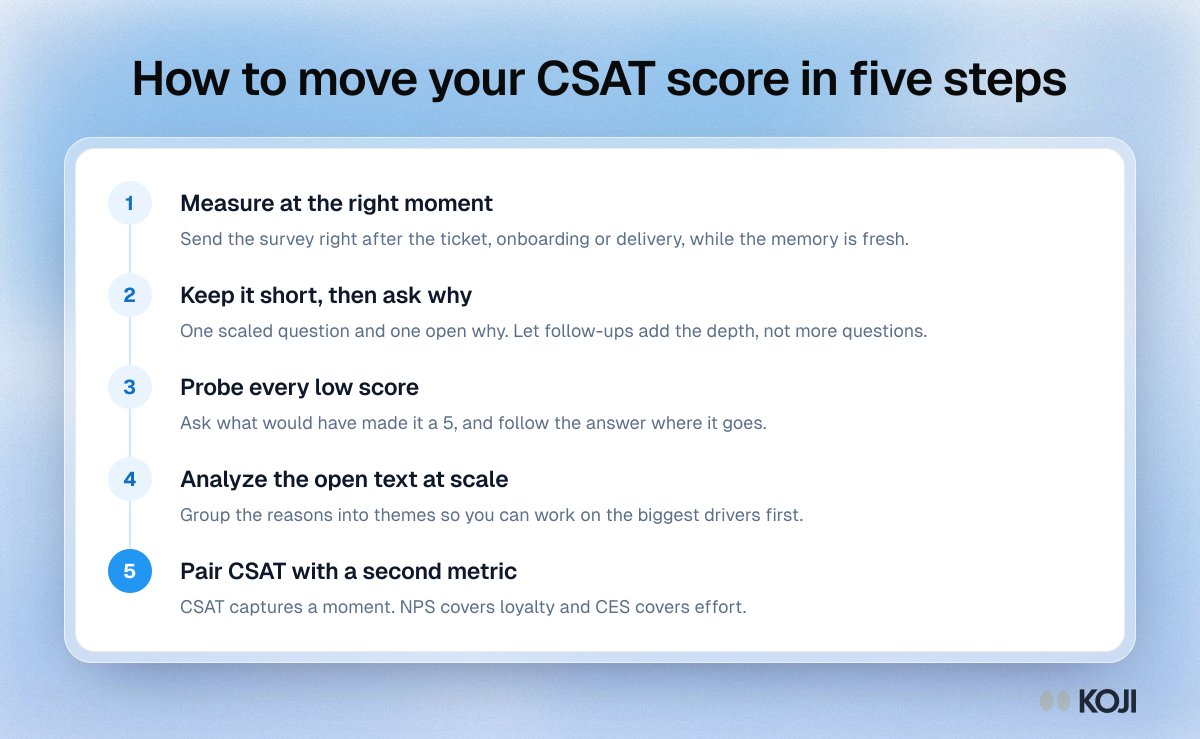
A five-step process for improving a customer satisfaction (CSAT) score, from timing the survey to pairing it with NPS or customer effort score. It is for CX, support and product teams who already track CSAT and want to act on it. Use it as a checklist when you set up or review a CSAT program. Koji can ask the CSAT question in an AI interview and follow up on every low score.
Where this appears
What's in this process
- Measure at the right moment: Send the survey right after the ticket, onboarding or delivery, while the memory is fresh.
- Keep it short, then ask why: One scaled question and one open why. Let follow-ups add the depth, not more questions.
- Probe every low score: Ask what would have made it a 5, and follow the answer where it goes.
- Analyze the open text at scale: Group the reasons into themes so you can work on the biggest drivers first.
- Pair CSAT with a second metric: CSAT captures a moment. NPS covers loyalty and CES covers effort.
Use this image
Free to use in your docs, decks and posts under CC BY 4.0, as long as you credit Koji with a link to this page. To embed it, paste this into your page:
html
<a href="https://www.koji.so/visuals/how-to-improve-csat-score-five-steps"><img src="https://www.koji.so/visuals/how-to-improve-csat-score-five-steps/how-to-improve-csat-score-five-steps.png" alt="Process showing five steps to raise a CSAT score: time the survey well, keep it short, probe low scores, analyze open text, add NPS or CES." width="1200" height="739" /></a>
<p>Source: <a href="https://www.koji.so/visuals/how-to-improve-csat-score-five-steps">How to move your CSAT score in five steps</a>, Koji</p>