Guide
9 quantitative user research methods
What each method measures, from surveys and A/B tests to SUS, SEQ and NPS
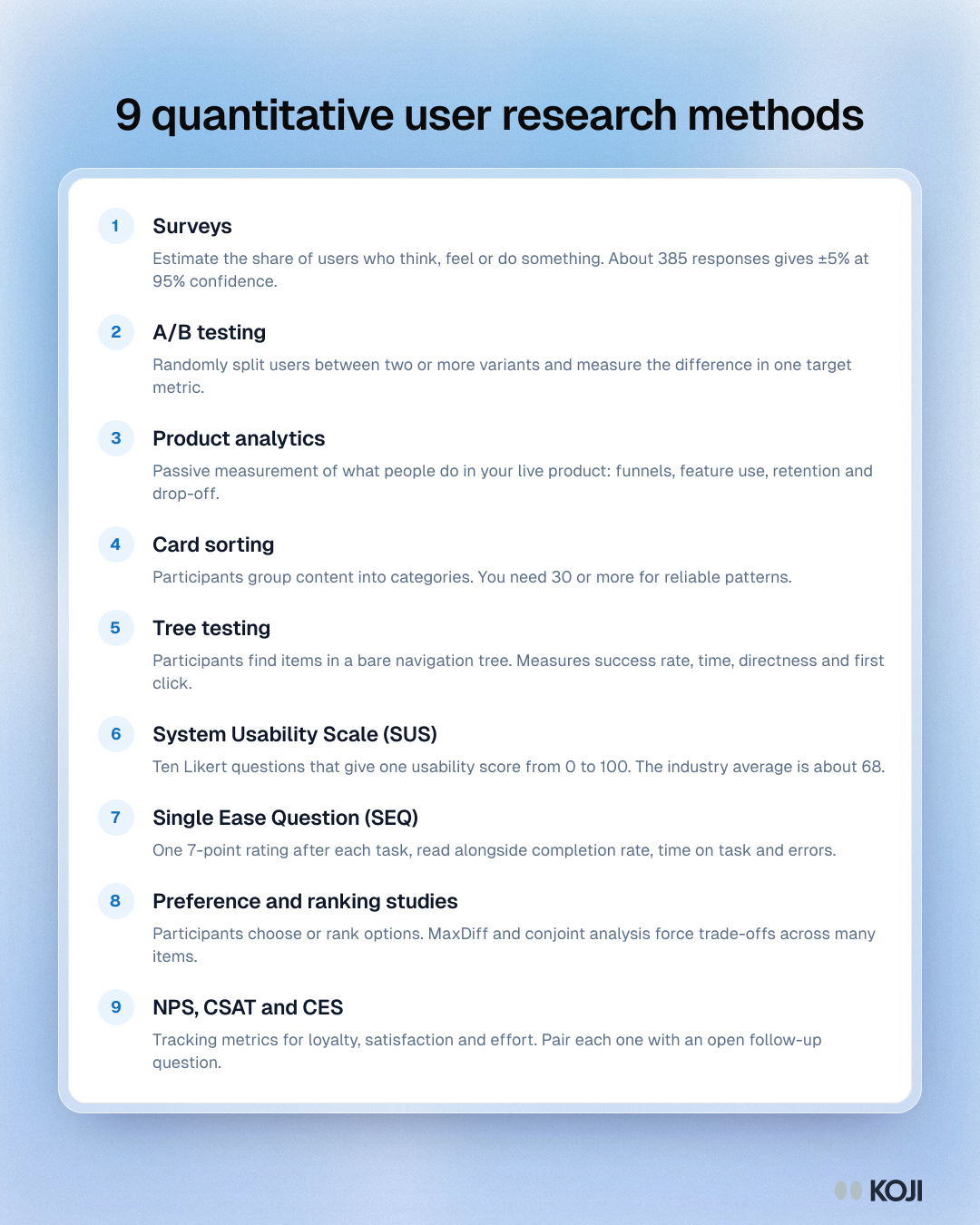
A one-page list of the nine core quantitative user research methods: surveys, A/B testing, product analytics, card sorting, tree testing, the System Usability Scale, the Single Ease Question, preference and ranking studies, and NPS, CSAT and CES. Each line says what the method measures and when it earns its cost. Use it to pick a method before you plan a study. Koji runs scale, ranking and open questions in the same AI interview, so the numbers come with the reasons behind them.
Where this appears
What's in this guide
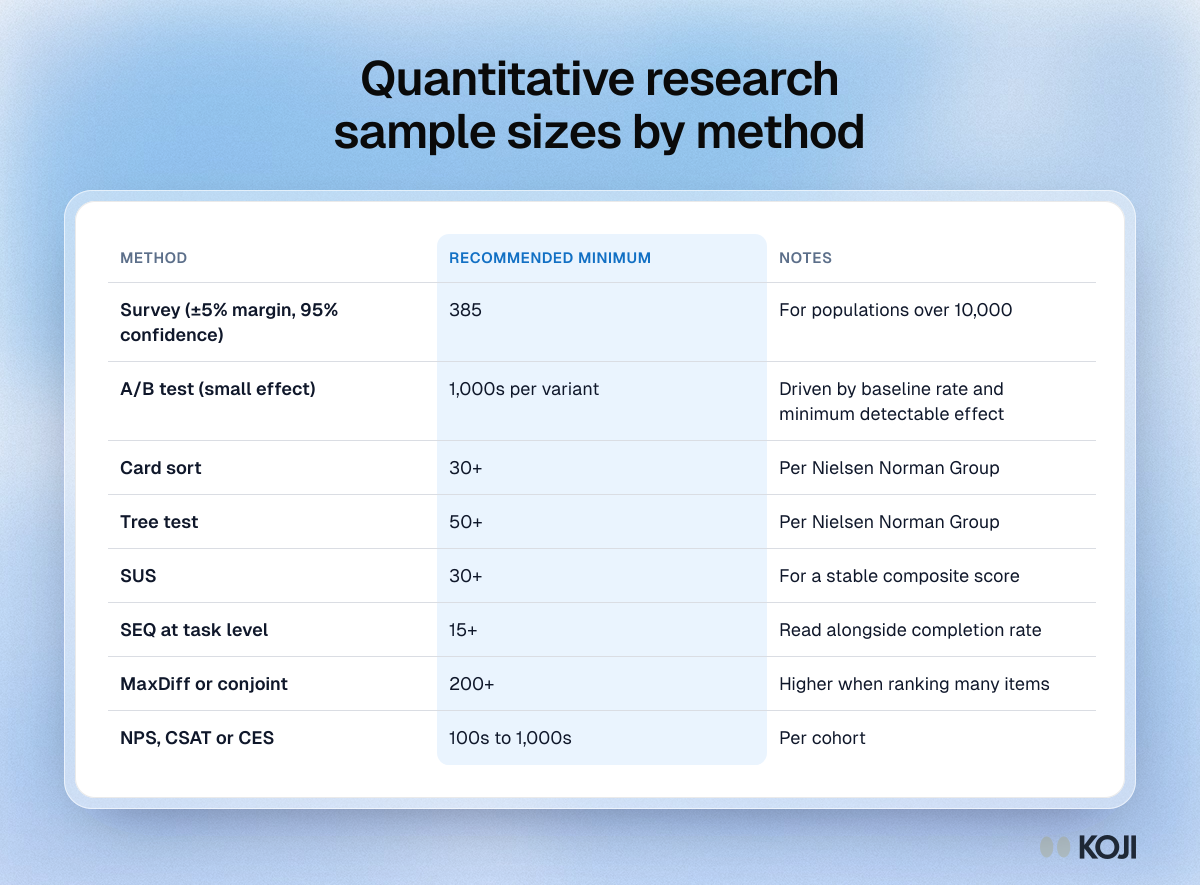
- Surveys: Estimate the share of users who think, feel or do something. About 385 responses gives ±5% at 95% confidence.
- A/B testing: Randomly split users between two or more variants and measure the difference in one target metric.
- Product analytics: Passive measurement of what people do in your live product: funnels, feature use, retention and drop-off.
- Card sorting: Participants group content into categories. You need 30 or more for reliable patterns.
- Tree testing: Participants find items in a bare navigation tree. Measures success rate, time, directness and first click.
- System Usability Scale (SUS): Ten Likert questions that give one usability score from 0 to 100. The industry average is about 68.
- Single Ease Question (SEQ): One 7-point rating after each task, read alongside completion rate, time on task and errors.
- Preference and ranking studies: Participants choose or rank options. MaxDiff and conjoint analysis force trade-offs across many items.
- NPS, CSAT and CES: Tracking metrics for loyalty, satisfaction and effort. Pair each one with an open follow-up question.
Use this image
Free to use in your docs, decks and posts under CC BY 4.0, as long as you credit Koji with a link to this page. To embed it, paste this into your page:
html
<a href="https://www.koji.so/visuals/nine-quantitative-user-research-methods"><img src="https://www.koji.so/visuals/nine-quantitative-user-research-methods/nine-quantitative-user-research-methods.png" alt="List of nine quantitative user research methods, from surveys and A/B testing to SUS, SEQ, MaxDiff and NPS, with what each one measures." width="1080" height="1350" /></a>
<p>Source: <a href="https://www.koji.so/visuals/nine-quantitative-user-research-methods">9 quantitative user research methods</a>, Koji</p>