Reference table
Personal or anonymous links for course evaluations
Personal links raise response, but students who feel identifiable may hold back on sensitive questions.

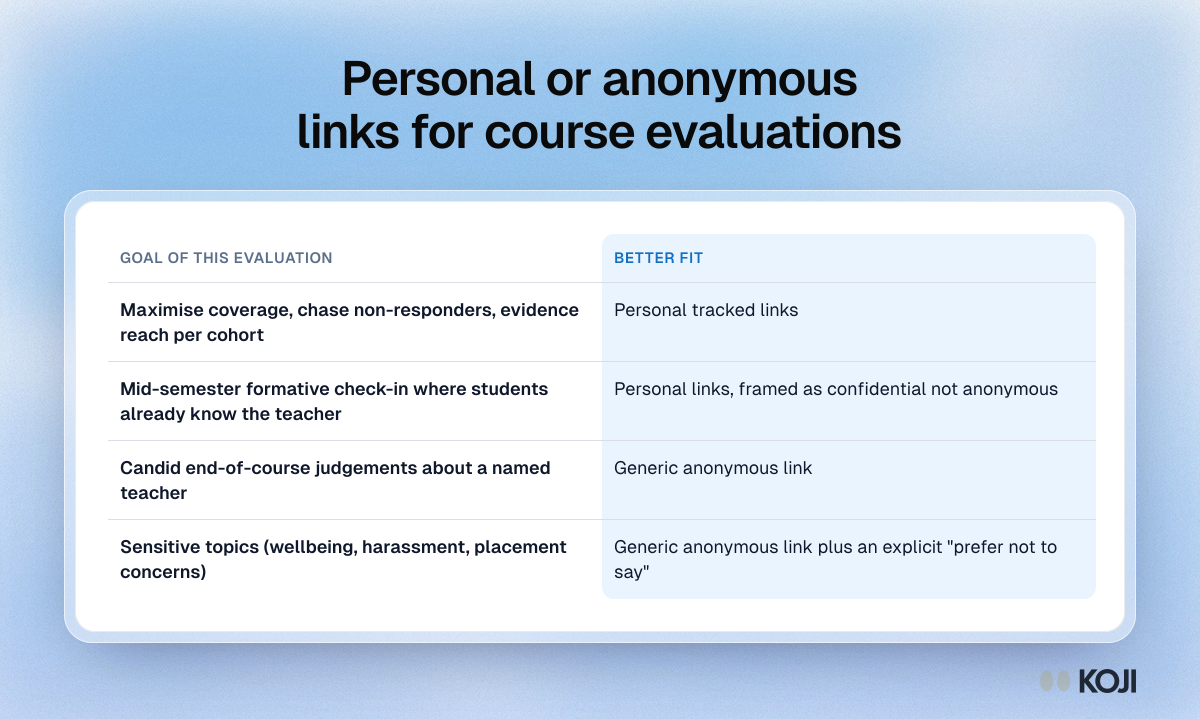
A decision table for evaluation and quality offices choosing how to invite students to a course evaluation. Personalised invitations raised web survey response in an experiment with first-year students, while feeling identifiable led to more refusals on sensitive items in other studies. Use the table to pick personal tracked links or a generic anonymous link per evaluation. Koji supports both: personal invite links from an imported class list, and an anonymous link for every study.
What's in this reference table
| Goal of this evaluation | Better fit |
|---|---|
| Maximise coverage, chase non-responders, evidence reach per cohort | Personal tracked links |
| Mid-semester formative check-in where students already know the teacher | Personal links, framed as confidential not anonymous |
| Candid end-of-course judgements about a named teacher | Generic anonymous link |
| Sensitive topics (wellbeing, harassment, placement concerns) | Generic anonymous link plus an explicit "prefer not to say" |
Use this image
Free to use in your docs, decks and posts under CC BY 4.0, as long as you credit Koji with a link to this page. To embed it, paste this into your page:
<a href="https://www.koji.so/visuals/personal-vs-anonymous-links-course-evaluation"><img src="https://www.koji.so/visuals/personal-vs-anonymous-links-course-evaluation/personal-vs-anonymous-links-course-evaluation.png" alt="Table matching four course evaluation goals to a link type, from tracked personal links for coverage to anonymous links for sensitive topics." width="1200" height="719" /></a>
<p>Source: <a href="https://www.koji.so/visuals/personal-vs-anonymous-links-course-evaluation">Personal or anonymous links for course evaluations</a>, Koji</p>