Guide
Four ways to reduce racial bias in student evaluations of teaching
Four practical changes for universities that use student evaluations of teaching in promotion, tenure or quality assurance decisions, drawn from research showing that instructors from minoritised groups receive systematically lower ratings. It is for quality assurance leads, institutional researchers and academic HR. Use it as a checklist when reviewing how evaluation results are reported and weighed. Koji for Education adds follow-up questions to low ratings and analyses every comment by theme.
What's in this guide
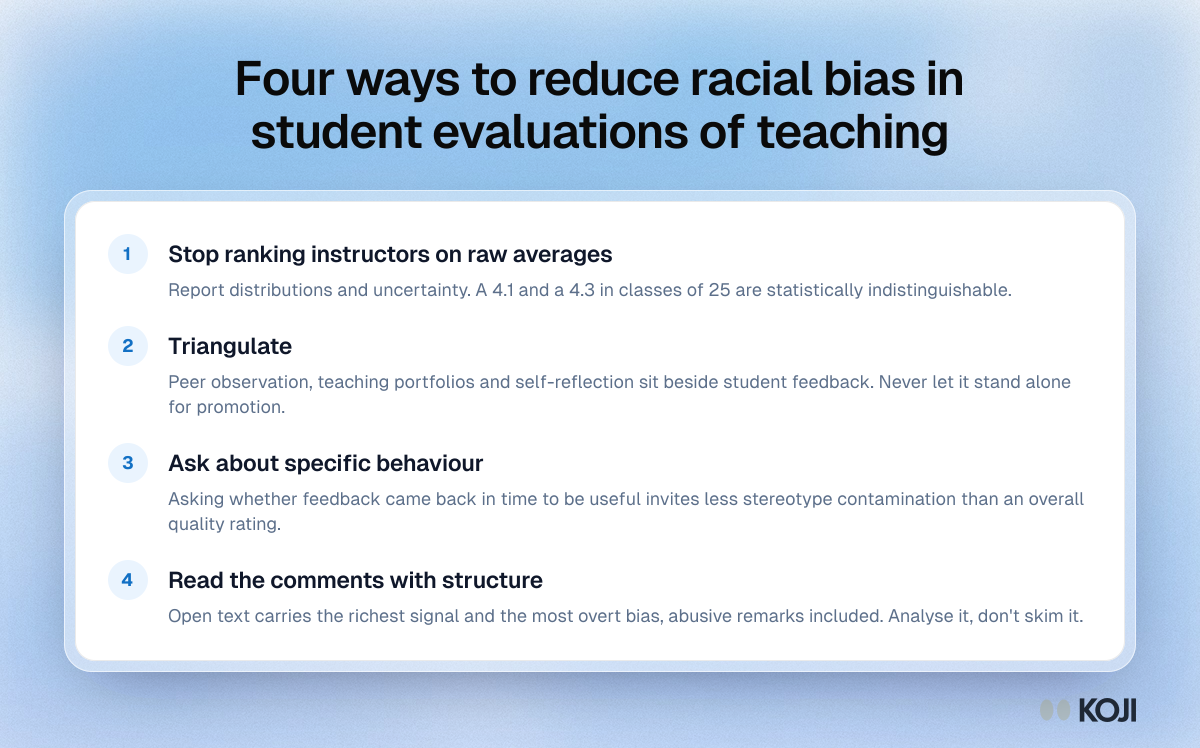
- Stop ranking instructors on raw averages: Report distributions and uncertainty. A 4.1 and a 4.3 in classes of 25 are statistically indistinguishable.
- Triangulate: Peer observation, teaching portfolios and self-reflection sit beside student feedback. Never let it stand alone for promotion.
- Ask about specific behaviour: Asking whether feedback came back in time to be useful invites less stereotype contamination than an overall quality rating.
- Read the comments with structure: Open text carries the richest signal and the most overt bias, abusive remarks included. Analyse it, don't skim it.
Use this image
Free to use in your docs, decks and posts under CC BY 4.0, as long as you credit Koji with a link to this page. To embed it, paste this into your page:
html
<a href="https://www.koji.so/visuals/reduce-racial-bias-student-evaluations-of-teaching"><img src="https://www.koji.so/visuals/reduce-racial-bias-student-evaluations-of-teaching/reduce-racial-bias-student-evaluations-of-teaching.png" alt="List of four changes that reduce racial bias in student evaluations of teaching: no average rankings, triangulation, specific items, structured reading." width="1200" height="748" /></a>
<p>Source: <a href="https://www.koji.so/visuals/reduce-racial-bias-student-evaluations-of-teaching">Four ways to reduce racial bias in student evaluations of teaching</a>, Koji</p>