Reference table
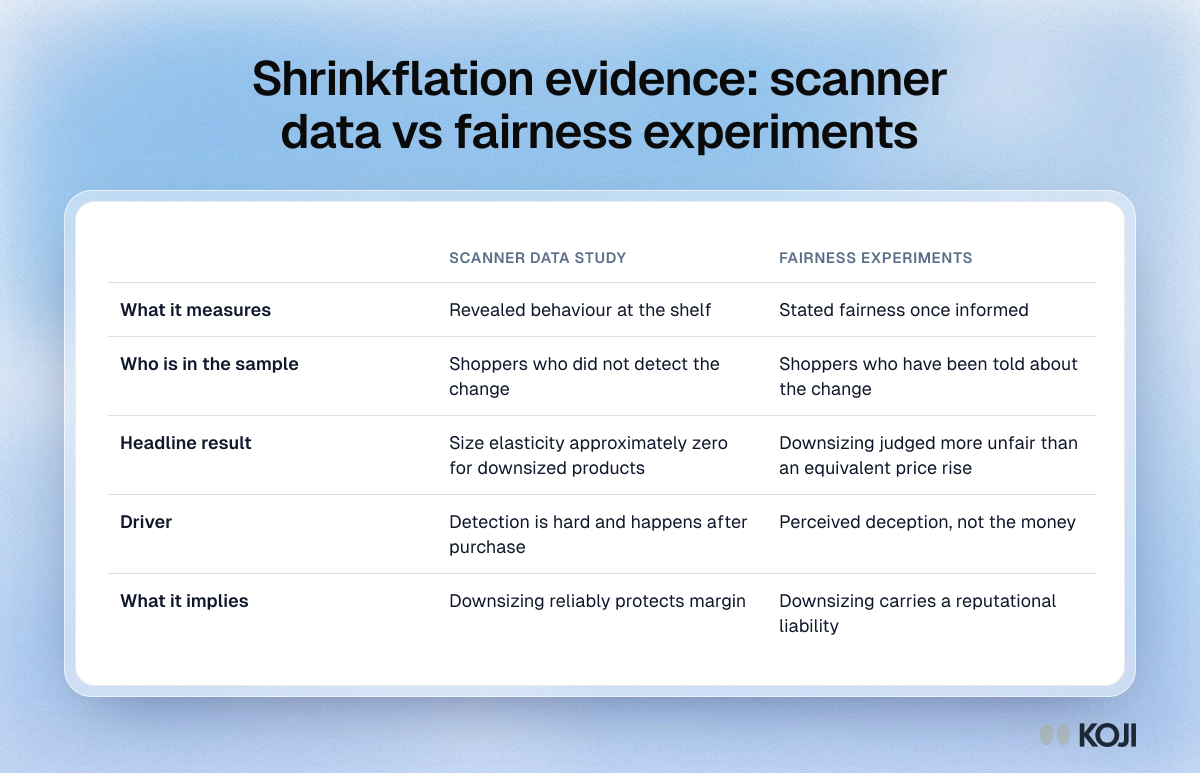
Shrinkflation evidence: scanner data vs fairness experiments
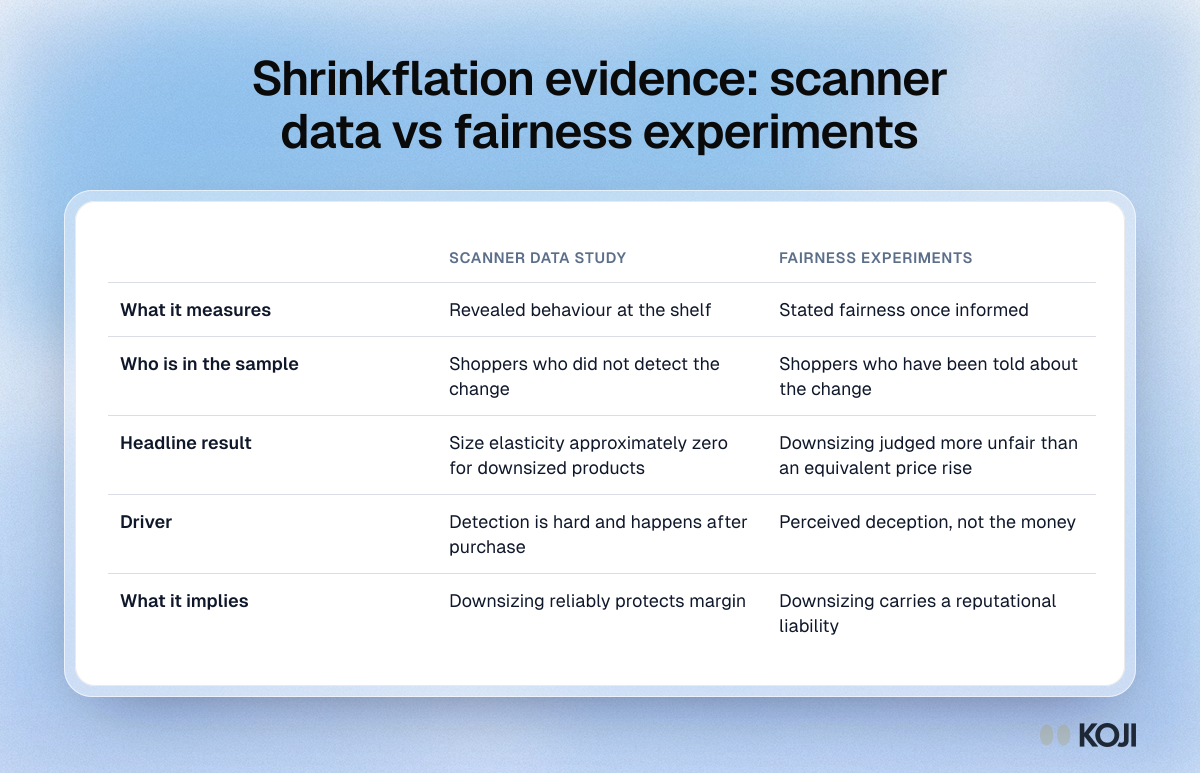
A comparison of the two main bodies of shrinkflation evidence. Janssen and Kasinger's scanner data study finds near-zero size elasticity for downsized products, because most shoppers never detect the change. Evangelidis's five preregistered experiments find that informed shoppers judge downsizing as more unfair than an equal price rise, mainly because it feels deceptive. Use it to explain why both results hold at once.
Where this appears
What's in this reference table
| Scanner data study | Fairness experiments | |
|---|---|---|
| What it measures | Revealed behaviour at the shelf | Stated fairness once informed |
| Who is in the sample | Shoppers who did not detect the change | Shoppers who have been told about the change |
| Headline result | Size elasticity approximately zero for downsized products | Downsizing judged more unfair than an equivalent price rise |
| Driver | Detection is hard and happens after purchase | Perceived deception, not the money |
| What it implies | Downsizing reliably protects margin | Downsizing carries a reputational liability |
Use this image
Free to use in your docs, decks and posts under CC BY 4.0, as long as you credit Koji with a link to this page. To embed it, paste this into your page:
html
<a href="https://www.koji.so/visuals/shrinkflation-scanner-data-vs-fairness-experiments"><img src="https://www.koji.so/visuals/shrinkflation-scanner-data-vs-fairness-experiments/shrinkflation-scanner-data-vs-fairness-experiments.png" alt="Table comparing shrinkflation evidence: scanner data shows shoppers who didn't notice barely react, while experiments show informed shoppers call it unfair." width="1200" height="773" /></a>
<p>Source: <a href="https://www.koji.so/visuals/shrinkflation-scanner-data-vs-fairness-experiments">Shrinkflation evidence: scanner data vs fairness experiments</a>, Koji</p>