Guide
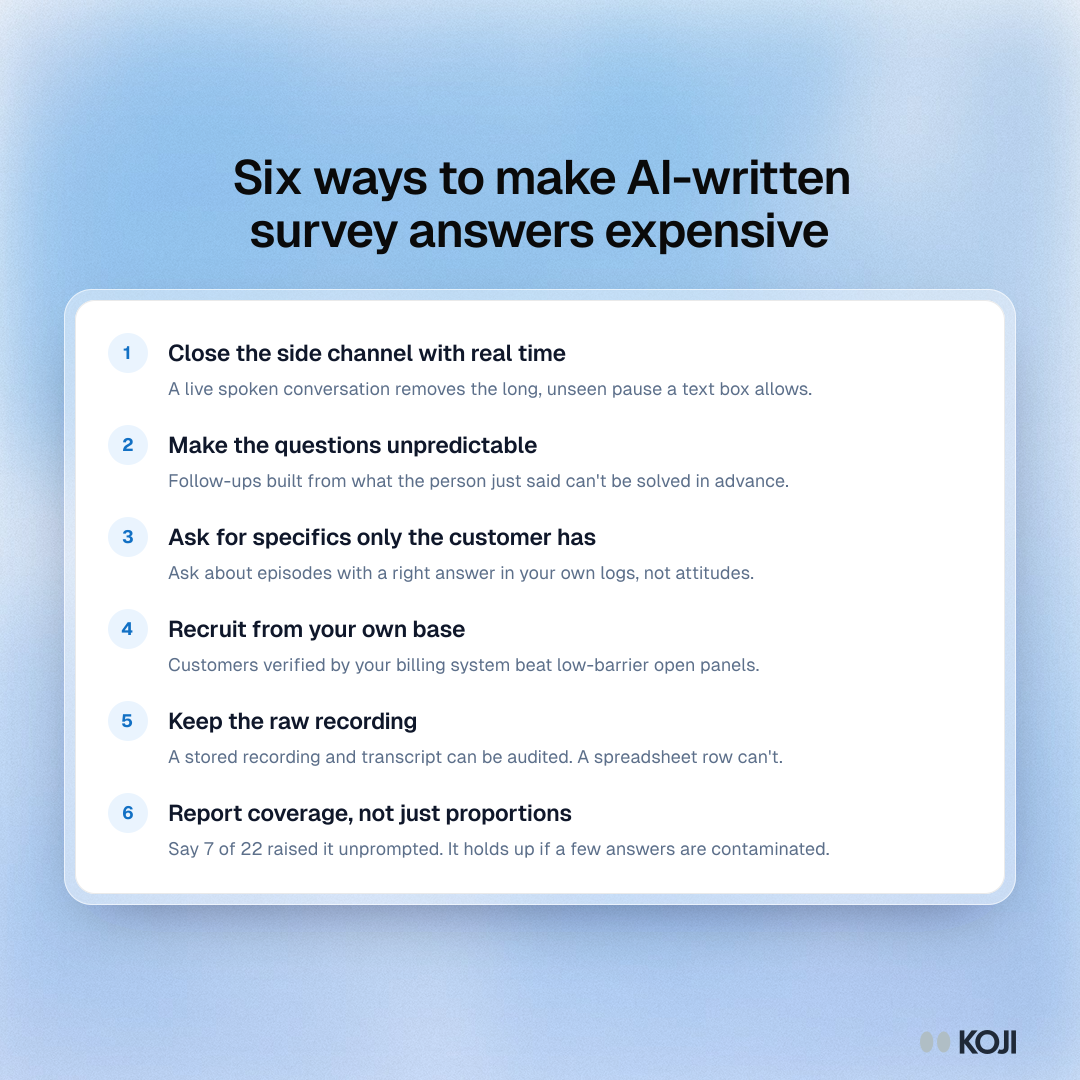
Six ways to make AI-written survey answers expensive
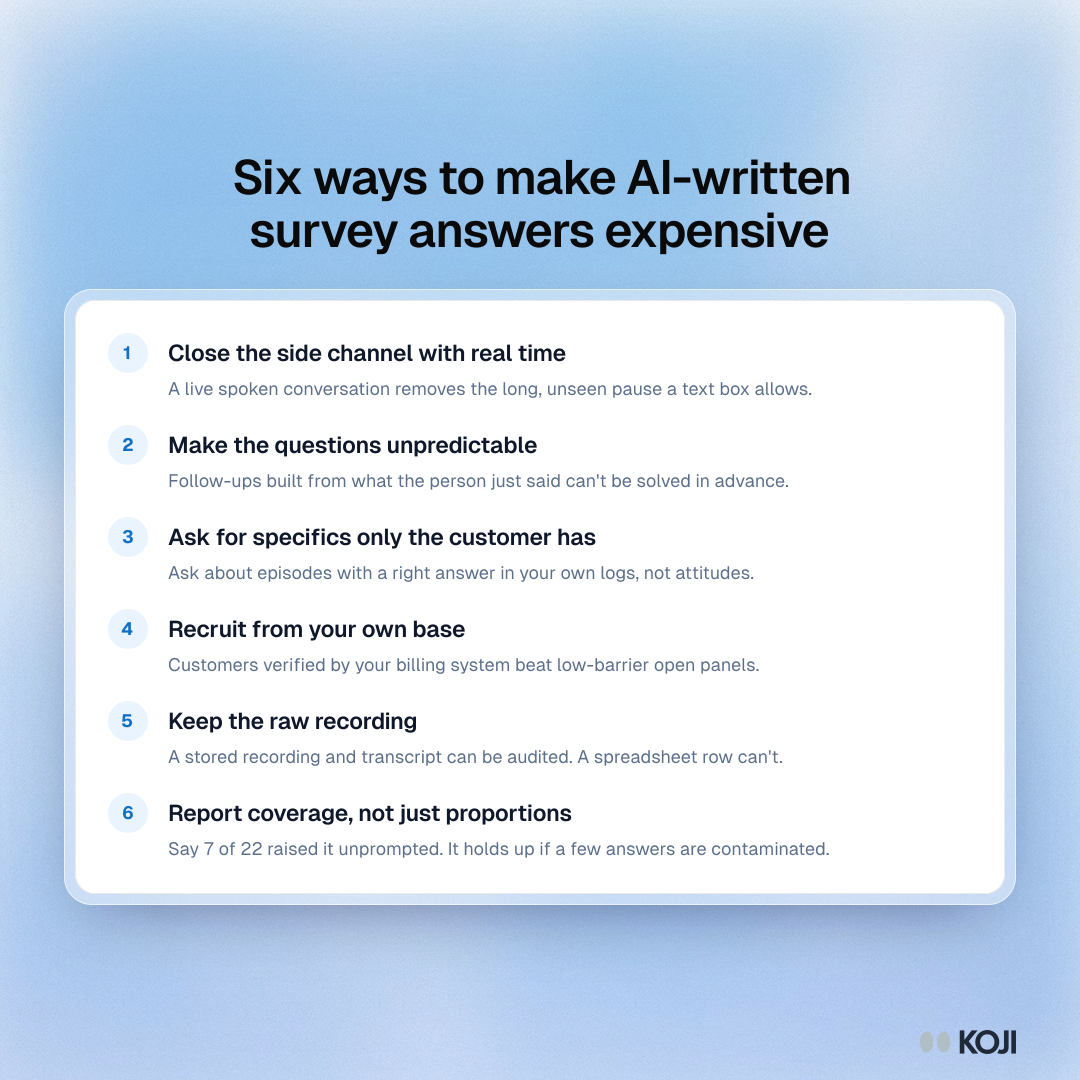
Six research design choices that raise the cost of faking or delegating answers to a language model: real-time spoken conversation, adaptive follow-up questions, questions about specific episodes, recruiting from your own customers, keeping raw recordings and reporting coverage counts. Use it as a checklist when you plan a study that relies on open-ended answers.
Where this appears
What's in this guide
- Close the side channel with real time: A live spoken conversation removes the long, unseen pause a text box allows.
- Make the questions unpredictable: Follow-ups built from what the person just said can't be solved in advance.
- Ask for specifics only the customer has: Ask about episodes with a right answer in your own logs, not attitudes.
- Recruit from your own base: Customers verified by your billing system beat low-barrier open panels.
- Keep the raw recording: A stored recording and transcript can be audited. A spreadsheet row can't.
- Report coverage, not just proportions: Say 7 of 22 raised it unprompted. It holds up if a few answers are contaminated.
Use this image
Free to use in your docs, decks and posts under CC BY 4.0, as long as you credit Koji with a link to this page. To embed it, paste this into your page:
html
<a href="https://www.koji.so/visuals/six-research-designs-that-make-ai-responses-expensive"><img src="https://www.koji.so/visuals/six-research-designs-that-make-ai-responses-expensive/six-research-designs-that-make-ai-responses-expensive.png" alt="List of six research designs that make AI-written survey answers harder to fake, from live voice conversations to keeping raw recordings." width="1080" height="1080" /></a>
<p>Source: <a href="https://www.koji.so/visuals/six-research-designs-that-make-ai-responses-expensive">Six ways to make AI-written survey answers expensive</a>, Koji</p>