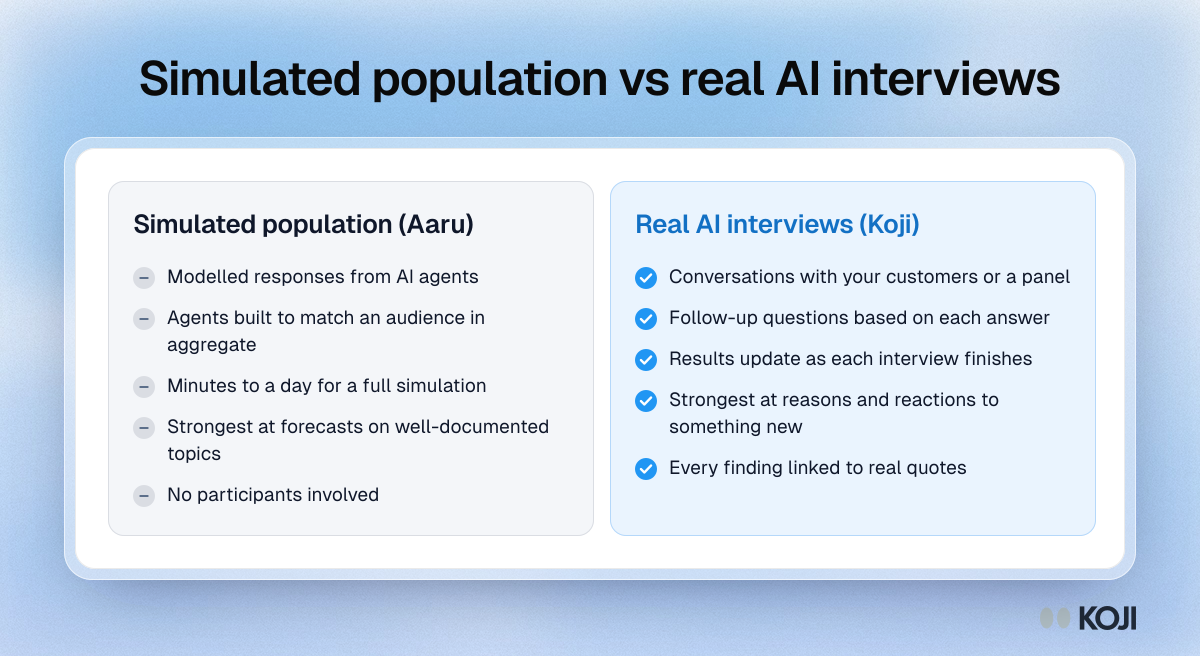
Short answer: Aaru and Koji answer different questions. Aaru simulates people: it builds a population of AI agents that match an audience in aggregate and predicts how that population would respond, in minutes, with no participants involved. Koji interviews people: an AI interviewer holds real voice, text or phone conversations with your customers or a research panel and reports what they said and why, with every finding linked to their own words. Use Aaru-style simulation when you need a fast forecast on a well-documented question across a large population. Use Koji when the answer has to come from real customers, when you need the reasons behind a choice, or when the topic is new enough that no model has seen it. Many teams will end up using both: simulate to narrow the options, then interview to check the one you are about to bet on.
Koji vs Aaru at a glance
| Aaru | Koji | |
|---|---|---|
| What it produces | Modelled responses from a simulated population | Interviews with real people, plus a report |
| Who answers | AI agents built to match an audience in aggregate | Your customers, users or Koji's research panel |
| Speed | Minutes to a day for a full simulation, per Aaru and EY | Results update as each interview finishes |
| Strongest at | Forecasting group outcomes on well-documented topics | Reasons, stories and reactions to something new |
| Evidence you can quote | Agent responses | Verbatim quotes from real participants |
| Buying model | Enterprise and partner-led, no public pricing | Self-serve, starts free, public pricing |
Why synthetic research is suddenly on the shortlist
Synthetic responses have moved from a conference topic to a budget line. In Qualtrics' 2025 Market Research Trends report, 69% of researchers said they had used synthetic responses in the past year, and 71% agreed that the majority of market research will use synthetic responses within three years (Qualtrics).
Aaru is the best-funded name in that space. It raised a Series A led by Redpoint Ventures in December 2025, reported at a $1 billion headline valuation (Yahoo Finance). Accenture Ventures had already invested earlier that year (Accenture). When a tool like that lands on a leadership slide, a research team needs a clear answer on what it can replace and what it can't.
What Aaru does
Aaru is a New York company founded in 2024 by Cameron Fink, Ned Koh and John Kessler. It describes its product as population simulation:
- Agents, not respondents. Aaru builds a population of agents, each a computational model of one person, whose traits such as age, income and location match the target audience in aggregate. Each agent answers the questions on its own, and you can read results per agent or across the population (Aaru).
- Many data sources. The simulation draws on public and licensed records about how people live, work and spend. Aaru says sources are weighted against each other, so agreement strengthens a signal and disagreement flags it.
- Lumen for business. Lumen is Aaru's model for the private sector. Accenture Song said it would build Lumen into its work on product development, marketing and customer service.
- A forecasting track record. Research Live, citing Semafor, reported that Aaru's 2024 New York Democratic primary forecast landed within 371 votes of the result (Research Live).
- Enterprise validation. EY used Aaru to recreate its Global Wealth Management Survey. The simulation took one day and reached a median Spearman correlation of 0.90 with the real survey across 53 single-select questions (EY). Aaru also reports, in its own paper, a mean absolute error of 2.78 percentage points across 2,993 questions (Aaru).
Pricing. Aaru does not publish prices. It sells to enterprises directly and through partners such as Accenture and EY, so expect a sales process.
Limits worth knowing. The strongest accuracy numbers are on single-select questions and on topics where a lot of public data exists, like elections and wealth attitudes. Aaru's own paper is company-reported. And a simulation tells you what a population is likely to answer, not what a specific customer of yours actually thinks.
What independent research says about synthetic samples
Synthetic samples are not all the same, but independent tests point to the same weak spots.
- Subgroups drift. Verasight's synthetic sampling research found topline political results within about four points of real survey figures, but subgroup error averaged 10 points and reached 30 points for the smallest groups. Results on brand awareness and product testing were worse than on politics (Verasight).
- Too positive, too uniform. A study from the NIM, Nuremberg Institute for Market Decisions, found synthetic answers captured broad brand trends but consistently overestimated positive attitudes, especially toward well-known brands, and showed much less variation than real people (NIM).
That pattern matters for product teams. The questions you most need answered are often about a niche segment, a new feature or a reason nobody has written about yet. That is where a model has the least to go on. We go deeper on this in our guide to synthetic users and research validity.
What Koji does
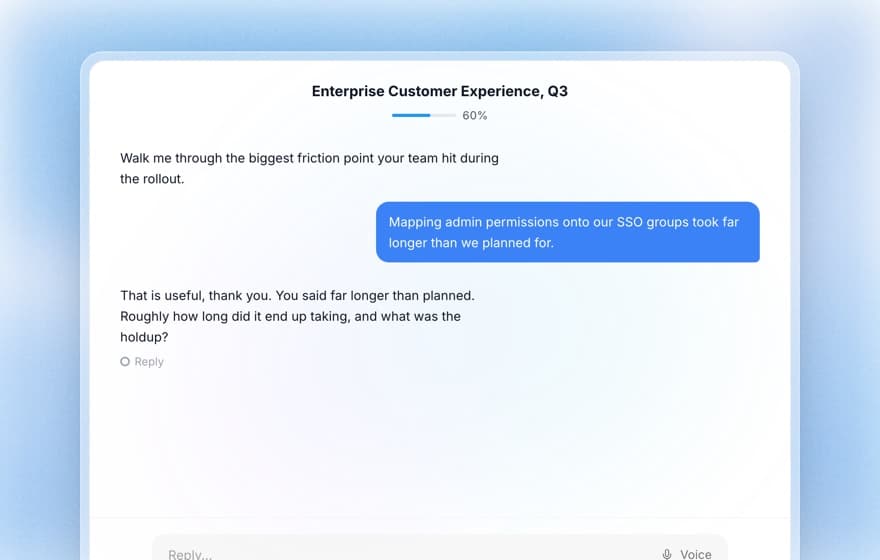
Koji is an AI-native research platform for talking to real people at scale. You type a research question, the research assistant drafts a brief, and an AI interviewer runs the conversations.
- Real conversations, by voice, text or phone, in 28 languages. The interviewer asks follow-up questions based on what each person just said. Voice interviews are on the Interviews and Enterprise plans; text works on every plan.
- Numbers and reasons together. Mix open questions with scales, single choice, multiple choice, ranking and yes/no questions, so you get a count and the story behind it from the same person.
- The right people. Invite your own customers by link or CSV import, or recruit from Koji's research panel on paid plans. Screening questions turn away people who don't fit.
- A quality gate. Every interview gets a quality score from 1 to 5. Only interviews scoring 3 or more use credits or enter the report.
- Evidence you can trace. Every finding in the report links to the quotes behind it.
Pricing. A free account comes with 10 credits. Insights is €29 a month with 29 credits, Interviews is €79 a month with 79 credits, and Enterprise is priced on request. A text interview uses 1 credit, a voice interview 3. Extra credits are €1 each.
Where they differ
Prediction versus explanation
Aaru is built to predict an outcome: which message wins, how a population splits. Koji is built to explain one: why a trial went quiet, what made a buyer pick a competitor, which words customers use for the problem. If the decision needs a reason you can act on, you need someone who lived it.
Known topics versus new ones
Simulations lean on what is already recorded about a population. That works well for well-studied attitudes. It works less well for a product that launched last month, a niche B2B workflow or your own churned customers. Interviews have no such limit, because the participant is the data.
What you can show a stakeholder
A real quote from a real customer is hard to argue with. Koji reports put the quote next to the finding. A simulated answer can guide a decision, but it is harder to defend in a room that wants to hear from customers.

How you buy
Aaru is sold to enterprises and through consulting partners. Koji is self-serve with public prices: a 30-interview text study is 30 credits, and you can run it this afternoon.
How to use both
Simulation and interviews are not rivals in every project. A sensible pattern:
- Use a simulation to screen many options quickly, such as ten message variants.
- Take the top two or three into real interviews with the people who matter, by voice or text.
- Read the reasons, check the subgroups the simulation was least sure about, and decide.
Who should choose which
Choose Aaru if:
- You need fast forecasts of how a large population will respond on a well-documented topic.
- You are an enterprise or agency team working through partners such as Accenture or EY.
- You want to test many variants before spending on fieldwork.
Choose Koji if:
- You need to hear from your actual customers, users or a defined panel audience.
- You need the reasons behind choices, in participants' own words.
- The topic is new, niche or specific to your product.
- You want public pricing and to start today.
The bottom line
Aaru is a serious bet on simulation, with real validation work behind it on well-studied questions. Koji is for the part of research that simulation can't replace: talking to real people, at scale, and bringing back what they said. When the stakes are high, run the interviews.
Try Koji free
Create a free Koji account, type the question your simulation can't answer, preview the interview yourself and send it to ten real customers. Your 10 signup credits cover ten text interviews. For more, read our comparison of Koji vs Synthetic Users or our take on AI personas vs real interviews.