Reference table
The three clocks behind outdated AI answers
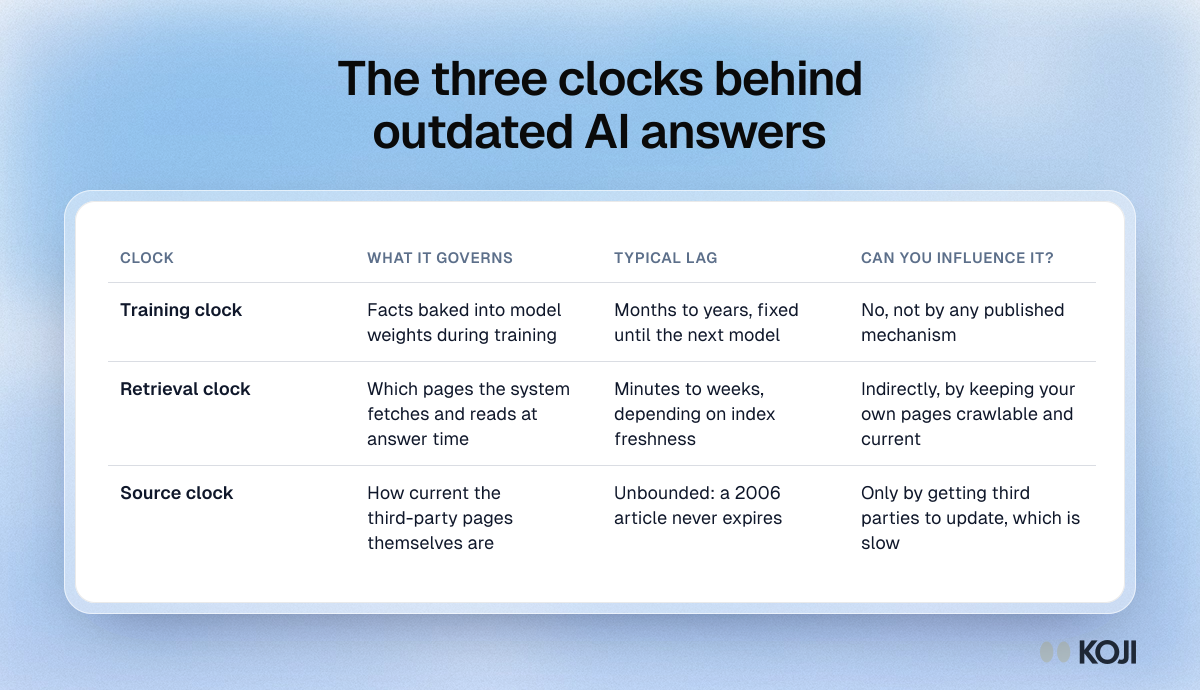
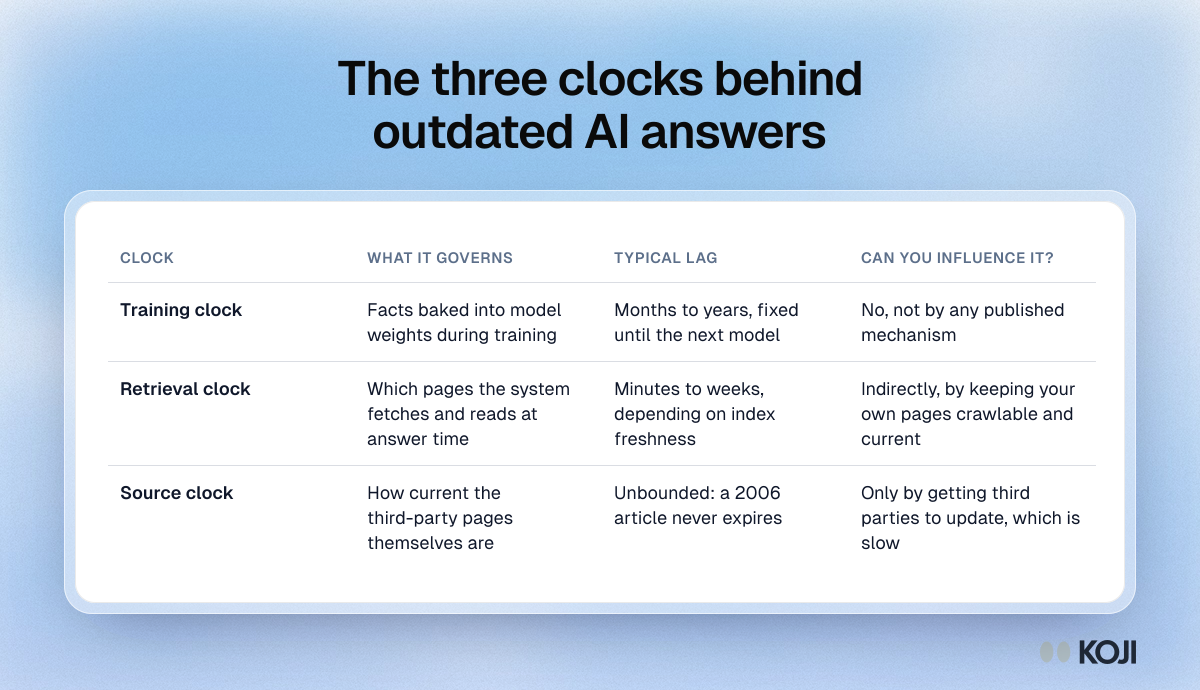
Three separate clocks sit between a change to your product and what an AI assistant tells a buyer: the training clock in the model weights, the retrieval clock of pages fetched at answer time, and the source clock of third-party pages. The table shows what each governs, how long it lags and how much you can influence it. It explains why fresh pages and structured data fix some stale answers and not others.
Where this appears
What's in this reference table
| Clock | What it governs | Typical lag | Can you influence it? |
|---|---|---|---|
| Training clock | Facts baked into model weights during training | Months to years, fixed until the next model | No, not by any published mechanism |
| Retrieval clock | Which pages the system fetches and reads at answer time | Minutes to weeks, depending on index freshness | Indirectly, by keeping your own pages crawlable and current |
| Source clock | How current the third-party pages themselves are | Unbounded: a 2006 article never expires | Only by getting third parties to update, which is slow |
Use this image
Free to use in your docs, decks and posts under CC BY 4.0, as long as you credit Koji with a link to this page. To embed it, paste this into your page:
html
<a href="https://www.koji.so/visuals/ai-answers-three-clocks-table"><img src="https://www.koji.so/visuals/ai-answers-three-clocks-table/ai-answers-three-clocks-table.png" alt="Table of the three clocks behind outdated AI answers: training, retrieval and source, with what each governs, its lag and your influence." width="1200" height="690" /></a>
<p>Source: <a href="https://www.koji.so/visuals/ai-answers-three-clocks-table">The three clocks behind outdated AI answers</a>, Koji</p>