Key figure
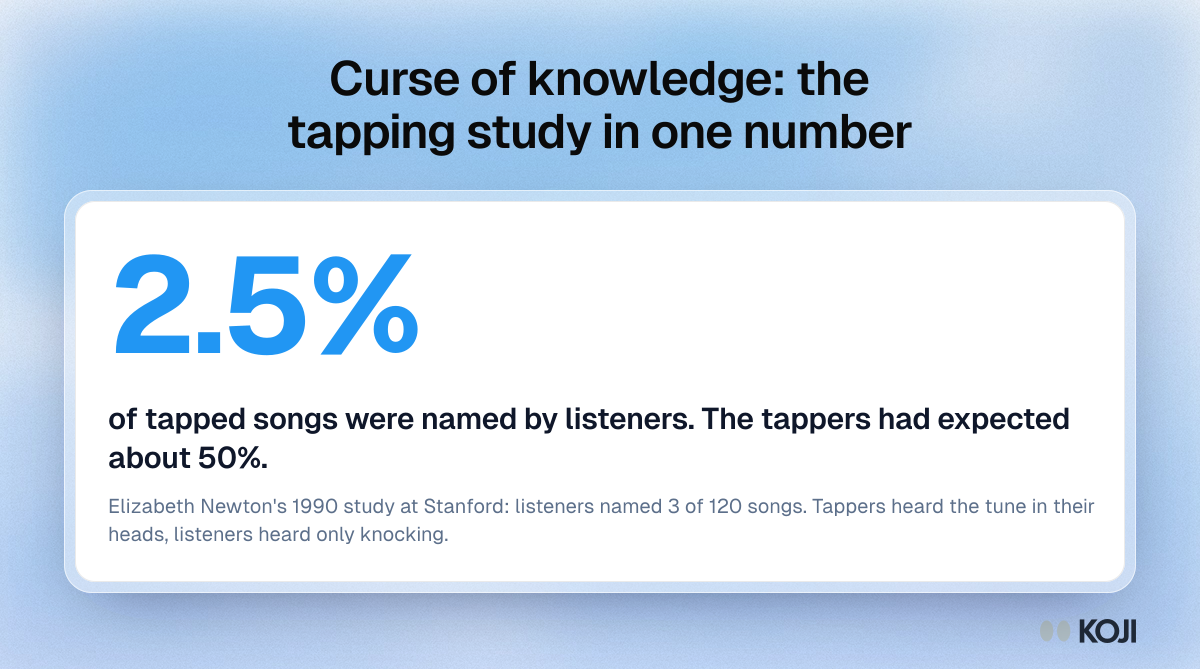
Curse of knowledge: the tapping study in one number
Why the people who know the most are the worst at guessing what others will understand
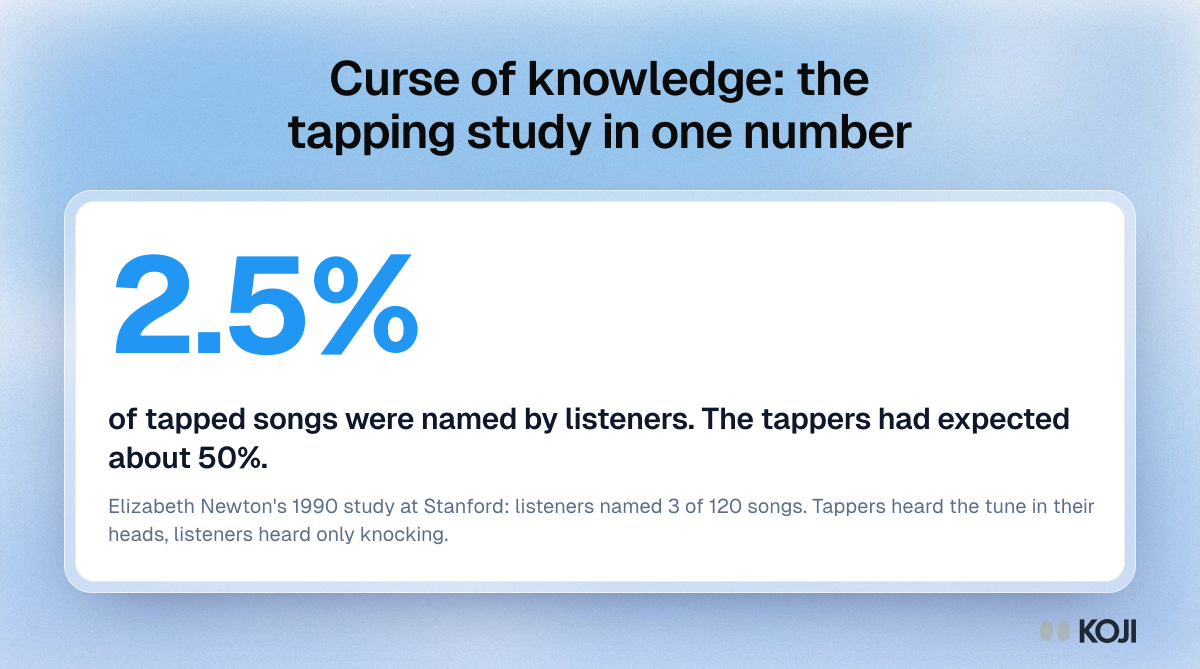
The result of Elizabeth Newton's 1990 tapping study at Stanford, the best-known demonstration of the curse of knowledge. Tappers expected listeners to name about half the songs they tapped; listeners named 3 of 120. Researchers can use it to explain why discussion guides, tasks and reports written by experts need testing on newcomers. Koji's interview preview makes that test quick to run.
Where this appears
What's in this key figure
2.5% of tapped songs were named by listeners. The tappers had expected about 50%.Elizabeth Newton's 1990 study at Stanford: listeners named 3 of 120 songs. Tappers heard the tune in their heads, listeners heard only knocking.
Use this image
Free to use in your docs, decks and posts under CC BY 4.0, as long as you credit Koji with a link to this page. To embed it, paste this into your page:
<a href="https://www.koji.so/visuals/curse-of-knowledge-tapping-study-stat"><img src="https://www.koji.so/visuals/curse-of-knowledge-tapping-study-stat/curse-of-knowledge-tapping-study-stat.png" alt="Stat card showing listeners named only 2.5% of tapped songs, while tappers had expected about 50%" width="1200" height="669" /></a>
<p>Source: <a href="https://www.koji.so/visuals/curse-of-knowledge-tapping-study-stat">Curse of knowledge: the tapping study in one number</a>, Koji</p>