Reference table
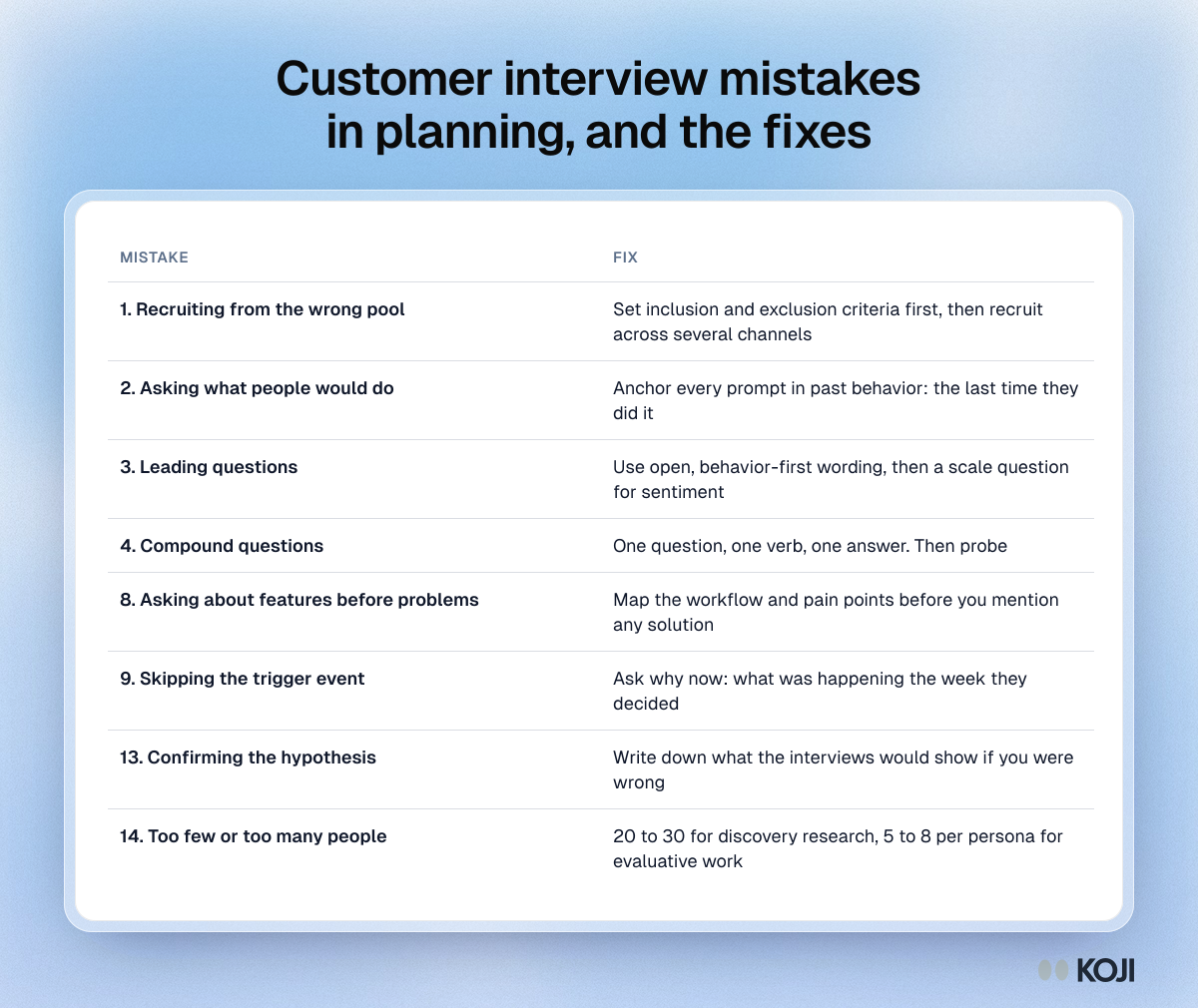
Customer interview mistakes in planning, and the fixes
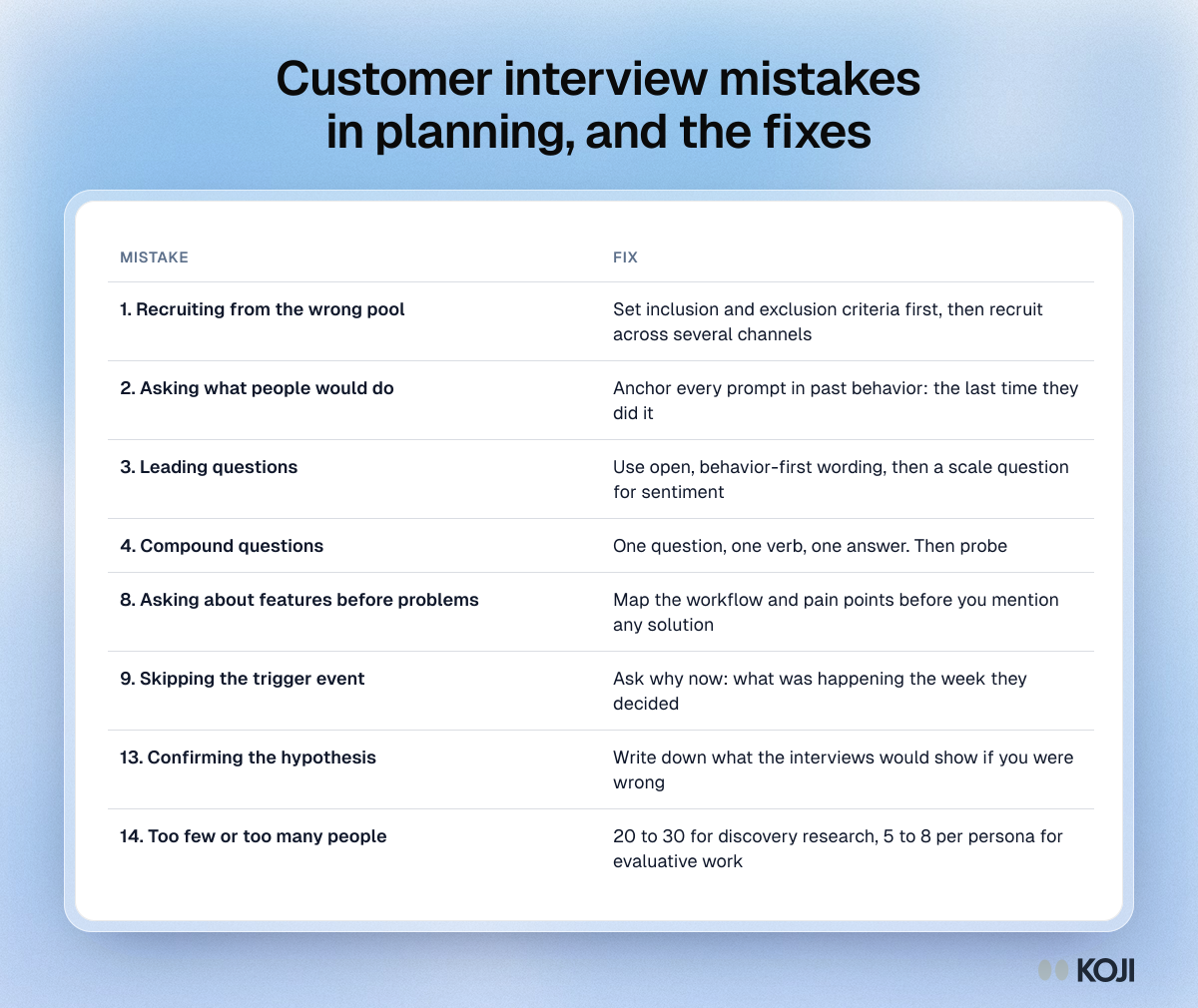
Eight common customer interview mistakes that happen while you plan and write questions: the wrong recruiting pool, hypothetical questions, leading and compound questions, features before problems, a skipped trigger event, the wrong sample size and a study built to confirm. Each row gives the fix. Koji templates start from past-behavior questions, which takes care of the second row by default.
Where this appears
What's in this reference table
| Mistake | Fix |
|---|---|
| 1. Recruiting from the wrong pool | Set inclusion and exclusion criteria first, then recruit across several channels |
| 2. Asking what people would do | Anchor every prompt in past behavior: the last time they did it |
| 3. Leading questions | Use open, behavior-first wording, then a scale question for sentiment |
| 4. Compound questions | One question, one verb, one answer. Then probe |
| 8. Asking about features before problems | Map the workflow and pain points before you mention any solution |
| 9. Skipping the trigger event | Ask why now: what was happening the week they decided |
| 13. Confirming the hypothesis | Write down what the interviews would show if you were wrong |
| 14. Too few or too many people | 20 to 30 for discovery research, 5 to 8 per persona for evaluative work |
Use this image
Free to use in your docs, decks and posts under CC BY 4.0, as long as you credit Koji with a link to this page. To embed it, paste this into your page:
html
<a href="https://www.koji.so/visuals/customer-interview-planning-mistakes-and-fixes"><img src="https://www.koji.so/visuals/customer-interview-planning-mistakes-and-fixes/customer-interview-planning-mistakes-and-fixes.png" alt="Table of eight customer interview mistakes made before the session, from recruiting the wrong pool to the wrong sample size, each with its fix." width="1200" height="1010" /></a>
<p>Source: <a href="https://www.koji.so/visuals/customer-interview-planning-mistakes-and-fixes">Customer interview mistakes in planning, and the fixes</a>, Koji</p>