Reference table
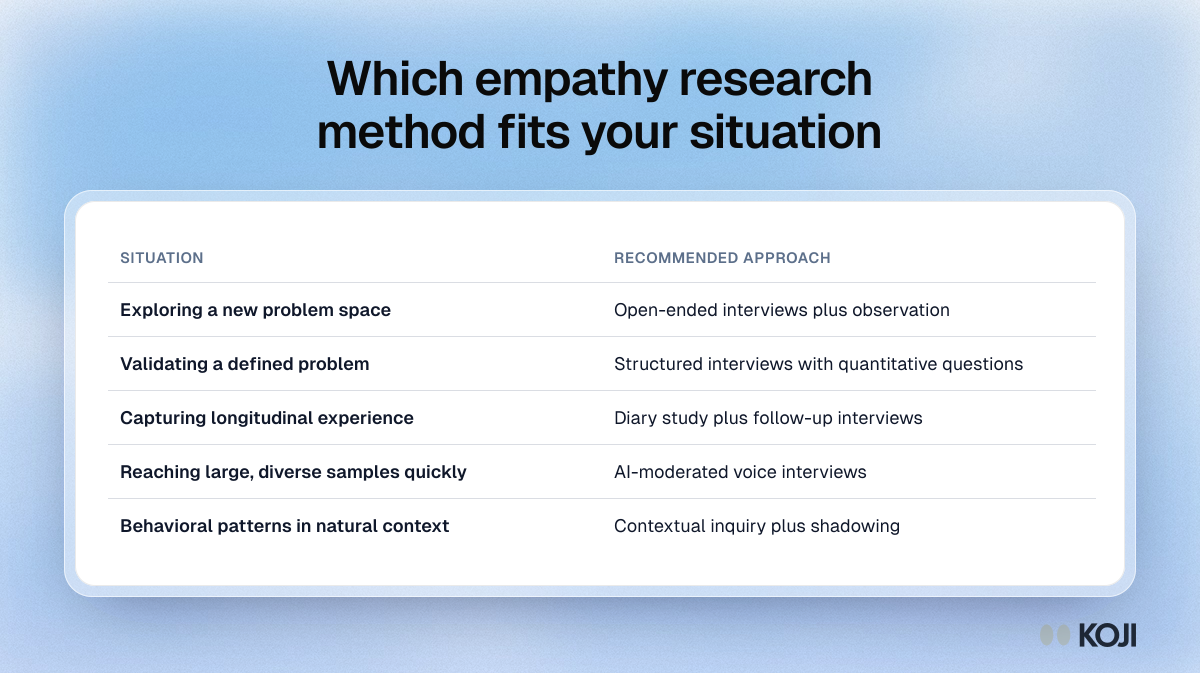
Which empathy research method fits your situation
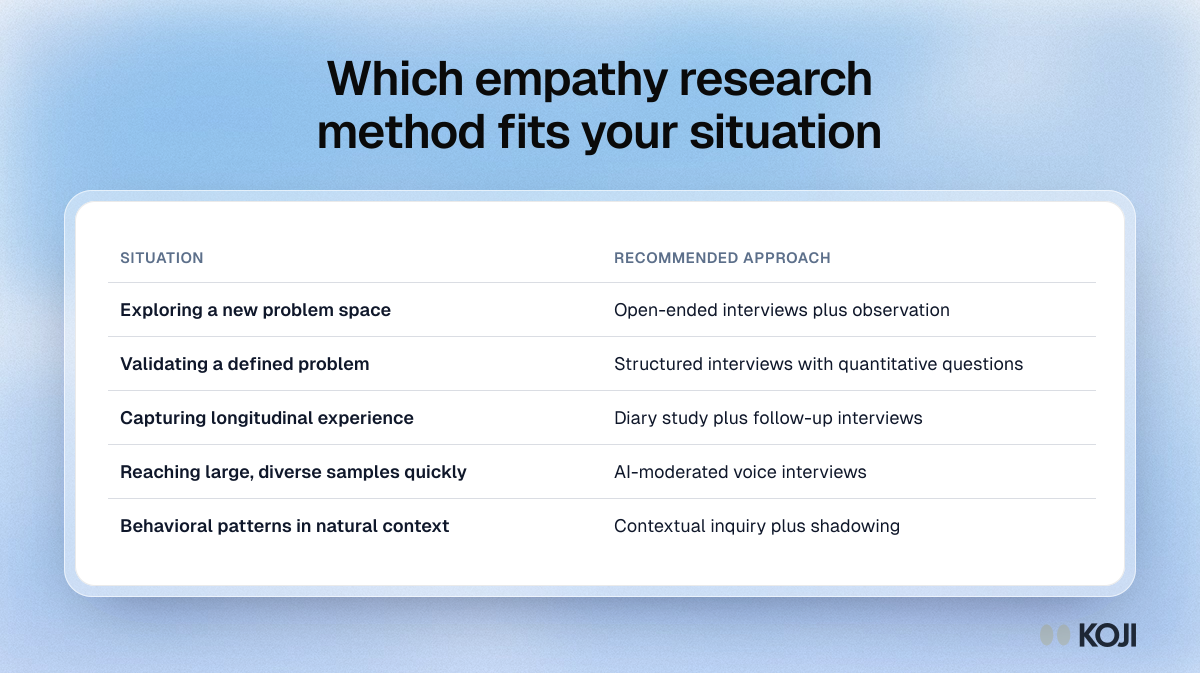
A table for the Empathize phase of design thinking that matches five research situations to a method: open-ended interviews and observation for a new problem space, structured interviews for a defined problem, diary studies for experience over time, AI-moderated voice interviews for large samples, and contextual inquiry with shadowing for behavior in context. Use it when you plan an empathy study.
Where this appears
What's in this reference table
| Situation | Recommended approach |
|---|---|
| Exploring a new problem space | Open-ended interviews plus observation |
| Validating a defined problem | Structured interviews with quantitative questions |
| Capturing longitudinal experience | Diary study plus follow-up interviews |
| Reaching large, diverse samples quickly | AI-moderated voice interviews |
| Behavioral patterns in natural context | Contextual inquiry plus shadowing |
Use this image
Free to use in your docs, decks and posts under CC BY 4.0, as long as you credit Koji with a link to this page. To embed it, paste this into your page:
html
<a href="https://www.koji.so/visuals/empathy-research-methods-by-situation"><img src="https://www.koji.so/visuals/empathy-research-methods-by-situation/empathy-research-methods-by-situation.png" alt="Table matching five empathy research situations to methods, from open-ended interviews and observation to diary studies, AI voice interviews and shadowing." width="1200" height="673" /></a>
<p>Source: <a href="https://www.koji.so/visuals/empathy-research-methods-by-situation">Which empathy research method fits your situation</a>, Koji</p>