Framework
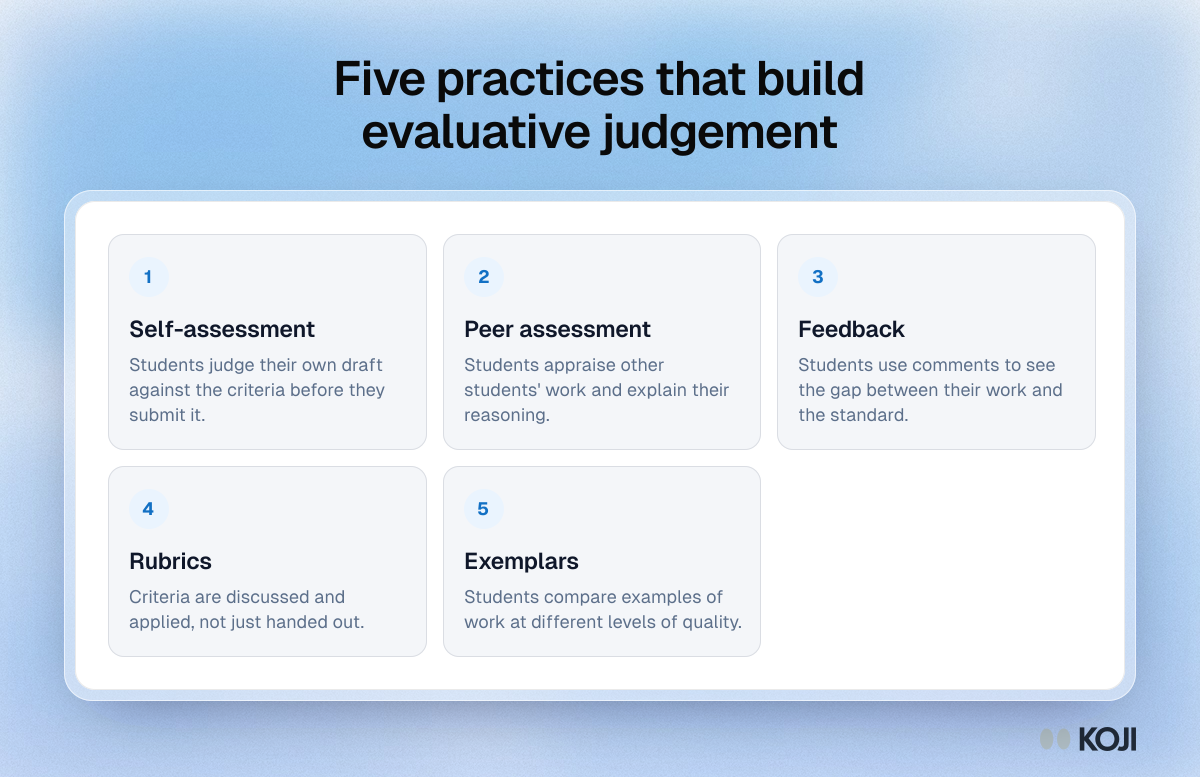
Five practices that build evaluative judgement
How students learn to judge the quality of their own and others' work
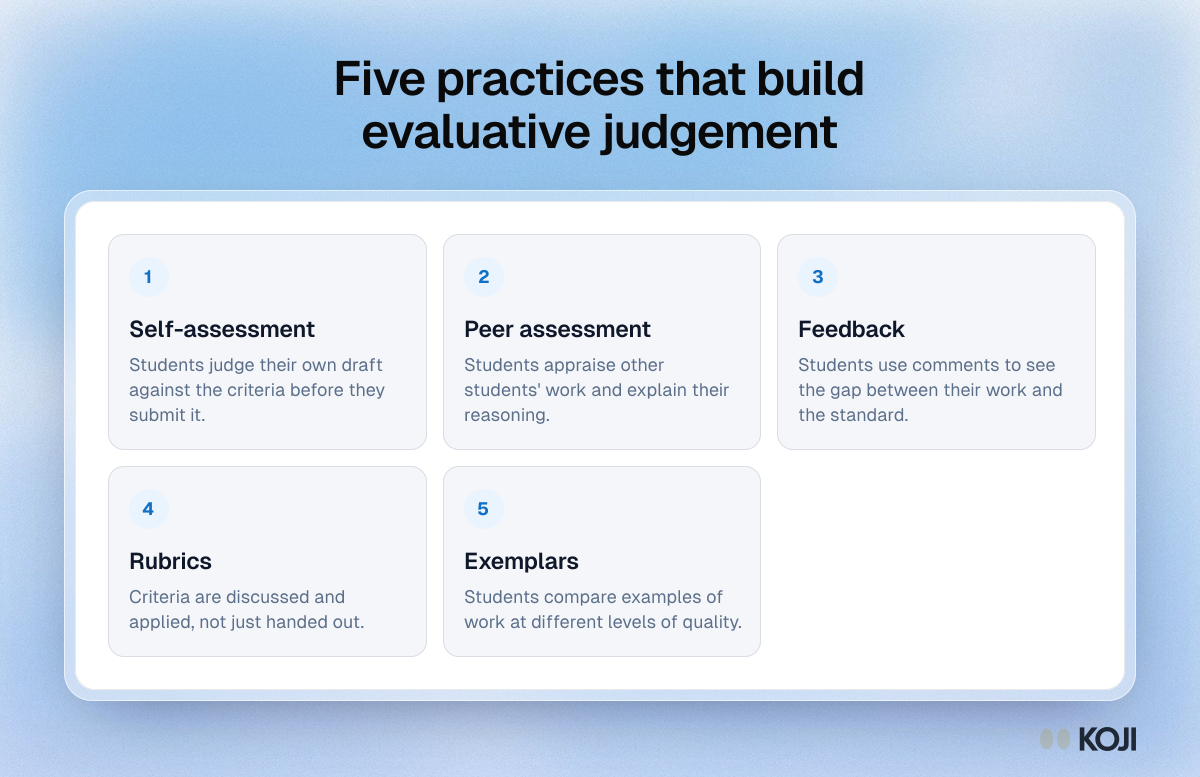
The five practices Tai, Ajjawi, Boud, Dawson and Panadero (2018) name as ways to develop students' evaluative judgement, the ability to decide on the quality of one's own and others' work. Programme teams can use it to check whether a course gives students these chances, and to add evaluation items that ask about them. Koji course evaluations can ask whether students saw exemplars or assessed peers, and follow up on why.
What's in this framework
- Self-assessment: Students judge their own draft against the criteria before they submit it.
- Peer assessment: Students appraise other students' work and explain their reasoning.
- Feedback: Students use comments to see the gap between their work and the standard.
- Rubrics: Criteria are discussed and applied, not just handed out.
- Exemplars: Students compare examples of work at different levels of quality.
Use this image
Free to use in your docs, decks and posts under CC BY 4.0, as long as you credit Koji with a link to this page. To embed it, paste this into your page:
html
<a href="https://www.koji.so/visuals/evaluative-judgement-five-practices-framework"><img src="https://www.koji.so/visuals/evaluative-judgement-five-practices-framework/evaluative-judgement-five-practices-framework.png" alt="Framework of five practices that develop students' evaluative judgement: self-assessment, peer assessment, feedback, rubrics and exemplars." width="1200" height="777" /></a>
<p>Source: <a href="https://www.koji.so/visuals/evaluative-judgement-five-practices-framework">Five practices that build evaluative judgement</a>, Koji</p>