Guide
Five interview analysis mistakes
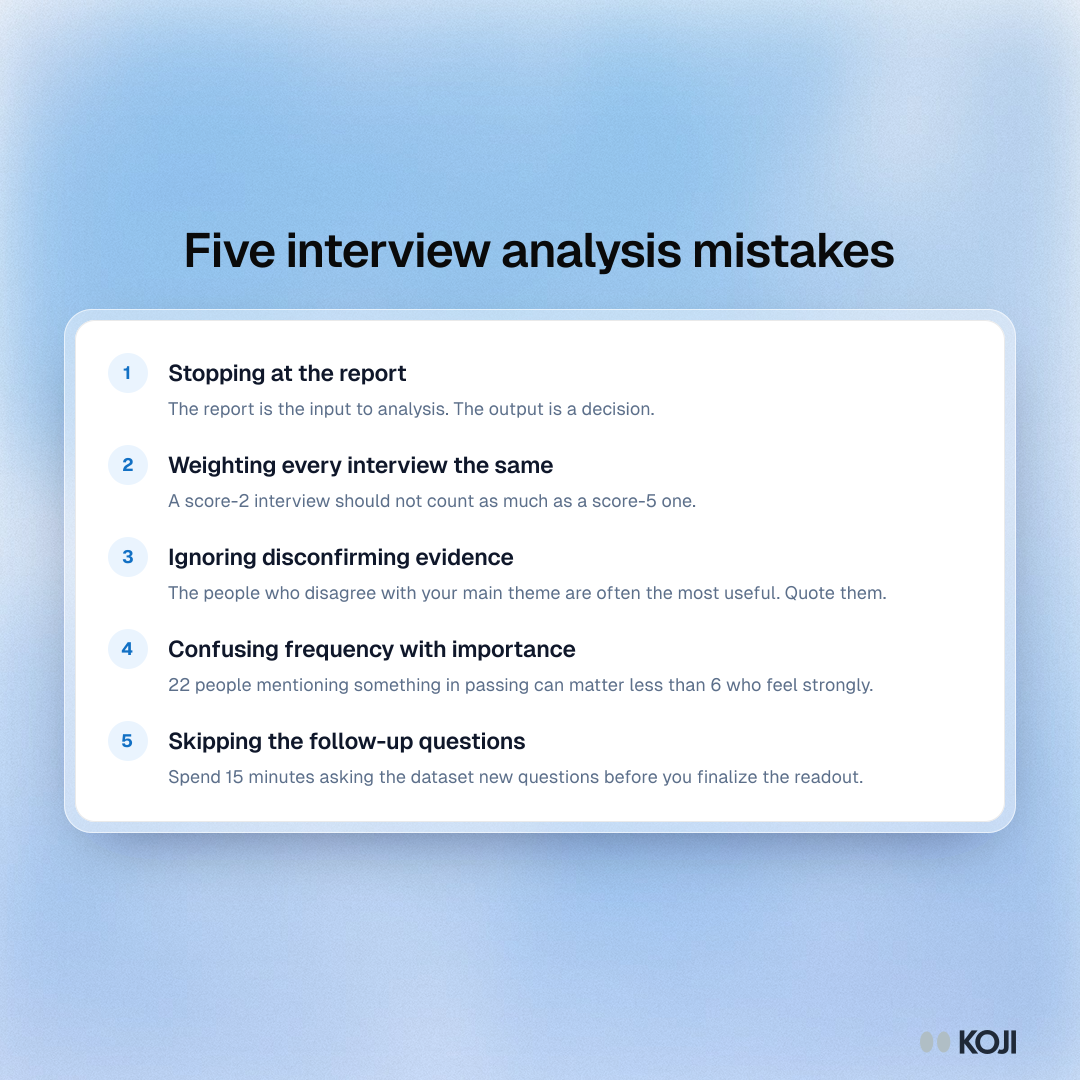
Five mistakes that weaken the analysis of customer and user interviews: treating the report as the end, giving low-quality interviews the same weight as rich ones, ignoring the people who disagree, mixing up how often something was said with how much it matters and never asking the data a second round of questions. Use it as a last check before you share findings with stakeholders.
Where this appears
What's in this guide
- Stopping at the report: The report is the input to analysis. The output is a decision.
- Weighting every interview the same: A score-2 interview should not count as much as a score-5 one.
- Ignoring disconfirming evidence: The people who disagree with your main theme are often the most useful. Quote them.
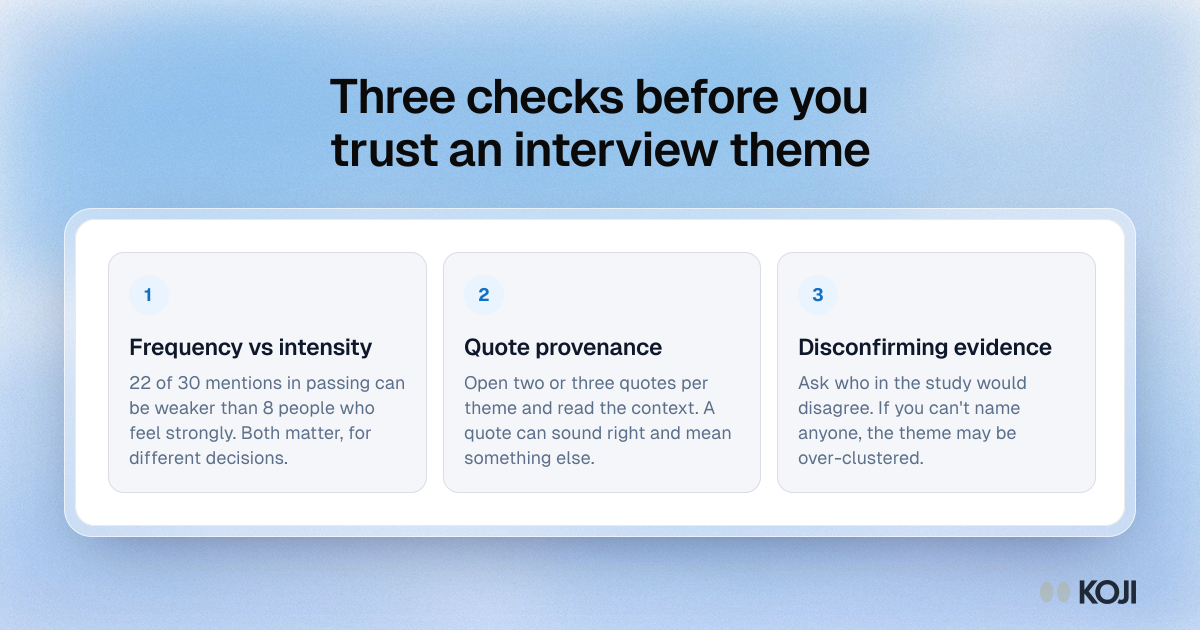
- Confusing frequency with importance: 22 people mentioning something in passing can matter less than 6 who feel strongly.
- Skipping the follow-up questions: Spend 15 minutes asking the dataset new questions before you finalize the readout.
Use this image
Free to use in your docs, decks and posts under CC BY 4.0, as long as you credit Koji with a link to this page. To embed it, paste this into your page:
html
<a href="https://www.koji.so/visuals/five-interview-analysis-mistakes"><img src="https://www.koji.so/visuals/five-interview-analysis-mistakes/five-interview-analysis-mistakes.png" alt="List of five interview analysis mistakes, from stopping at the report to skipping follow-up questions of the dataset." width="1080" height="1080" /></a>
<p>Source: <a href="https://www.koji.so/visuals/five-interview-analysis-mistakes">Five interview analysis mistakes</a>, Koji</p>