Framework
Four futility rules for customer research
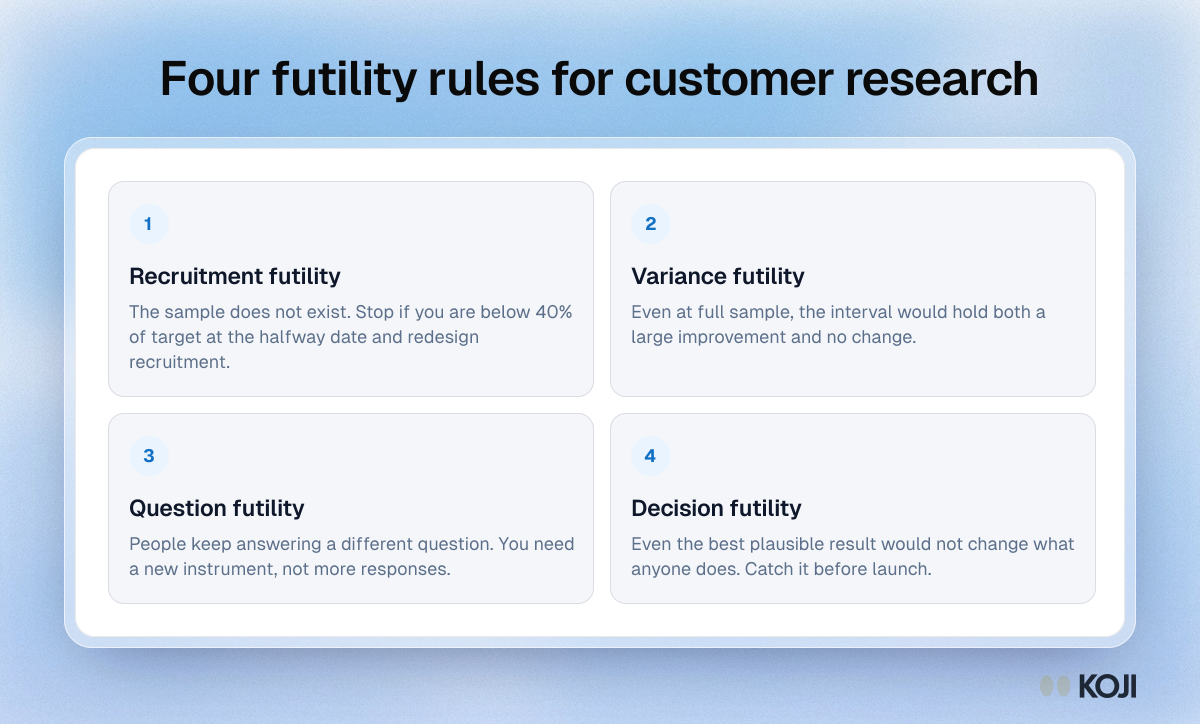
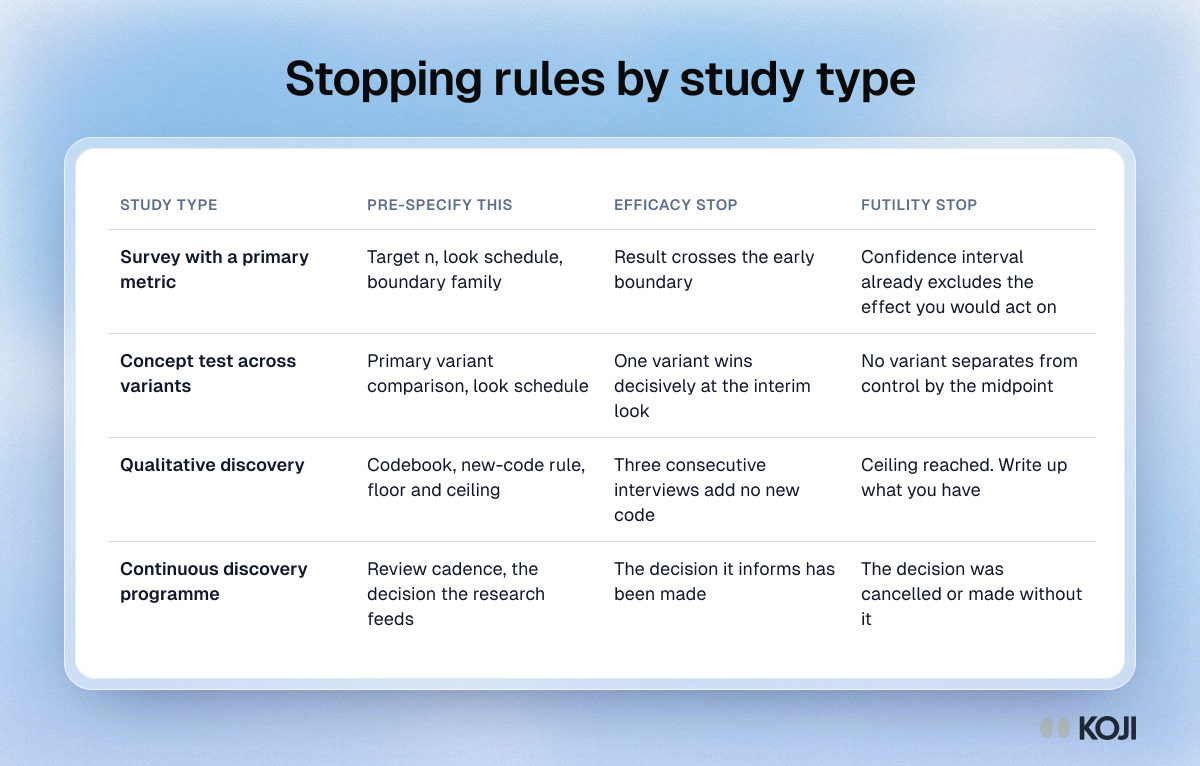
Four structural futility rules that tell you when a running customer research study will not produce a usable answer, without computing conditional power. They cover a sample that does not exist, an outcome too noisy to settle, respondents who answer a different question, and a result nobody would act on. Write the triggers into the study brief before fielding, and check them at the halfway point of a Koji study.
Where this appears
What's in this framework
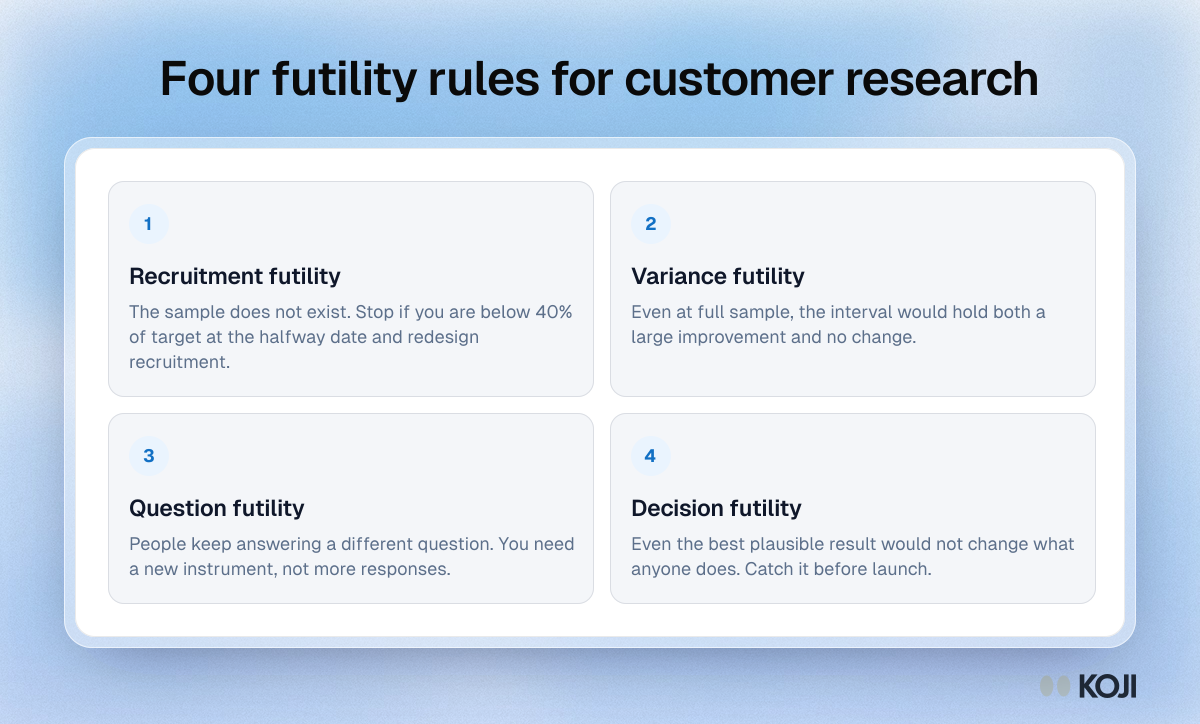
- Recruitment futility: The sample does not exist. Stop if you are below 40% of target at the halfway date and redesign recruitment.
- Variance futility: Even at full sample, the interval would hold both a large improvement and no change.
- Question futility: People keep answering a different question. You need a new instrument, not more responses.
- Decision futility: Even the best plausible result would not change what anyone does. Catch it before launch.
Use this image
Free to use in your docs, decks and posts under CC BY 4.0, as long as you credit Koji with a link to this page. To embed it, paste this into your page:
html
<a href="https://www.koji.so/visuals/four-futility-rules-customer-research"><img src="https://www.koji.so/visuals/four-futility-rules-customer-research/four-futility-rules-customer-research.png" alt="Framework of four futility rules for customer research: recruitment futility, variance futility, question futility and decision futility." width="1200" height="724" /></a>
<p>Source: <a href="https://www.koji.so/visuals/four-futility-rules-customer-research">Four futility rules for customer research</a>, Koji</p>