Framework
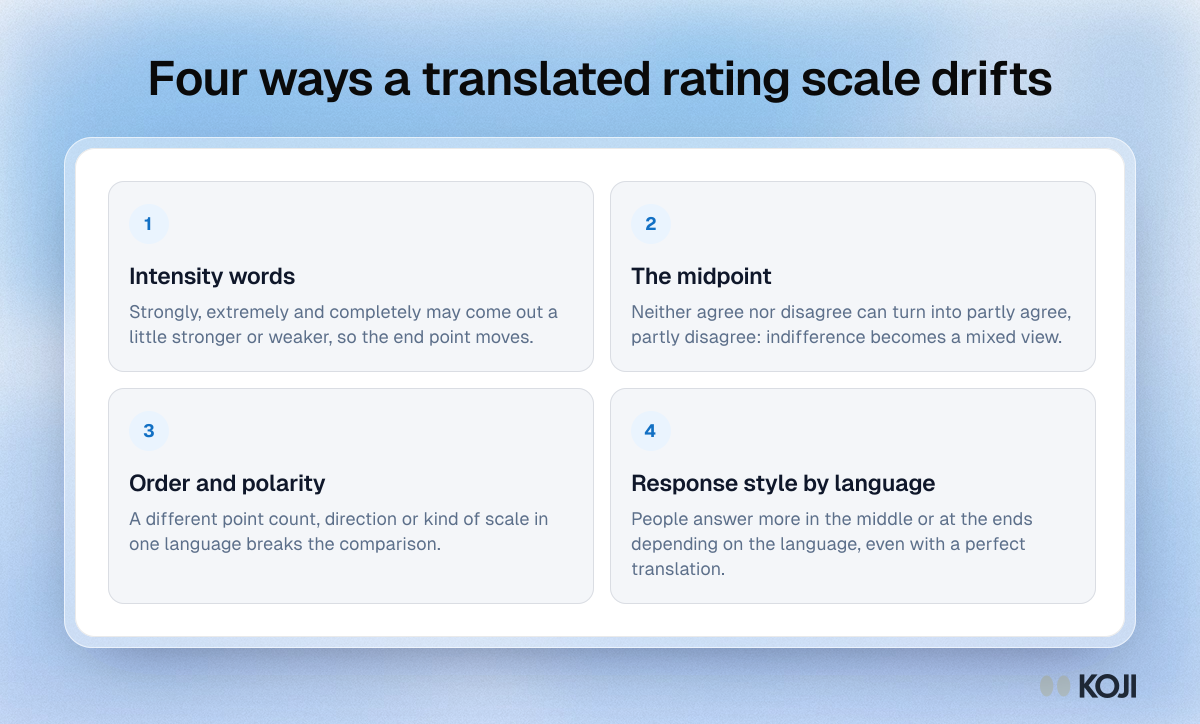
Four ways a translated rating scale drifts
Why a scale can stop being comparable across languages even when every word is correct
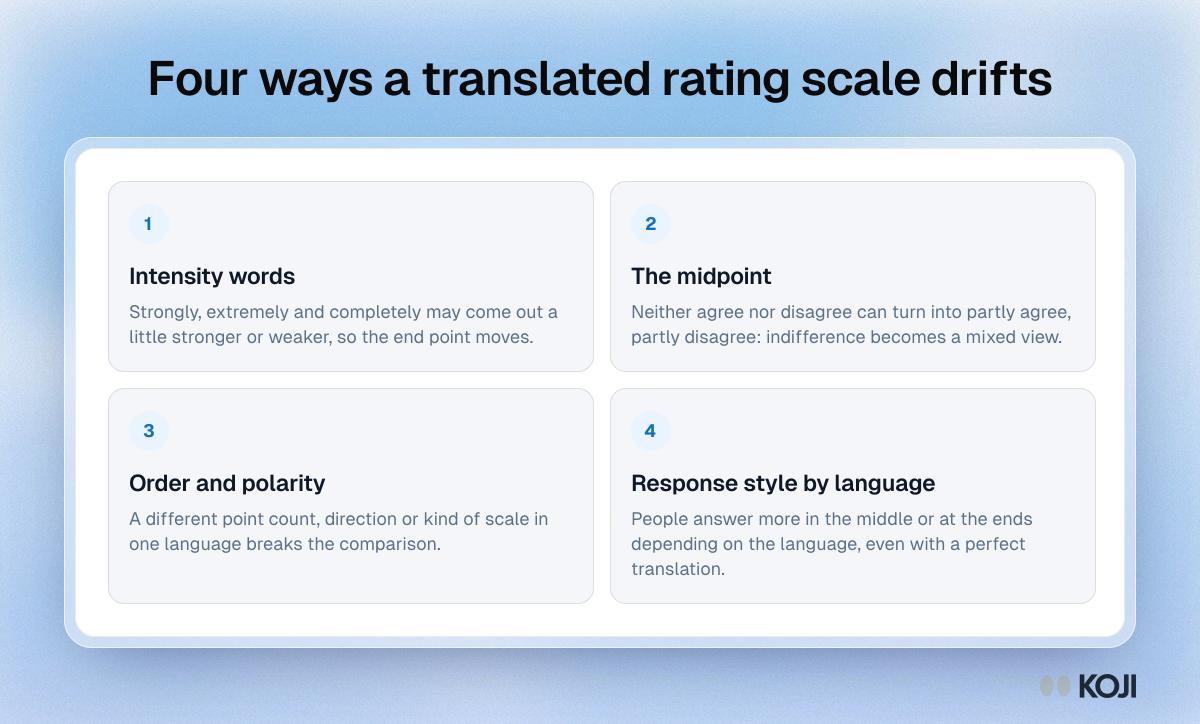
A framework for researchers and product teams who run the same rating question in several languages. It names four ways a translated scale stops being comparable: intensity words that shift the end points, a midpoint that changes meaning, a changed order or point count, and language-driven response styles such as more middle or extreme answers. It draws on European Social Survey translation guidance and cross-national response style research. Koji stores every answer against the original option so the data stays comparable.
Where this appears
What's in this framework
- Intensity words: Strongly, extremely and completely may come out a little stronger or weaker, so the end point moves.
- The midpoint: Neither agree nor disagree can turn into partly agree, partly disagree: indifference becomes a mixed view.
- Order and polarity: A different point count, direction or kind of scale in one language breaks the comparison.
- Response style by language: People answer more in the middle or at the ends depending on the language, even with a perfect translation.
Use this image
Free to use in your docs, decks and posts under CC BY 4.0, as long as you credit Koji with a link to this page. To embed it, paste this into your page:
<a href="https://www.koji.so/visuals/four-ways-a-translated-rating-scale-drifts"><img src="https://www.koji.so/visuals/four-ways-a-translated-rating-scale-drifts/four-ways-a-translated-rating-scale-drifts.png" alt="Framework of four ways a translated rating scale drifts: intensity words, the midpoint, order and polarity, and response style by language." width="1200" height="724" /></a>
<p>Source: <a href="https://www.koji.so/visuals/four-ways-a-translated-rating-scale-drifts">Four ways a translated rating scale drifts</a>, Koji</p>