Framework
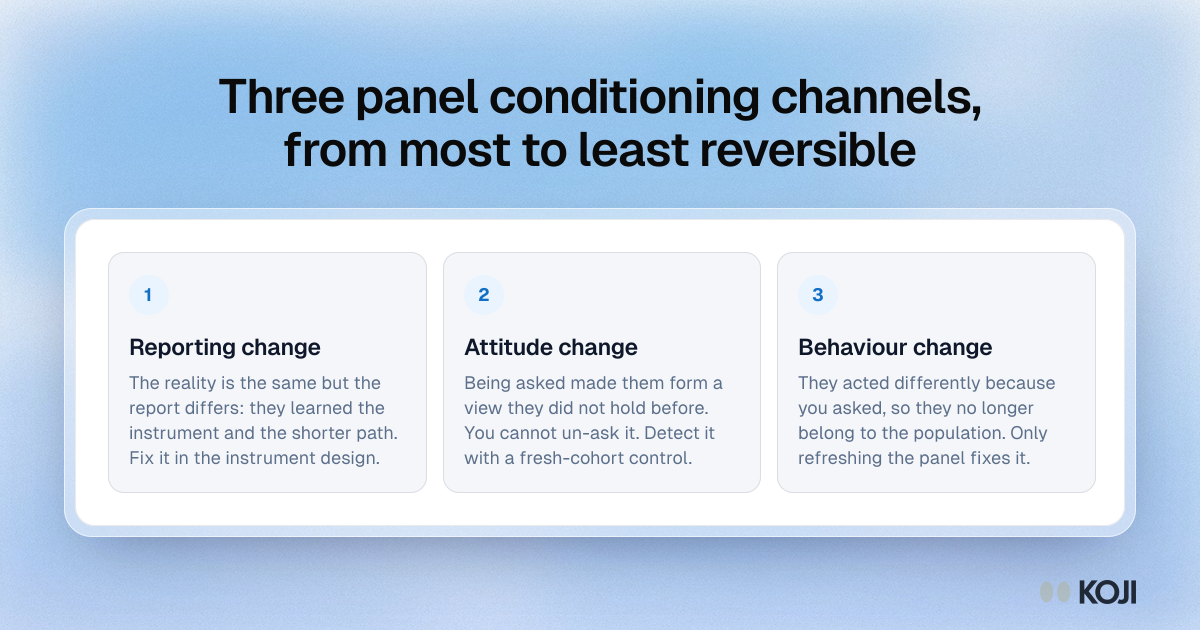
Three panel conditioning channels, from most to least reversible
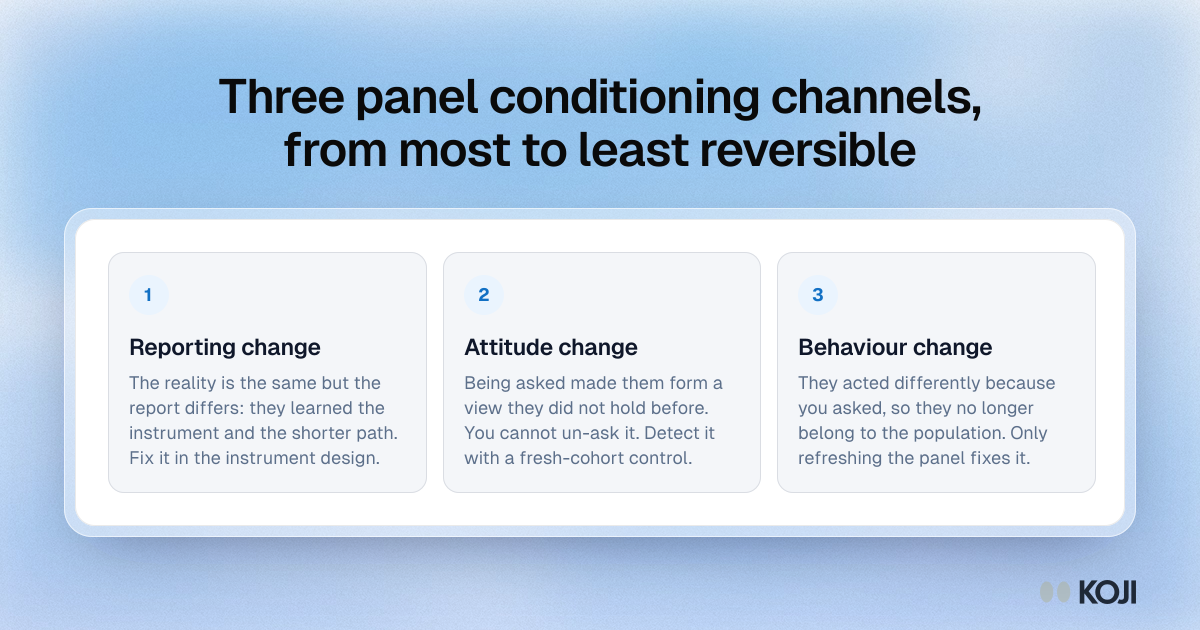
The three ways repeat participation changes research data, ranked by how recoverable they are. Reporting change can be designed out of the instrument, attitude change can only be detected with a fresh cohort, and behaviour change means the participant has left the population you sample. Use it to decide whether a tracker needs a new instrument, a control arm or panel rotation.
Where this appears
What's in this framework
- Reporting change: The reality is the same but the report differs: they learned the instrument and the shorter path. Fix it in the instrument design.
- Attitude change: Being asked made them form a view they did not hold before. You cannot un-ask it. Detect it with a fresh-cohort control.
- Behaviour change: They acted differently because you asked, so they no longer belong to the population. Only refreshing the panel fixes it.
Use this image
Free to use in your docs, decks and posts under CC BY 4.0, as long as you credit Koji with a link to this page. To embed it, paste this into your page:
html
<a href="https://www.koji.so/visuals/panel-conditioning-three-channels-framework"><img src="https://www.koji.so/visuals/panel-conditioning-three-channels-framework/panel-conditioning-three-channels-framework.png" alt="Framework of three panel conditioning channels: reporting change, attitude change and behaviour change, ranked by how far each can be undone." width="1200" height="630" /></a>
<p>Source: <a href="https://www.koji.so/visuals/panel-conditioning-three-channels-framework">Three panel conditioning channels, from most to least reversible</a>, Koji</p>