Reference table
The four-bucket golden set for AI evaluation
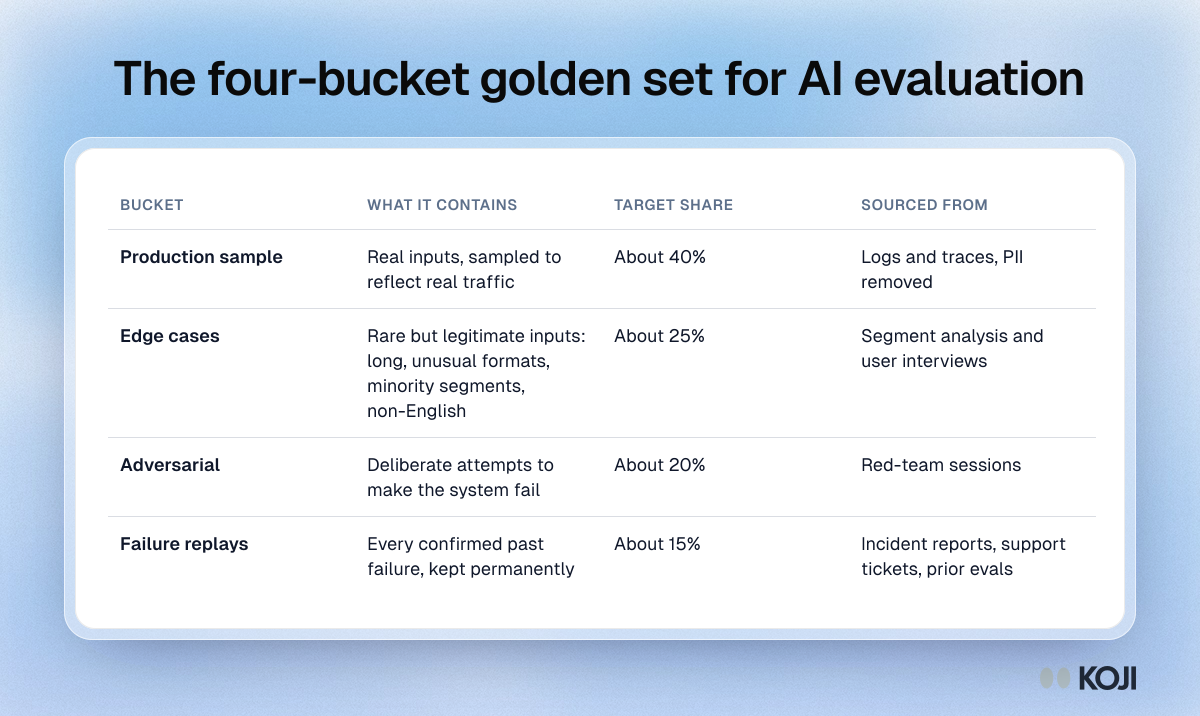
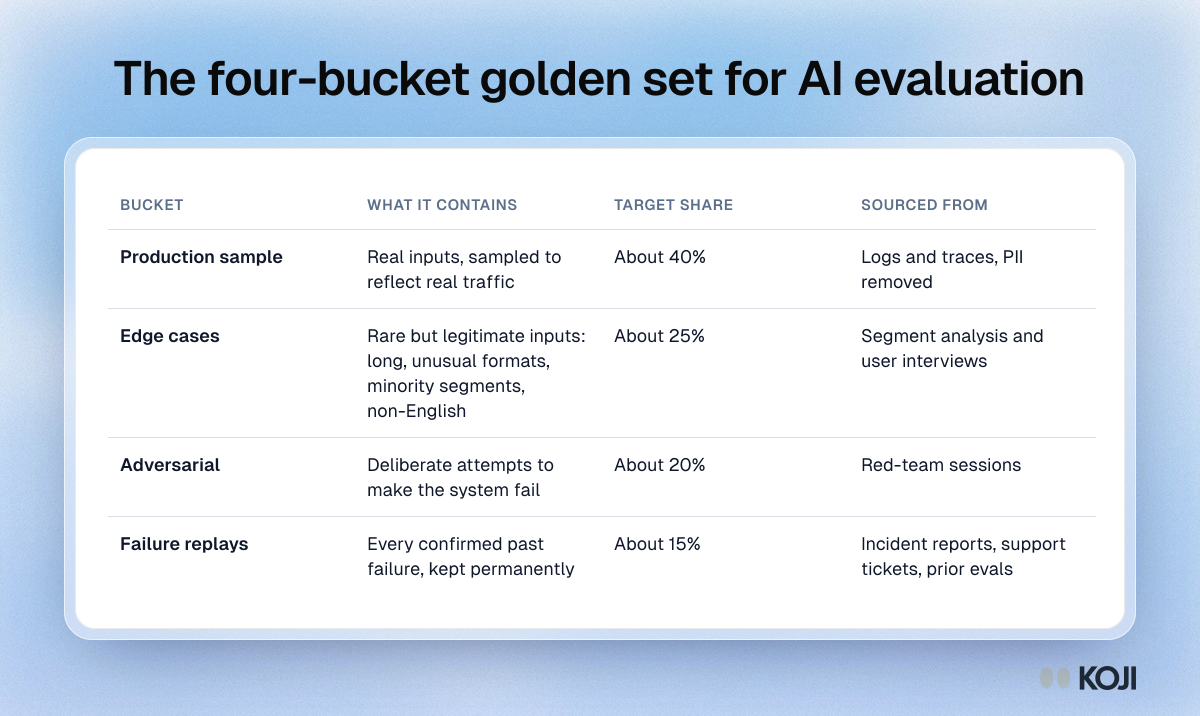
A structure for an AI evaluation golden set built from four buckets, each with what it holds, its rough target share and where its items come from: a production sample of about 40%, edge cases of about 25%, adversarial cases of about 20% and permanent failure replays of about 15%. Use it when building or auditing an eval set so the average case and the tail are both covered. Koji helps source edge cases and acceptance criteria from real user interviews.
Where this appears
What's in this reference table
| Bucket | What it contains | Target share | Sourced from |
|---|---|---|---|
| Production sample | Real inputs, sampled to reflect real traffic | About 40% | Logs and traces, PII removed |
| Edge cases | Rare but legitimate inputs: long, unusual formats, minority segments, non-English | About 25% | Segment analysis and user interviews |
| Adversarial | Deliberate attempts to make the system fail | About 20% | Red-team sessions |
| Failure replays | Every confirmed past failure, kept permanently | About 15% | Incident reports, support tickets, prior evals |
Use this image
Free to use in your docs, decks and posts under CC BY 4.0, as long as you credit Koji with a link to this page. To embed it, paste this into your page:
html
<a href="https://www.koji.so/visuals/golden-set-four-bucket-structure-table"><img src="https://www.koji.so/visuals/golden-set-four-bucket-structure-table/golden-set-four-bucket-structure-table.png" alt="Table of the four buckets in an AI evaluation golden set: production sample, edge cases, adversarial and failure replays, with target shares and sources." width="1200" height="716" /></a>
<p>Source: <a href="https://www.koji.so/visuals/golden-set-four-bucket-structure-table">The four-bucket golden set for AI evaluation</a>, Koji</p>