Reference table
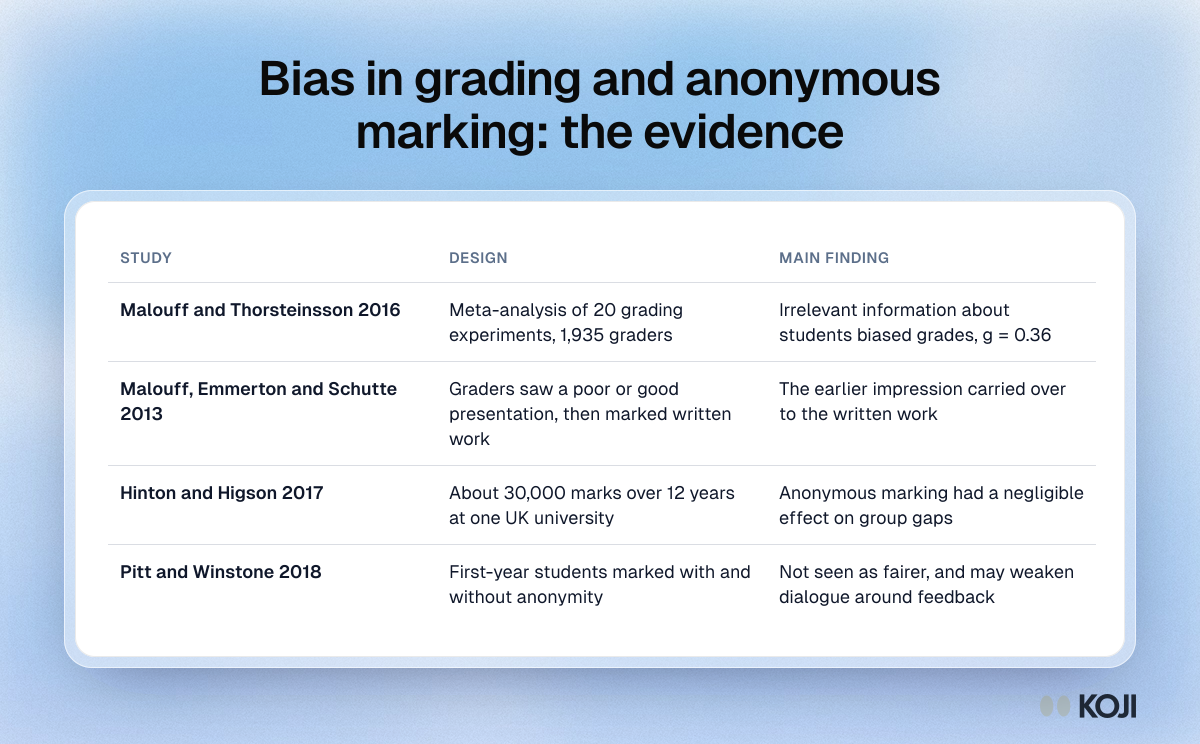
Bias in grading and anonymous marking: the evidence
Four studies, from controlled experiments to a twelve-year field record
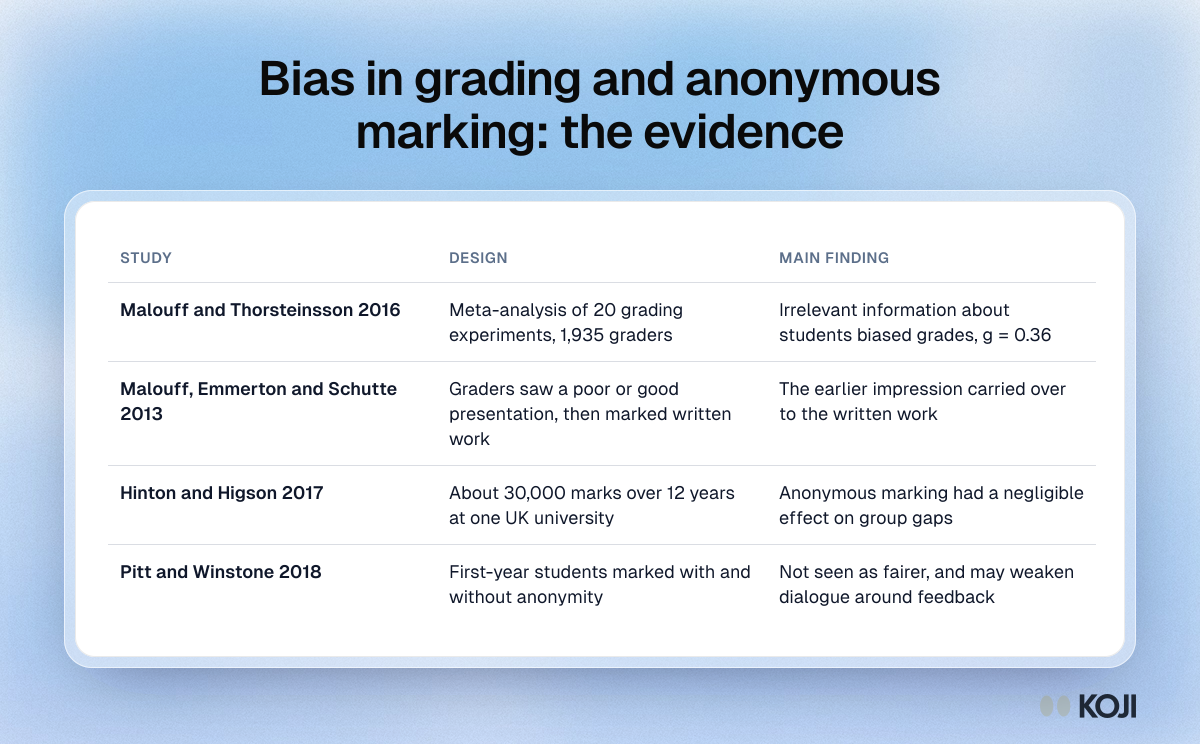
A summary of four peer-reviewed studies on bias in grading. Experiments show that graders who know irrelevant information about a student, or have seen their earlier work, can mark identical work differently. A twelve-year UK field study found anonymous marking did little to reduce group gaps, and students did not rate it as fairer. Useful for assessment policy reviews and for writing course evaluation questions on marking fairness.
What's in this reference table
| Study | Design | Main finding |
|---|---|---|
| Malouff and Thorsteinsson 2016 | Meta-analysis of 20 grading experiments, 1,935 graders | Irrelevant information about students biased grades, g = 0.36 |
| Malouff, Emmerton and Schutte 2013 | Graders saw a poor or good presentation, then marked written work | The earlier impression carried over to the written work |
| Hinton and Higson 2017 | About 30,000 marks over 12 years at one UK university | Anonymous marking had a negligible effect on group gaps |
| Pitt and Winstone 2018 | First-year students marked with and without anonymity | Not seen as fairer, and may weaken dialogue around feedback |
Use this image
Free to use in your docs, decks and posts under CC BY 4.0, as long as you credit Koji with a link to this page. To embed it, paste this into your page:
html
<a href="https://www.koji.so/visuals/grading-bias-anonymous-marking-evidence-table"><img src="https://www.koji.so/visuals/grading-bias-anonymous-marking-evidence-table/grading-bias-anonymous-marking-evidence-table.png" alt="Table of four studies on bias in grading and anonymous marking, with each study's design and main finding." width="1200" height="744" /></a>
<p>Source: <a href="https://www.koji.so/visuals/grading-bias-anonymous-marking-evidence-table">Bias in grading and anonymous marking: the evidence</a>, Koji</p>