Framework
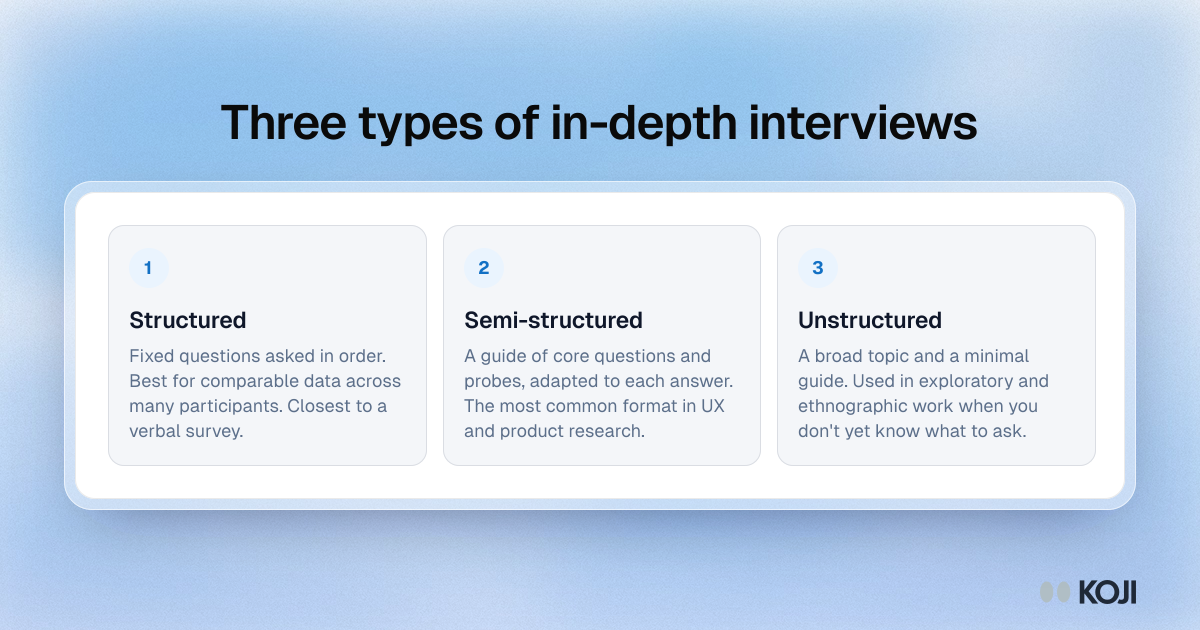
Three types of in-depth interviews
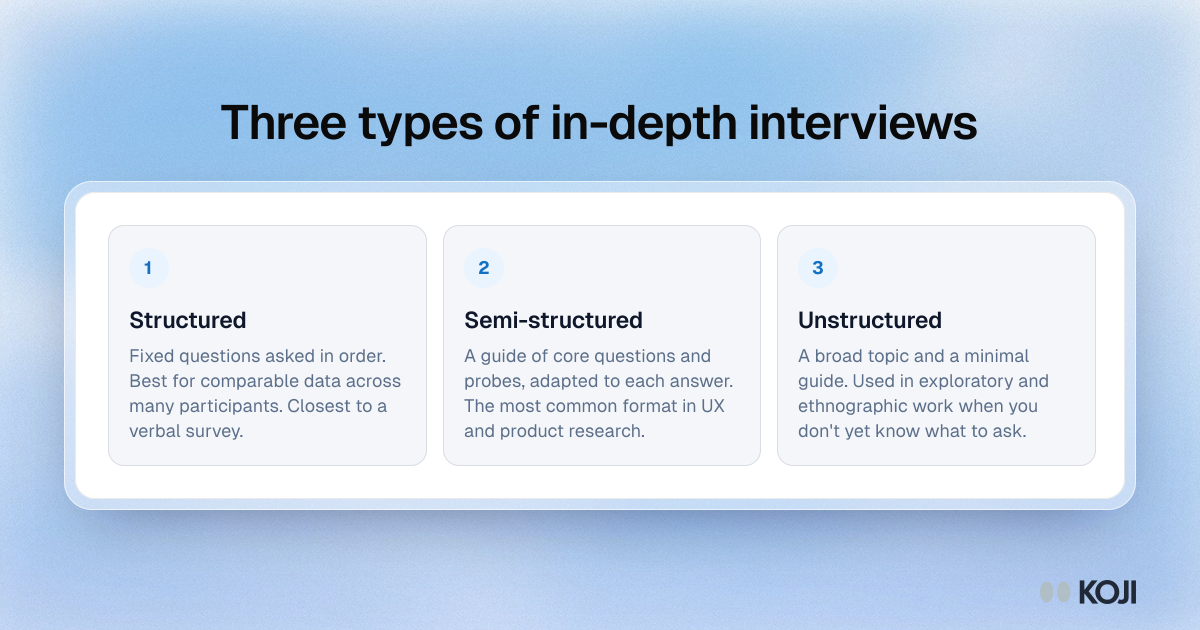
The three types of in-depth interview: structured, semi-structured and unstructured. Each is described by how fixed the questions are and what research it suits. Most product, UX and market researchers choose semi-structured interviews because they stay comparable across participants and still leave room for the unexpected. Use it to choose a format before you draft a discussion guide.
Where this appears
What's in this framework
- Structured: Fixed questions asked in order. Best for comparable data across many participants. Closest to a verbal survey.
- Semi-structured: A guide of core questions and probes, adapted to each answer. The most common format in UX and product research.
- Unstructured: A broad topic and a minimal guide. Used in exploratory and ethnographic work when you don't yet know what to ask.
Use this image
Free to use in your docs, decks and posts under CC BY 4.0, as long as you credit Koji with a link to this page. To embed it, paste this into your page:
html
<a href="https://www.koji.so/visuals/in-depth-interview-types-structured-semi-unstructured"><img src="https://www.koji.so/visuals/in-depth-interview-types-structured-semi-unstructured/in-depth-interview-types-structured-semi-unstructured.png" alt="Framework showing three types of in-depth interviews, structured, semi-structured and unstructured, and when to use each one." width="1200" height="630" /></a>
<p>Source: <a href="https://www.koji.so/visuals/in-depth-interview-types-structured-semi-unstructured">Three types of in-depth interviews</a>, Koji</p>