Framework
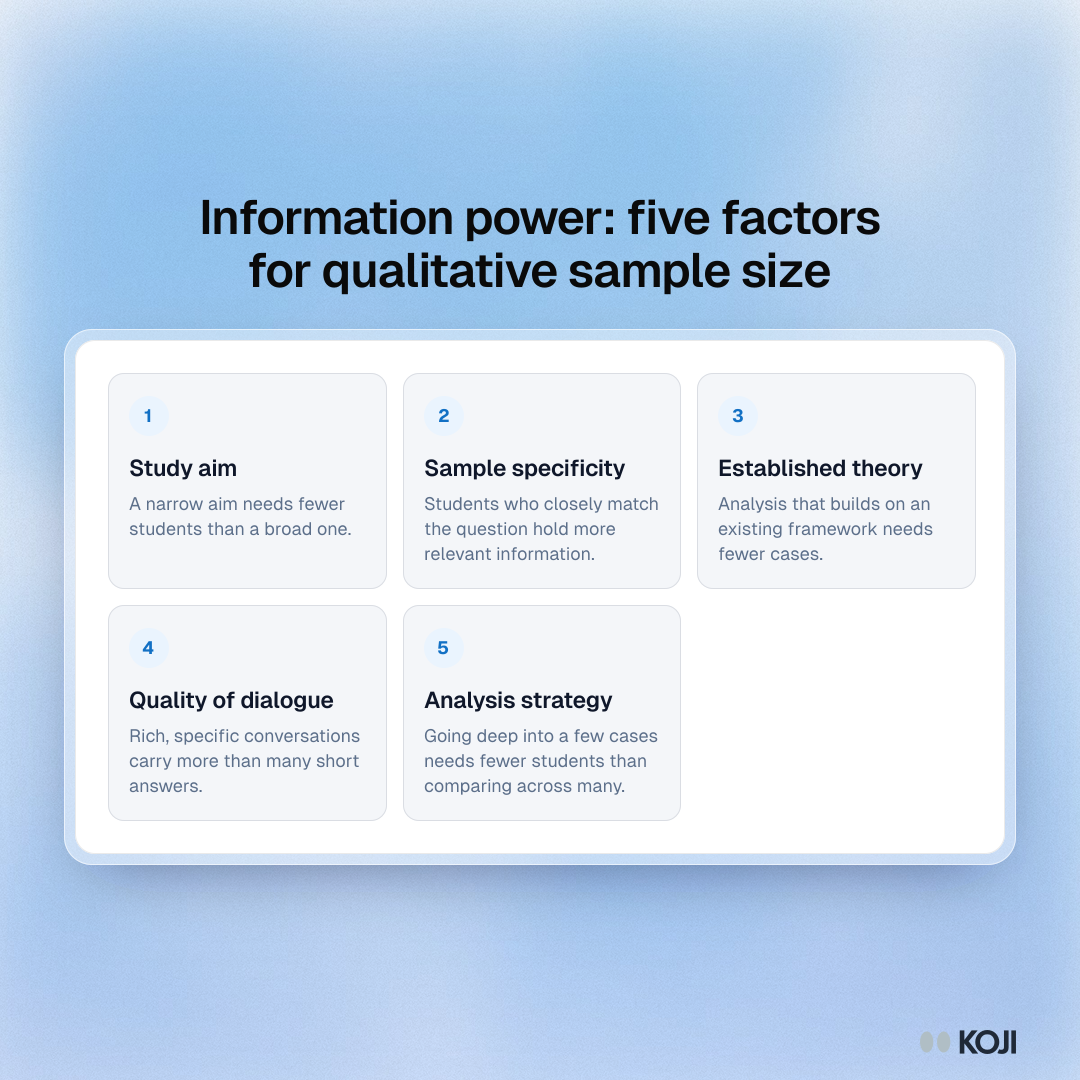
Information power: five factors for qualitative sample size
How to justify the number of student interviews before fieldwork starts
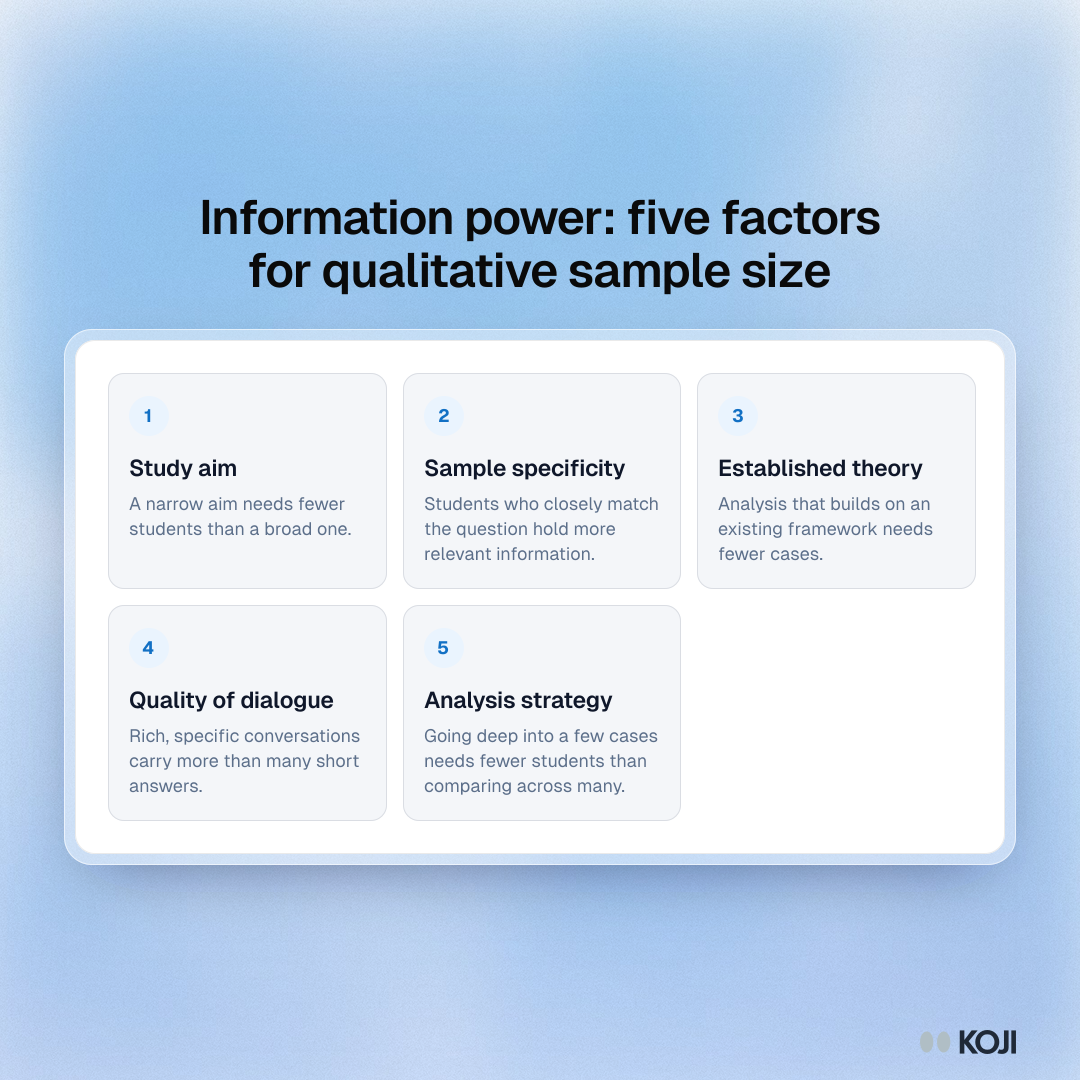
A framework for deciding how many interviews a qualitative study needs, based on the information power model. Each factor raises or lowers the number of participants required. Course evaluation and quality teams can use it to write a sample-size rationale for student interviews or focus groups before data collection. Koji's conversational interviews ask follow-up questions, which helps with the quality of dialogue.
What's in this framework
- Study aim: A narrow aim needs fewer students than a broad one.
- Sample specificity: Students who closely match the question hold more relevant information.
- Established theory: Analysis that builds on an existing framework needs fewer cases.
- Quality of dialogue: Rich, specific conversations carry more than many short answers.
- Analysis strategy: Going deep into a few cases needs fewer students than comparing across many.
Use this image
Free to use in your docs, decks and posts under CC BY 4.0, as long as you credit Koji with a link to this page. To embed it, paste this into your page:
html
<a href="https://www.koji.so/visuals/information-power-five-factors-framework"><img src="https://www.koji.so/visuals/information-power-five-factors-framework/information-power-five-factors-framework.png" alt="Framework of the five factors that set information power in interview studies: study aim, sample specificity, theory, dialogue quality and analysis." width="1080" height="1080" /></a>
<p>Source: <a href="https://www.koji.so/visuals/information-power-five-factors-framework">Information power: five factors for qualitative sample size</a>, Koji</p>