Guide
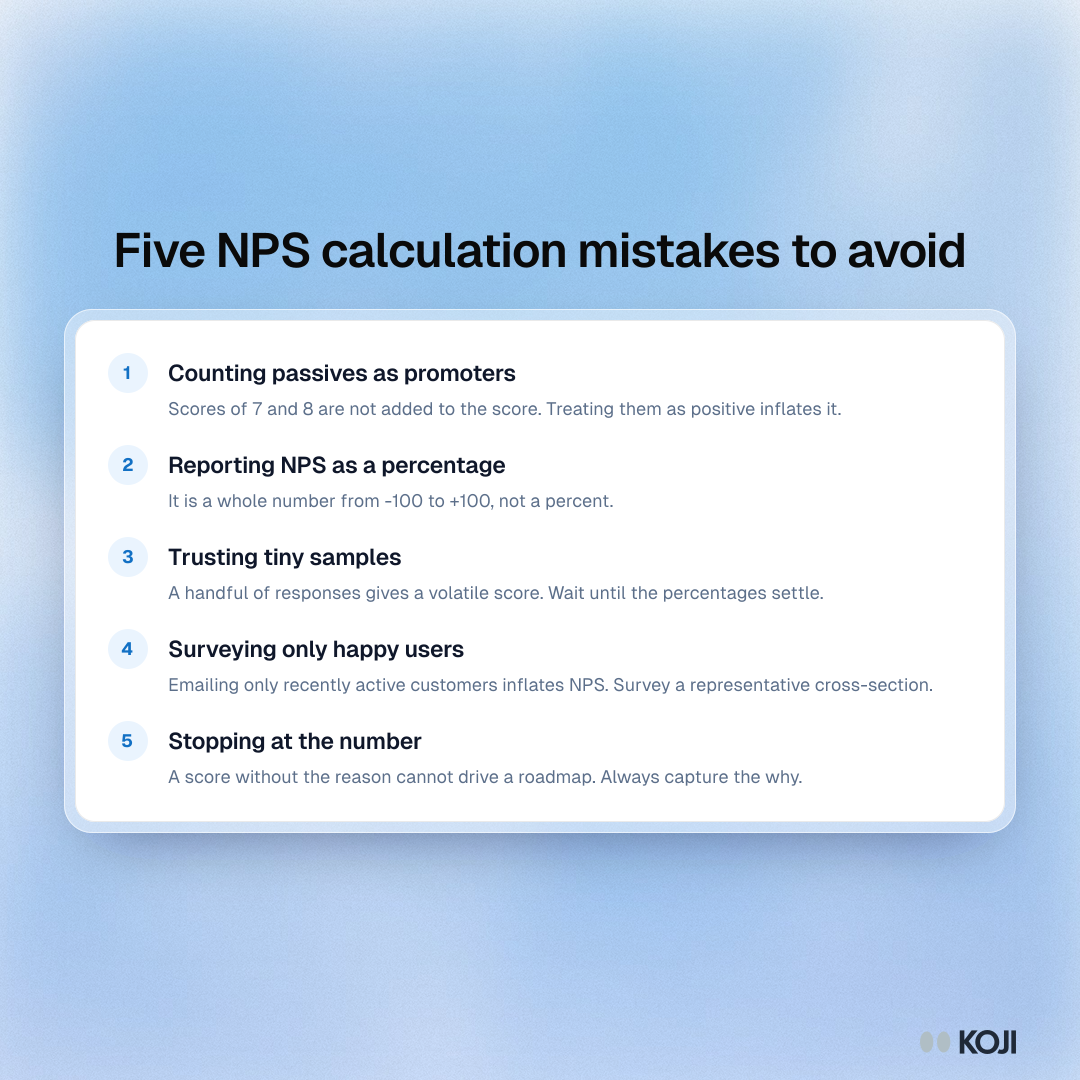
Five NPS calculation mistakes to avoid
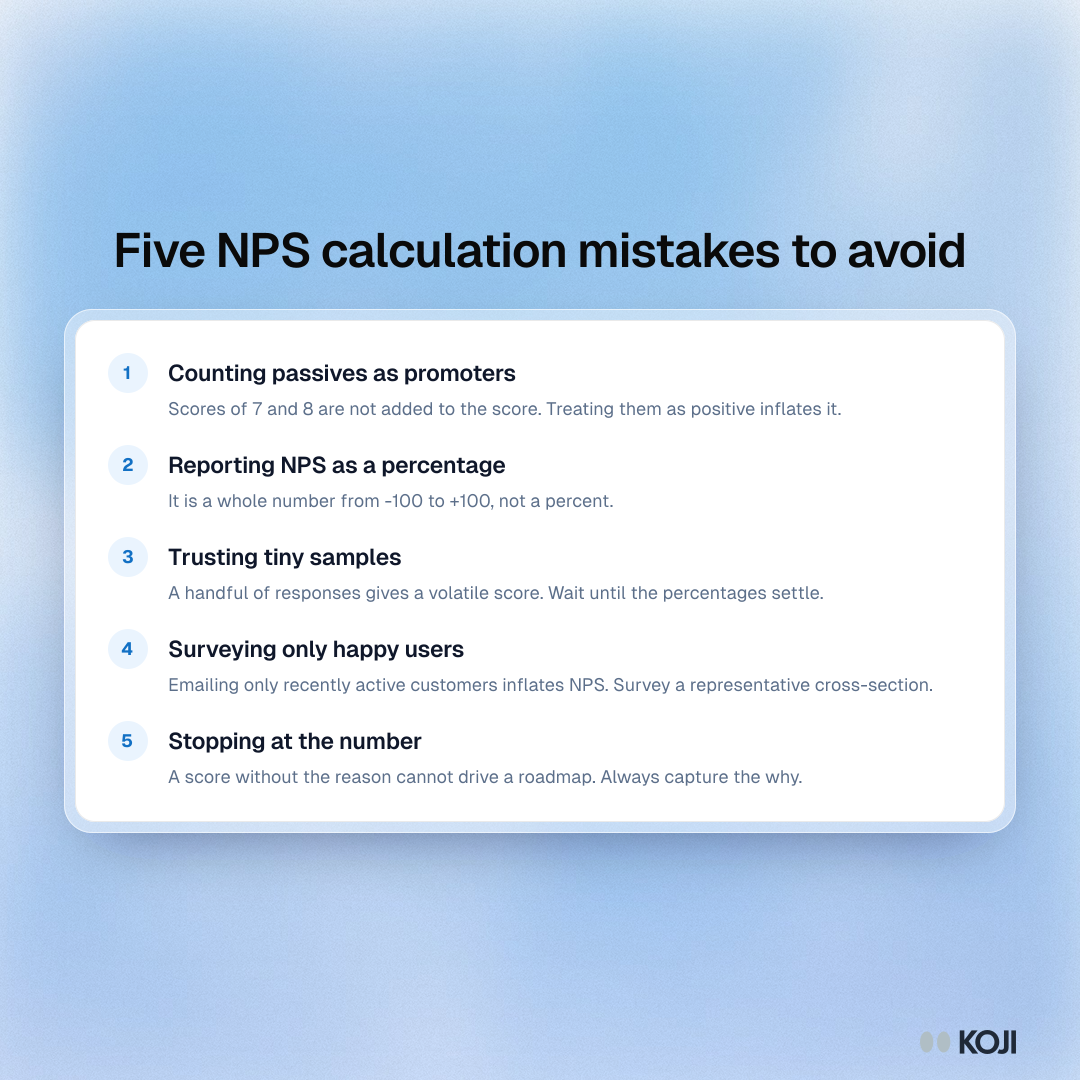
Five mistakes that make a Net Promoter Score wrong or misleading, from counting passives as promoters to reporting the score as a percentage and trusting a tiny sample. It is for product, CX and marketing teams who report NPS. Check your method against the list before you share a score. Koji asks the NPS question as a scale and follows up on the reason behind each answer.
Where this appears
What's in this guide
- Counting passives as promoters: Scores of 7 and 8 are not added to the score. Treating them as positive inflates it.
- Reporting NPS as a percentage: It is a whole number from -100 to +100, not a percent.
- Trusting tiny samples: A handful of responses gives a volatile score. Wait until the percentages settle.
- Surveying only happy users: Emailing only recently active customers inflates NPS. Survey a representative cross-section.
- Stopping at the number: A score without the reason cannot drive a roadmap. Always capture the why.
Use this image
Free to use in your docs, decks and posts under CC BY 4.0, as long as you credit Koji with a link to this page. To embed it, paste this into your page:
html
<a href="https://www.koji.so/visuals/nps-calculation-mistakes-to-avoid"><img src="https://www.koji.so/visuals/nps-calculation-mistakes-to-avoid/nps-calculation-mistakes-to-avoid.png" alt="List of five NPS calculation mistakes: counting passives as promoters, reporting a percentage, tiny samples, surveying only happy users, stopping at the score." width="1080" height="1080" /></a>
<p>Source: <a href="https://www.koji.so/visuals/nps-calculation-mistakes-to-avoid">Five NPS calculation mistakes to avoid</a>, Koji</p>