Reference table
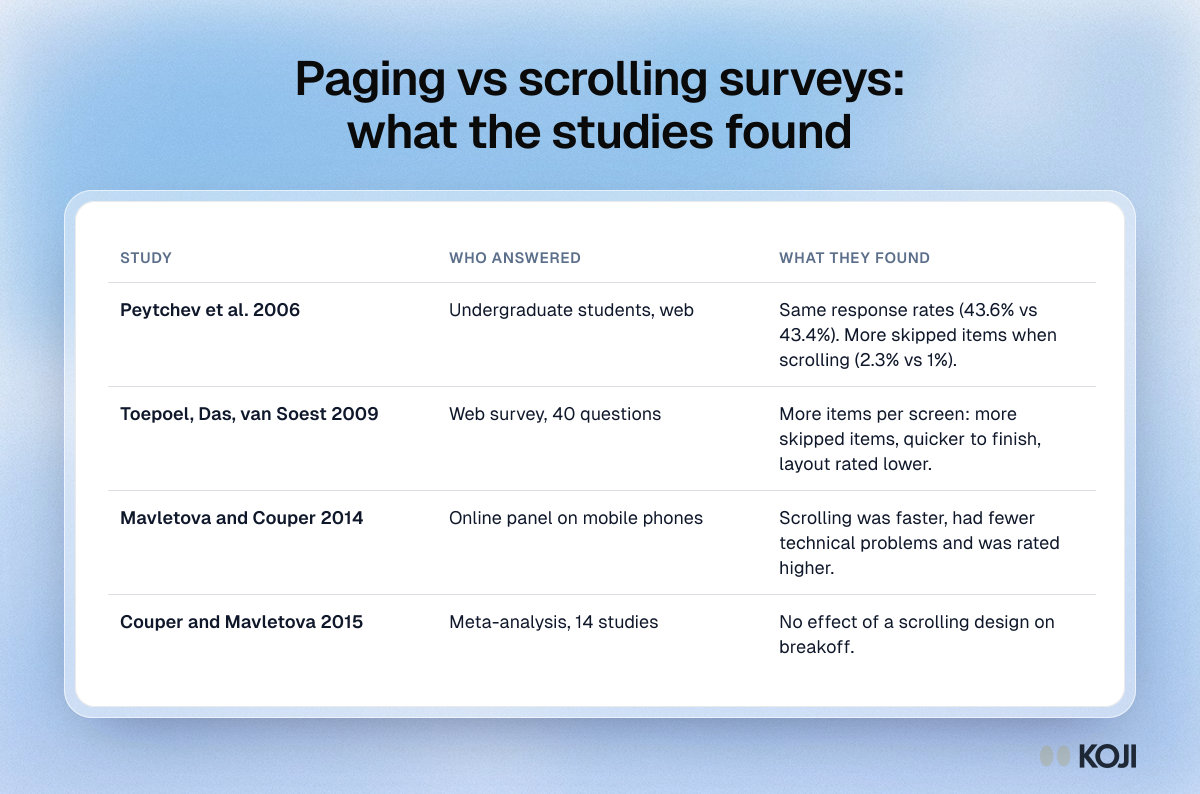
Paging vs scrolling surveys: what the studies found
Four studies on one question per page against one long scrolling page
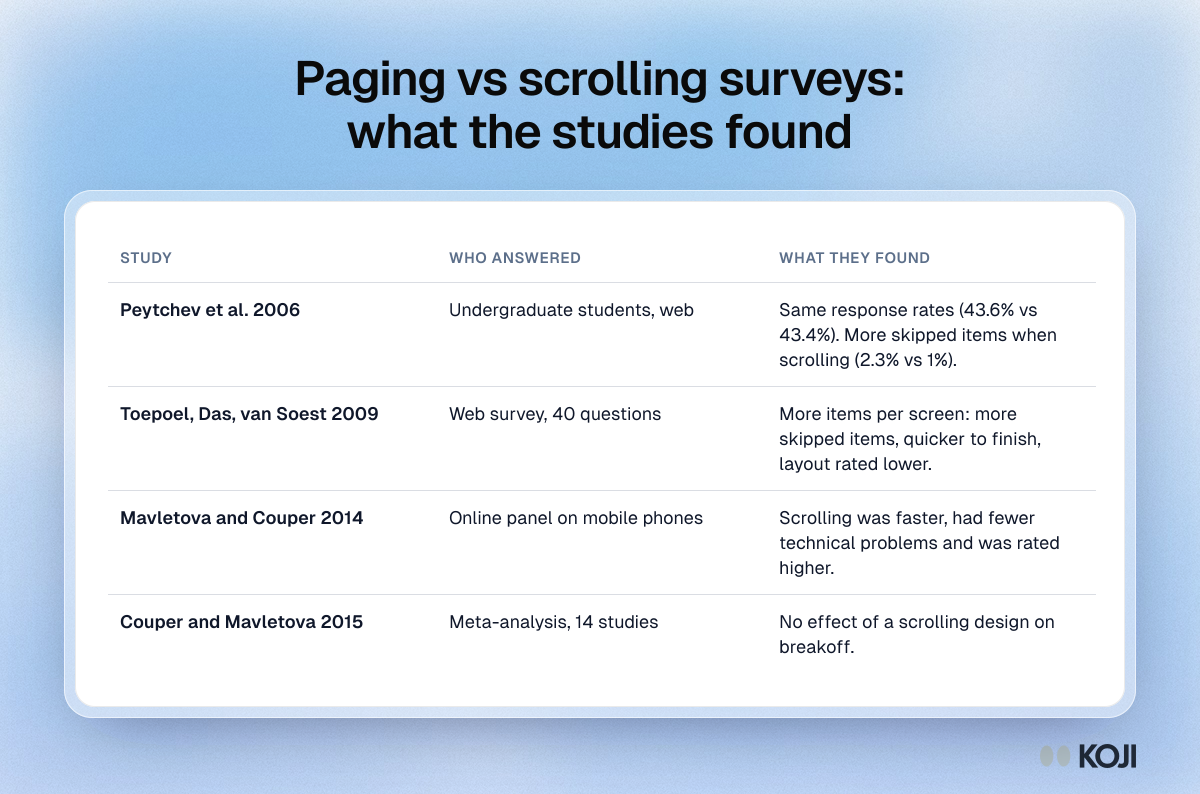
A summary of four studies that compared paging survey layouts, with a few questions per screen, against a single scrolling page. Response rates and breakoff hardly changed, but scrolling and crowded screens led to more skipped items, while scrolling was quicker on phones. Quality and institutional research teams can use it to pick a layout for a course evaluation and to explain the choice. Koji runs course evaluations one question per message, which works like a paging design.
What's in this reference table
| Study | Who answered | What they found |
|---|---|---|
| Peytchev et al. 2006 | Undergraduate students, web | Same response rates (43.6% vs 43.4%). More skipped items when scrolling (2.3% vs 1%). |
| Toepoel, Das, van Soest 2009 | Web survey, 40 questions | More items per screen: more skipped items, quicker to finish, layout rated lower. |
| Mavletova and Couper 2014 | Online panel on mobile phones | Scrolling was faster, had fewer technical problems and was rated higher. |
| Couper and Mavletova 2015 | Meta-analysis, 14 studies | No effect of a scrolling design on breakoff. |
Use this image
Free to use in your docs, decks and posts under CC BY 4.0, as long as you credit Koji with a link to this page. To embed it, paste this into your page:
html
<a href="https://www.koji.so/visuals/paging-vs-scrolling-survey-design-study-findings"><img src="https://www.koji.so/visuals/paging-vs-scrolling-survey-design-study-findings/paging-vs-scrolling-survey-design-study-findings.png" alt="Table comparing four studies of paging and scrolling survey layouts and what each found about response rates, skipped items, speed and breakoff." width="1200" height="794" /></a>
<p>Source: <a href="https://www.koji.so/visuals/paging-vs-scrolling-survey-design-study-findings">Paging vs scrolling surveys: what the studies found</a>, Koji</p>