Reference table
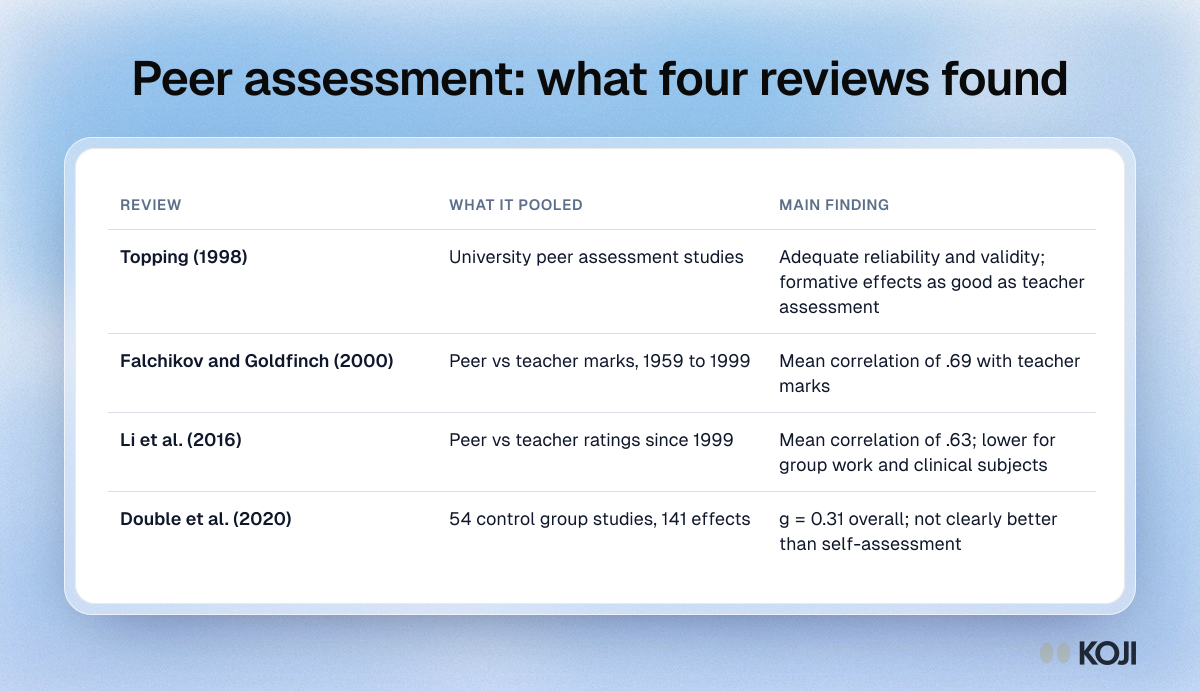
Peer assessment: what four reviews found
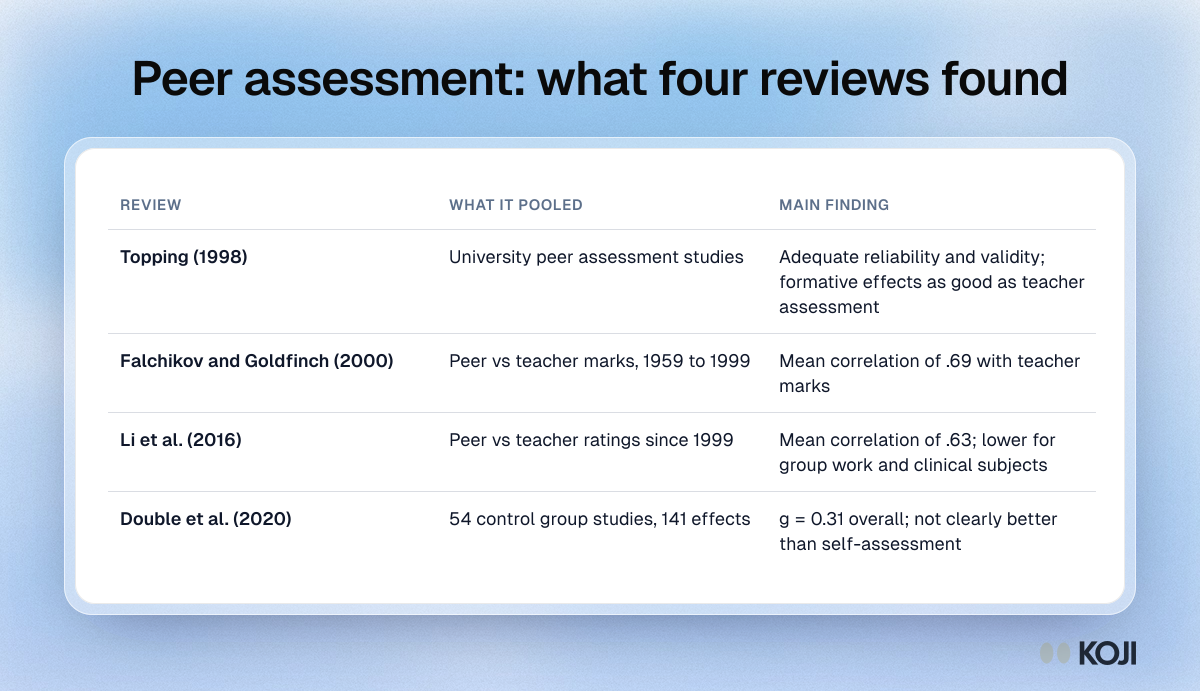
A summary table of four widely cited reviews of peer assessment in education, for programme directors, assessment leads and quality teams deciding how to use and evaluate peer assessment. It shows what each review pooled and its main finding, from agreement between peer and teacher marks to the effect on academic performance. Use it alongside course evaluation questions on criteria, comments and fairness. Koji can collect students' accounts of how peer assessment worked in a course.
What's in this reference table
| Review | What it pooled | Main finding |
|---|---|---|
| Topping (1998) | University peer assessment studies | Adequate reliability and validity; formative effects as good as teacher assessment |
| Falchikov and Goldfinch (2000) | Peer vs teacher marks, 1959 to 1999 | Mean correlation of .69 with teacher marks |
| Li et al. (2016) | Peer vs teacher ratings since 1999 | Mean correlation of .63; lower for group work and clinical subjects |
| Double et al. (2020) | 54 control group studies, 141 effects | g = 0.31 overall; not clearly better than self-assessment |
Use this image
Free to use in your docs, decks and posts under CC BY 4.0, as long as you credit Koji with a link to this page. To embed it, paste this into your page:
html
<a href="https://www.koji.so/visuals/peer-assessment-what-the-meta-analyses-show"><img src="https://www.koji.so/visuals/peer-assessment-what-the-meta-analyses-show/peer-assessment-what-the-meta-analyses-show.png" alt="Table comparing four peer assessment reviews, from Topping 1998 to Double et al. 2020, with what each pooled and its main finding." width="1200" height="691" /></a>
<p>Source: <a href="https://www.koji.so/visuals/peer-assessment-what-the-meta-analyses-show">Peer assessment: what four reviews found</a>, Koji</p>