Reference table
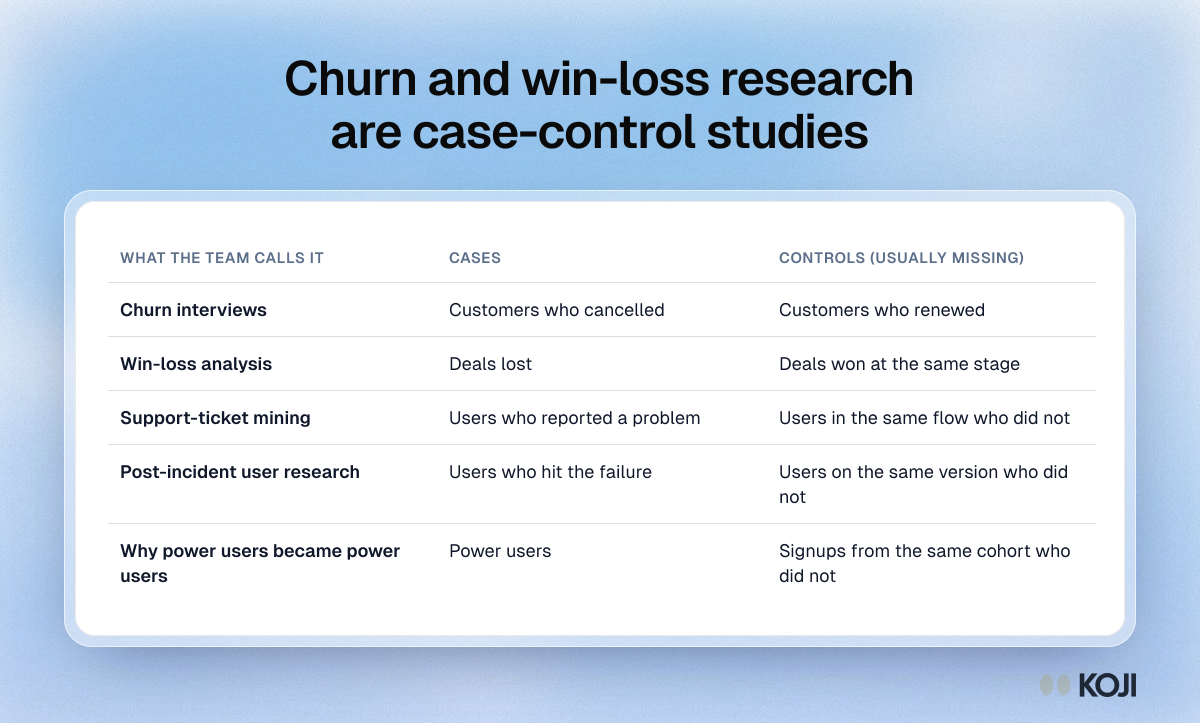
Churn and win-loss research are case-control studies
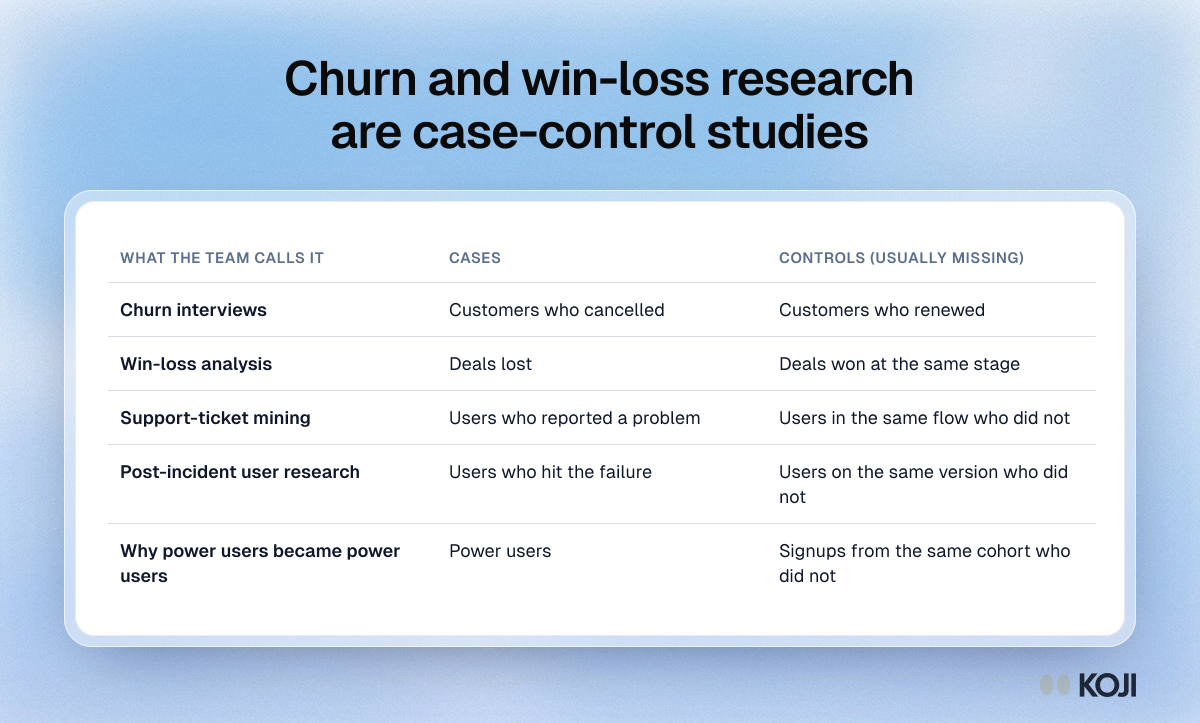
A table that maps five common product research studies onto the case-control design from epidemiology: churn interviews, win-loss analysis, support-ticket mining, post-incident research and power user studies. For each it names the cases and the control group teams usually leave out, such as customers who renewed or deals won at the same stage. Use it to check whether your study has a comparison group.
Where this appears
What's in this reference table
| What the team calls it | Cases | Controls (usually missing) |
|---|---|---|
| Churn interviews | Customers who cancelled | Customers who renewed |
| Win-loss analysis | Deals lost | Deals won at the same stage |
| Support-ticket mining | Users who reported a problem | Users in the same flow who did not |
| Post-incident user research | Users who hit the failure | Users on the same version who did not |
| Why power users became power users | Power users | Signups from the same cohort who did not |
Use this image
Free to use in your docs, decks and posts under CC BY 4.0, as long as you credit Koji with a link to this page. To embed it, paste this into your page:
html
<a href="https://www.koji.so/visuals/product-research-as-case-control-studies"><img src="https://www.koji.so/visuals/product-research-as-case-control-studies/product-research-as-case-control-studies.png" alt="Table of five product research studies as case-control designs, such as churn interviews, with cancelled customers as cases and renewed ones as controls." width="1200" height="723" /></a>
<p>Source: <a href="https://www.koji.so/visuals/product-research-as-case-control-studies">Churn and win-loss research are case-control studies</a>, Koji</p>