Reference table
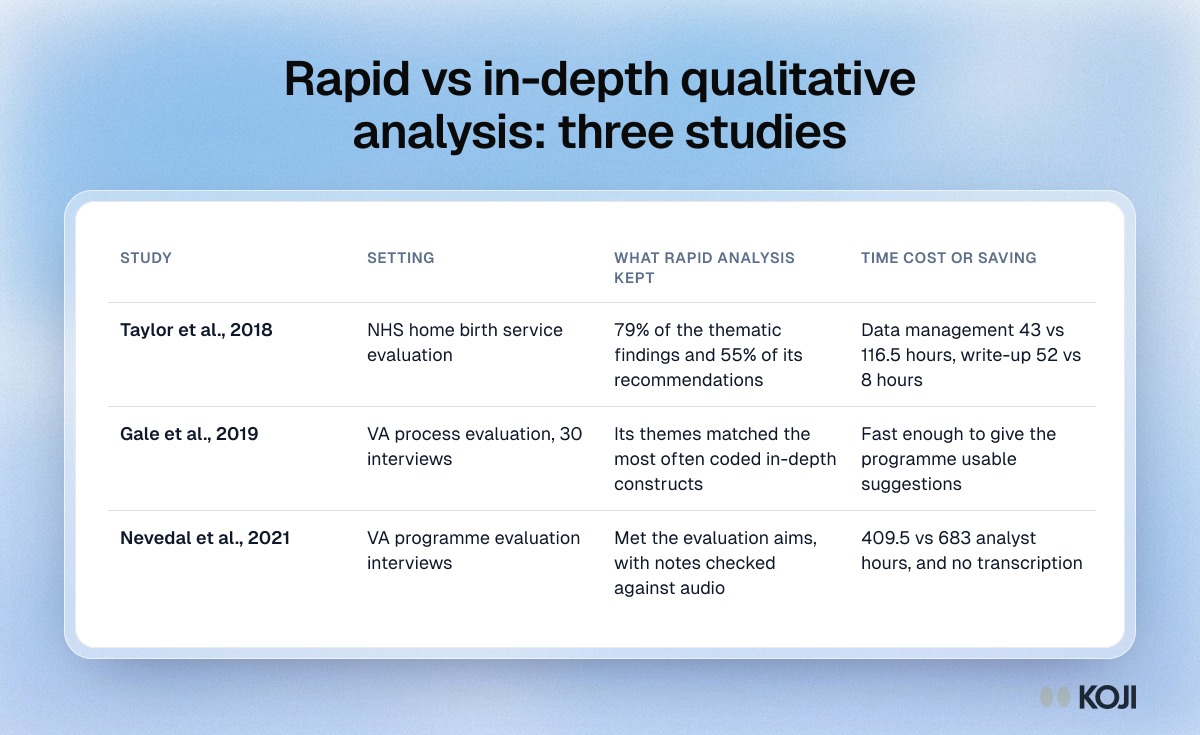
Rapid vs in-depth qualitative analysis: three studies
What a rapid approach kept, and what it cost or saved, when compared with in-depth analysis of the same interviews.
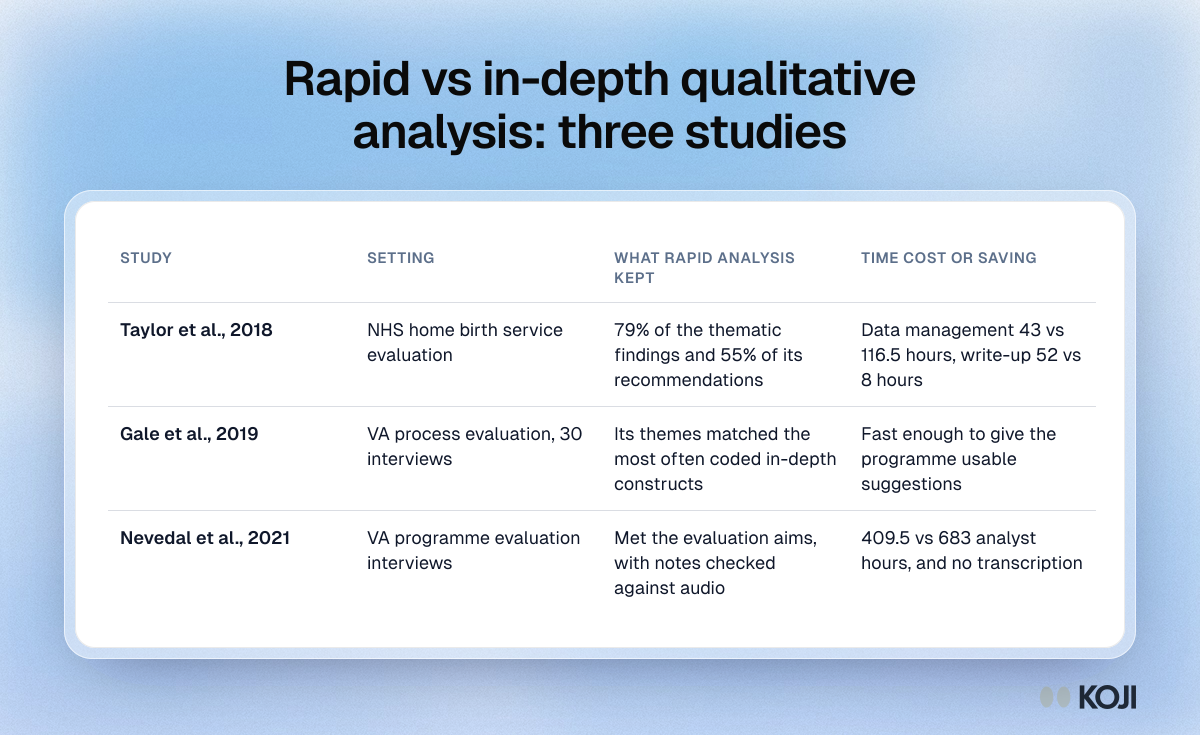
A table summarising three studies that ran rapid and in-depth qualitative analysis on the same interview data: Taylor et al. (2018) in an NHS service evaluation, and Gale et al. (2019) and Nevedal et al. (2021) in US Veterans Affairs evaluations. It shows how many findings the rapid approach kept and how much time it took. Quality and evaluation teams can use it to decide when rapid analysis of student feedback is good enough.
What's in this reference table
| Study | Setting | What rapid analysis kept | Time cost or saving |
|---|---|---|---|
| Taylor et al., 2018 | NHS home birth service evaluation | 79% of the thematic findings and 55% of its recommendations | Data management 43 vs 116.5 hours, write-up 52 vs 8 hours |
| Gale et al., 2019 | VA process evaluation, 30 interviews | Its themes matched the most often coded in-depth constructs | Fast enough to give the programme usable suggestions |
| Nevedal et al., 2021 | VA programme evaluation interviews | Met the evaluation aims, with notes checked against audio | 409.5 vs 683 analyst hours, and no transcription |
Use this image
Free to use in your docs, decks and posts under CC BY 4.0, as long as you credit Koji with a link to this page. To embed it, paste this into your page:
html
<a href="https://www.koji.so/visuals/rapid-vs-in-depth-qualitative-analysis-three-studies"><img src="https://www.koji.so/visuals/rapid-vs-in-depth-qualitative-analysis-three-studies/rapid-vs-in-depth-qualitative-analysis-three-studies.png" alt="Table comparing three studies of rapid vs in-depth qualitative analysis: what the rapid approach kept and what it cost or saved in each." width="1200" height="735" /></a>
<p>Source: <a href="https://www.koji.so/visuals/rapid-vs-in-depth-qualitative-analysis-three-studies">Rapid vs in-depth qualitative analysis: three studies</a>, Koji</p>