Checklist
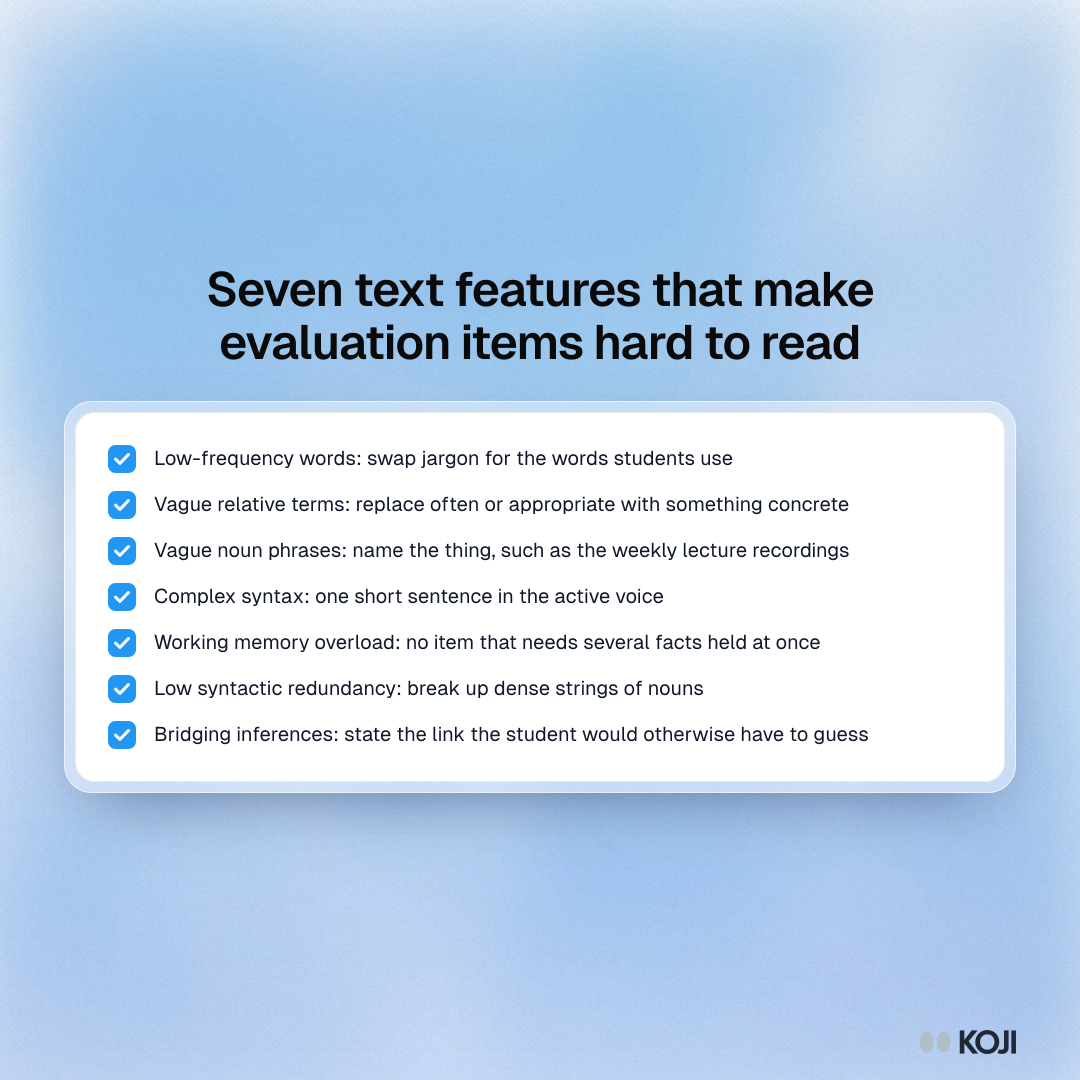
Seven text features that make evaluation items hard to read
A screening list for course evaluation items, based on a psycholinguistic web experiment
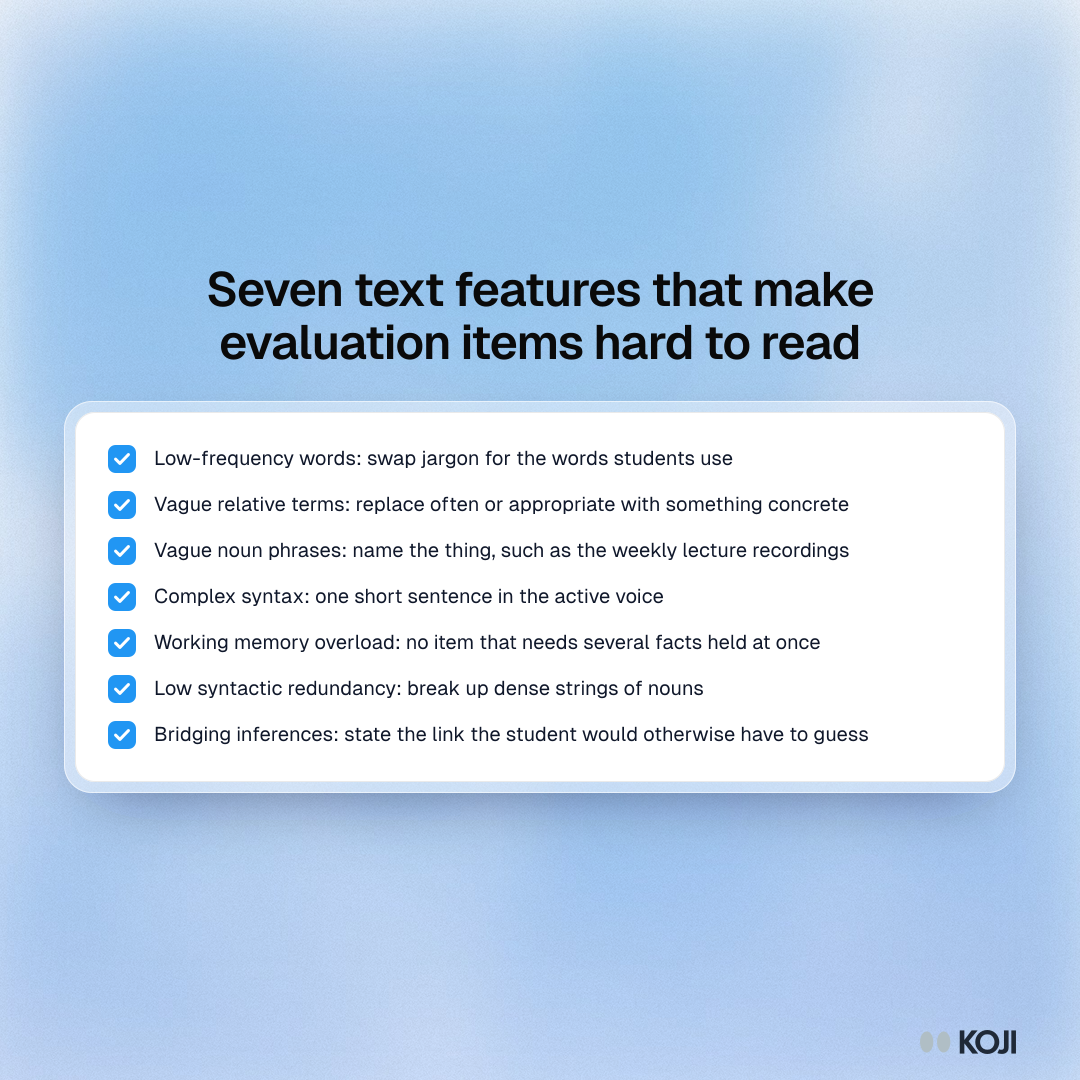
A checklist of the seven text features that Lenzner, Kaczmirek and Lenzner (2010) found add cognitive burden to survey questions, with a plain fix for each. It is for anyone writing or reviewing course evaluation items, especially in multilingual cohorts. Run each item through it before the evaluation goes out, then pretest with a few students. Koji follow-ups can show when students read an item differently.
What's in this checklist
- Low-frequency words: swap jargon for the words students use
- Vague relative terms: replace often or appropriate with something concrete
- Vague noun phrases: name the thing, such as the weekly lecture recordings
- Complex syntax: one short sentence in the active voice
- Working memory overload: no item that needs several facts held at once
- Low syntactic redundancy: break up dense strings of nouns
- Bridging inferences: state the link the student would otherwise have to guess
Use this image
Free to use in your docs, decks and posts under CC BY 4.0, as long as you credit Koji with a link to this page. To embed it, paste this into your page:
html
<a href="https://www.koji.so/visuals/seven-text-features-hard-survey-questions-checklist"><img src="https://www.koji.so/visuals/seven-text-features-hard-survey-questions-checklist/seven-text-features-hard-survey-questions-checklist.png" alt="Checklist of seven text features that make course evaluation items hard to understand, from low-frequency words to bridging inferences, each with a fix." width="1080" height="1080" /></a>
<p>Source: <a href="https://www.koji.so/visuals/seven-text-features-hard-survey-questions-checklist">Seven text features that make evaluation items hard to read</a>, Koji</p>