Reference table
Smiley face and coloured rating scales: what experiments found
Four web survey studies on visual extras in rating scales
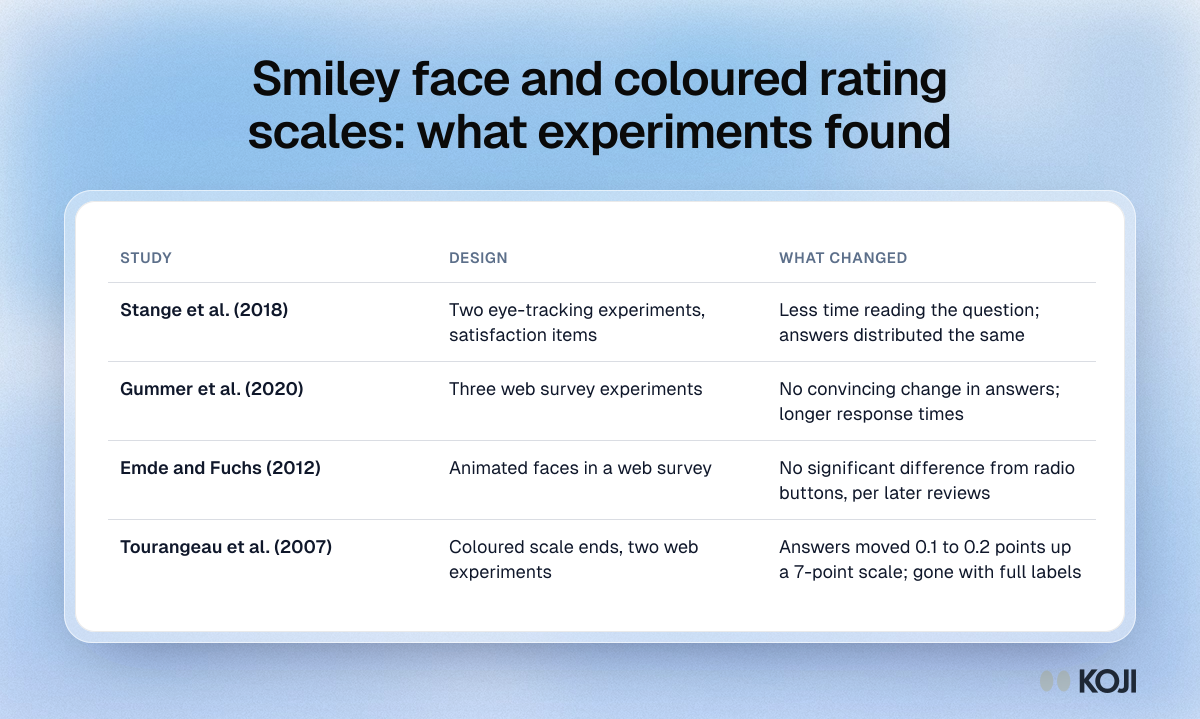
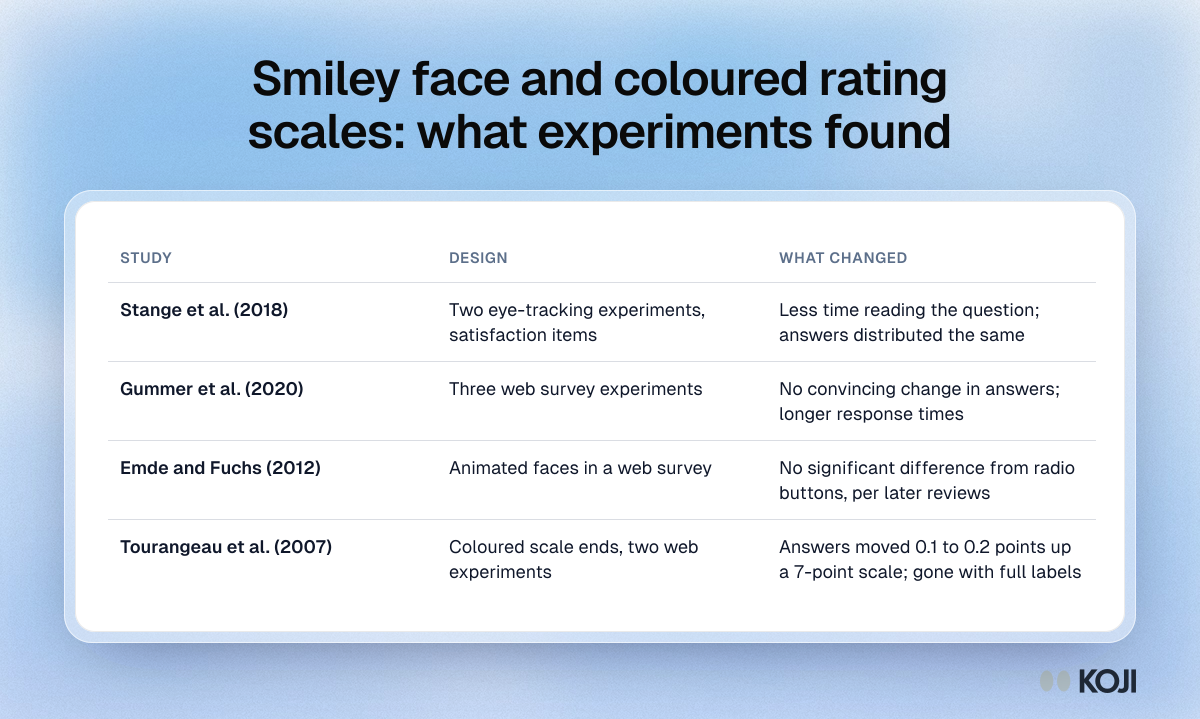
A summary table of four web survey experiments on smiley face scales and coloured response scales, for anyone deciding whether to add faces or colour to a course evaluation. Stange and colleagues (2018) and Gummer and colleagues (2020) found no meaningful change in answers from smileys, and Tourangeau, Couper and Conrad (2007) found a small colour effect that disappeared with full verbal labels. Koji shows rating scales as numbered buttons with optional endpoint labels and no faces.
What's in this reference table
| Study | Design | What changed |
|---|---|---|
| Stange et al. (2018) | Two eye-tracking experiments, satisfaction items | Less time reading the question; answers distributed the same |
| Gummer et al. (2020) | Three web survey experiments | No convincing change in answers; longer response times |
| Emde and Fuchs (2012) | Animated faces in a web survey | No significant difference from radio buttons, per later reviews |
| Tourangeau et al. (2007) | Coloured scale ends, two web experiments | Answers moved 0.1 to 0.2 points up a 7-point scale; gone with full labels |
Use this image
Free to use in your docs, decks and posts under CC BY 4.0, as long as you credit Koji with a link to this page. To embed it, paste this into your page:
html
<a href="https://www.koji.so/visuals/smiley-face-rating-scale-experiments-findings"><img src="https://www.koji.so/visuals/smiley-face-rating-scale-experiments-findings/smiley-face-rating-scale-experiments-findings.png" alt="Table of four experiments on smiley face and coloured rating scales, showing faces changed reading time but not answers, and labels removed colour effects." width="1200" height="719" /></a>
<p>Source: <a href="https://www.koji.so/visuals/smiley-face-rating-scale-experiments-findings">Smiley face and coloured rating scales: what experiments found</a>, Koji</p>