Reference table
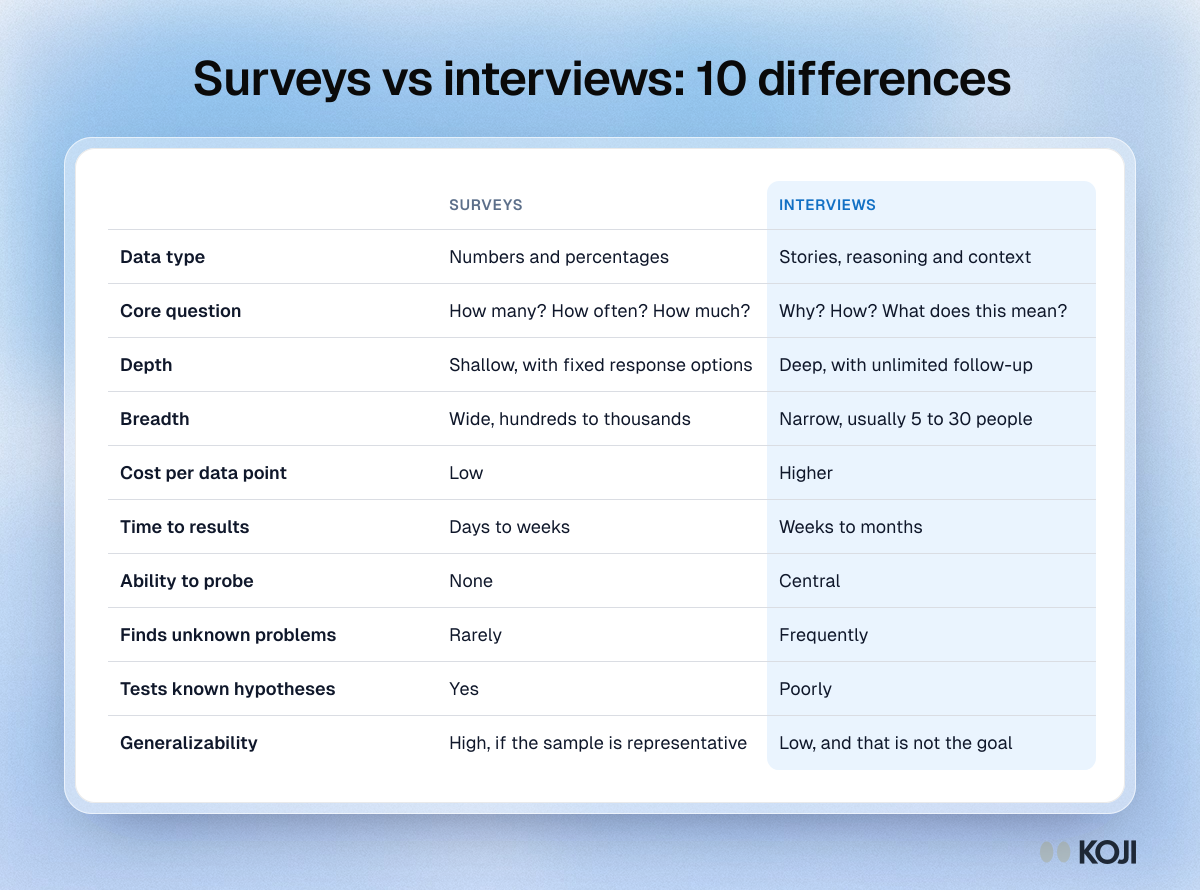
Surveys vs interviews: 10 differences
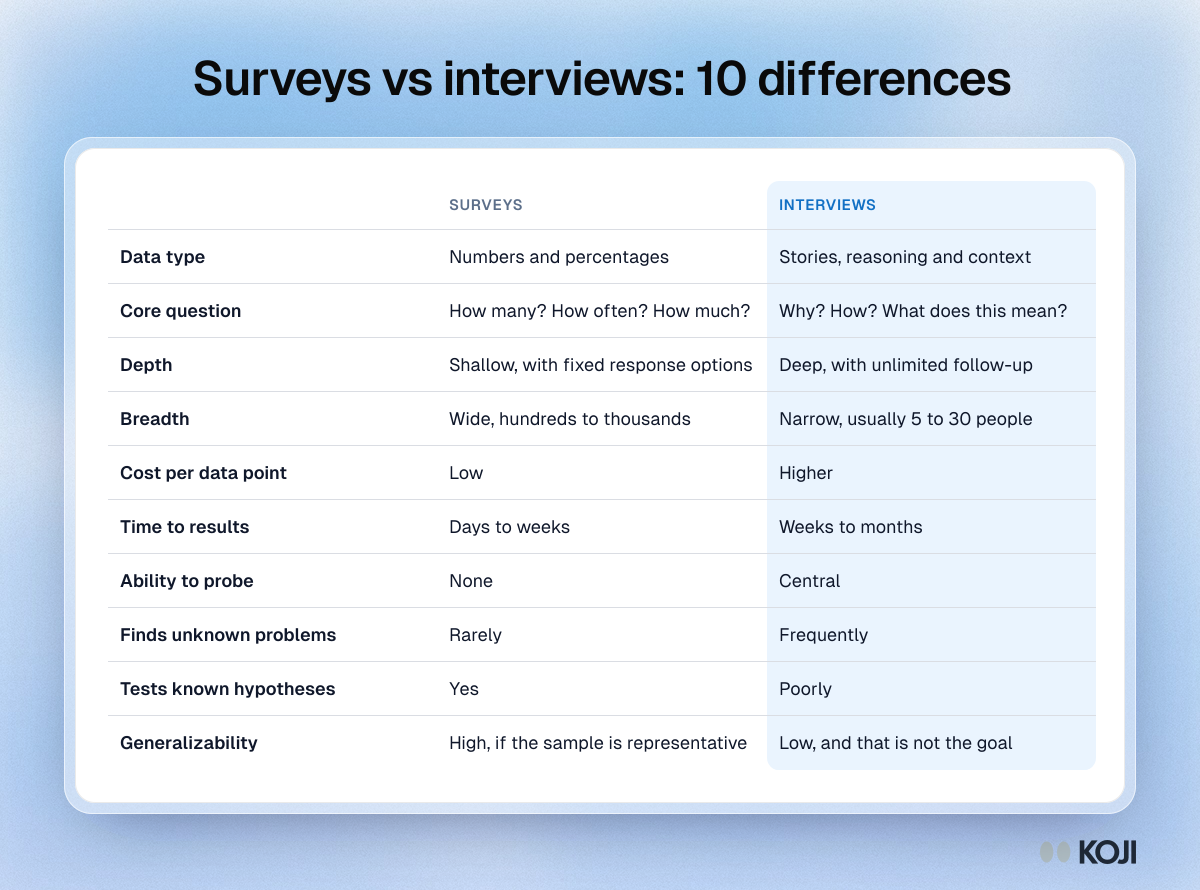
A side-by-side table of how surveys and interviews differ on ten points: the data they produce, the question they answer, depth, breadth, cost, speed, probing, discovery, hypothesis testing and generalizability. Use it when you are choosing a method for a new study or explaining the choice to a stakeholder. Koji runs AI-moderated interviews, so you can get interview depth from more people than a team could talk to by hand.
Where this appears
What's in this reference table
| Surveys | Interviews | |
|---|---|---|
| Data type | Numbers and percentages | Stories, reasoning and context |
| Core question | How many? How often? How much? | Why? How? What does this mean? |
| Depth | Shallow, with fixed response options | Deep, with unlimited follow-up |
| Breadth | Wide, hundreds to thousands | Narrow, usually 5 to 30 people |
| Cost per data point | Low | Higher |
| Time to results | Days to weeks | Weeks to months |
| Ability to probe | None | Central |
| Finds unknown problems | Rarely | Frequently |
| Tests known hypotheses | Yes | Poorly |
| Generalizability | High, if the sample is representative | Low, and that is not the goal |
Use this image
Free to use in your docs, decks and posts under CC BY 4.0, as long as you credit Koji with a link to this page. To embed it, paste this into your page:
html
<a href="https://www.koji.so/visuals/survey-vs-interview-ten-differences-table"><img src="https://www.koji.so/visuals/survey-vs-interview-ten-differences-table/survey-vs-interview-ten-differences-table.png" alt="Table comparing surveys and interviews on ten points, from data type, depth and breadth to cost, speed and finding unknown problems." width="1200" height="890" /></a>
<p>Source: <a href="https://www.koji.so/visuals/survey-vs-interview-ten-differences-table">Surveys vs interviews: 10 differences</a>, Koji</p>