Reference table
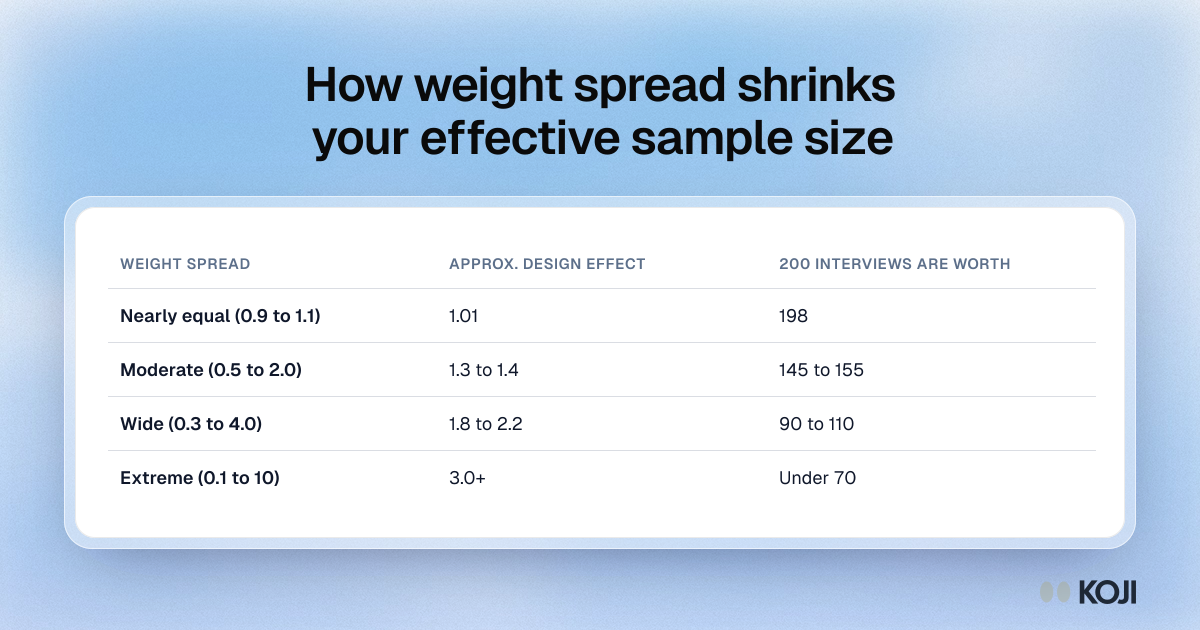
How weight spread shrinks your effective sample size
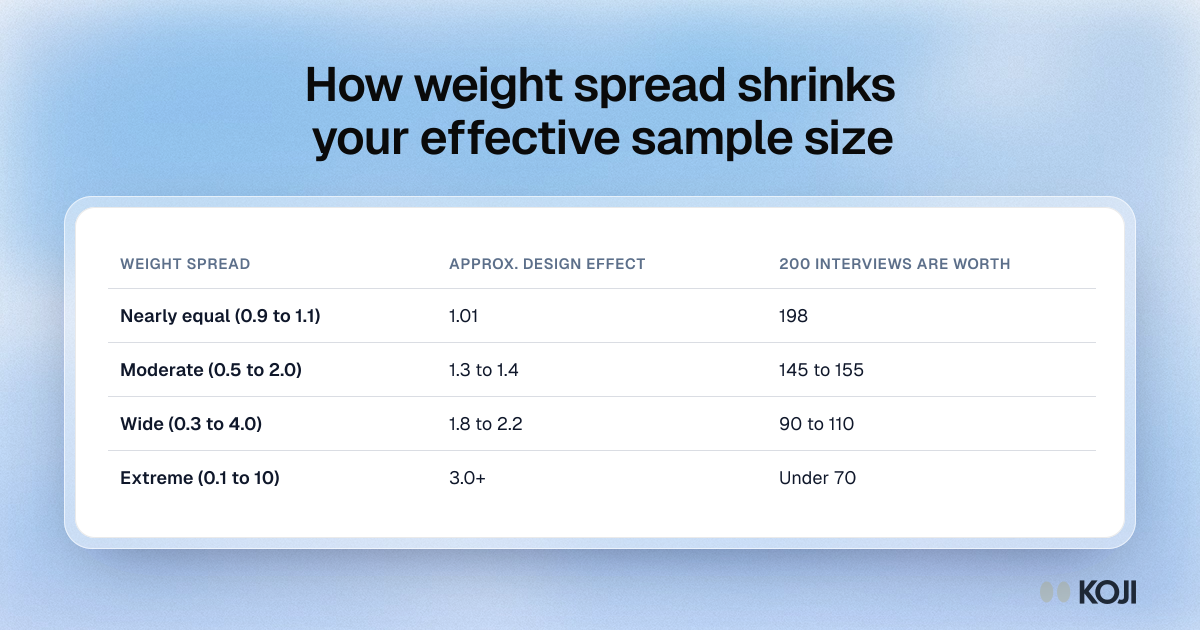
A table of how unequal survey weights raise the design effect and cut effective sample size, using Kish's formula on a study of 200 interviews. Nearly equal weights cost almost nothing, a moderate spread of 0.5 to 2.0 leaves the precision of about 150, and extreme weights leave fewer than 70. Use it to sense-check a weighted result before it goes in a deck, and to see why filling quotas during fieldwork beats heavy weighting afterwards.
Where this appears
What's in this reference table
| Weight spread | Approx. design effect | 200 interviews are worth |
|---|---|---|
| Nearly equal (0.9 to 1.1) | 1.01 | 198 |
| Moderate (0.5 to 2.0) | 1.3 to 1.4 | 145 to 155 |
| Wide (0.3 to 4.0) | 1.8 to 2.2 | 90 to 110 |
| Extreme (0.1 to 10) | 3.0+ | Under 70 |
Use this image
Free to use in your docs, decks and posts under CC BY 4.0, as long as you credit Koji with a link to this page. To embed it, paste this into your page:
html
<a href="https://www.koji.so/visuals/survey-weight-spread-design-effect-table"><img src="https://www.koji.so/visuals/survey-weight-spread-design-effect-table/survey-weight-spread-design-effect-table.png" alt="Table of weight spread against design effect: nearly equal weights keep 198 of 200 interviews, while extreme weights leave the precision of fewer than 70." width="1200" height="630" /></a>
<p>Source: <a href="https://www.koji.so/visuals/survey-weight-spread-design-effect-table">How weight spread shrinks your effective sample size</a>, Koji</p>