Reference table
When to weight a survey sample, and what to do instead
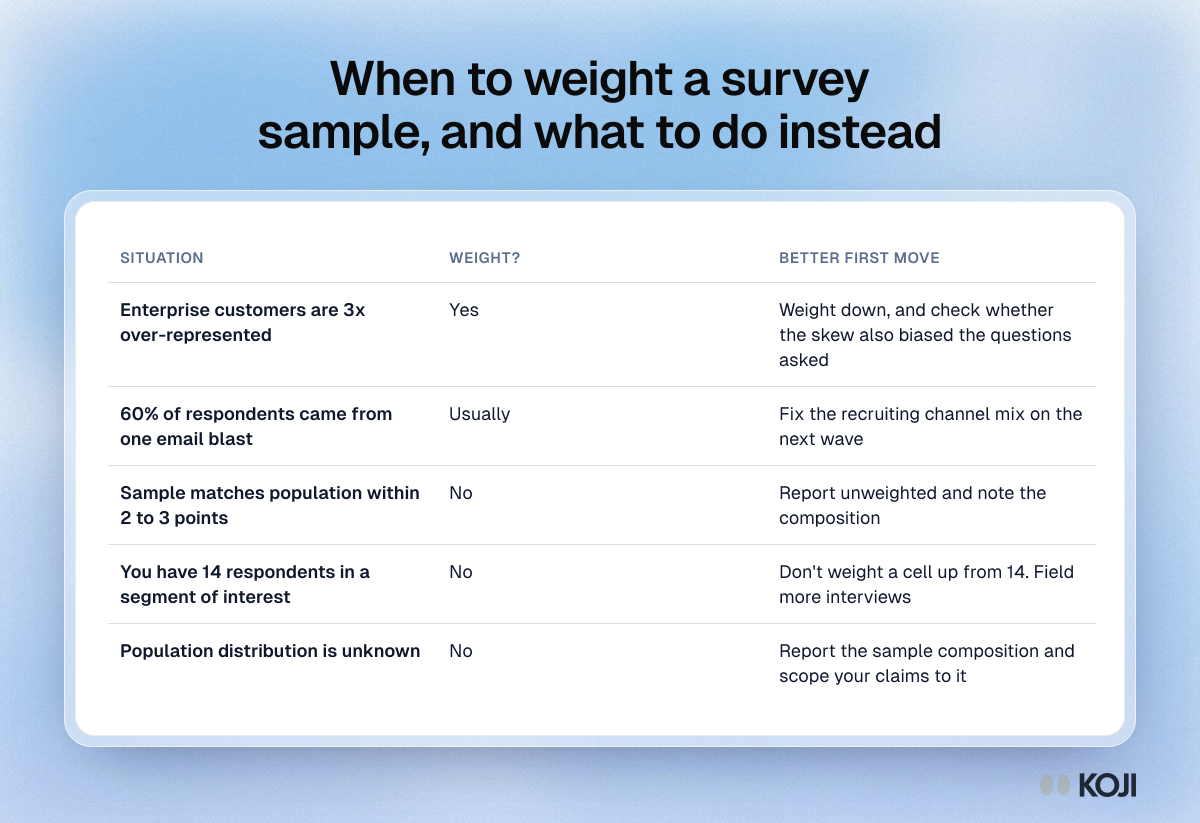
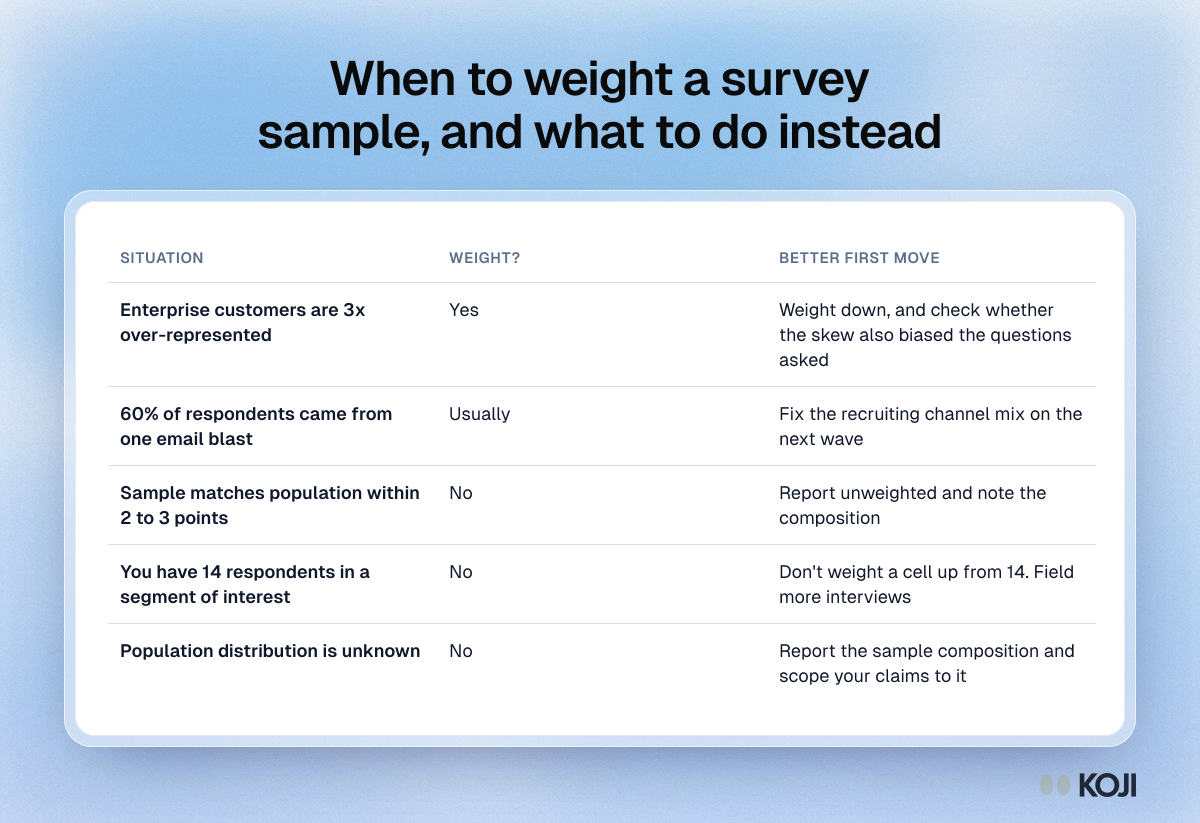
A decision table for survey and customer research teams deciding whether to weight a sample. It covers five common situations, including an over-represented segment, one dominant recruiting channel, a sample that already matches, a tiny segment of interest and an unknown population, with whether to weight and the better first move for each. The rule behind it: never weight a thin cell up, field more interviews instead. Koji makes that cheap with AI-moderated interviews.
Where this appears
What's in this reference table
| Situation | Weight? | Better first move |
|---|---|---|
| Enterprise customers are 3x over-represented | Yes | Weight down, and check whether the skew also biased the questions asked |
| 60% of respondents came from one email blast | Usually | Fix the recruiting channel mix on the next wave |
| Sample matches population within 2 to 3 points | No | Report unweighted and note the composition |
| You have 14 respondents in a segment of interest | No | Don't weight a cell up from 14. Field more interviews |
| Population distribution is unknown | No | Report the sample composition and scope your claims to it |
Use this image
Free to use in your docs, decks and posts under CC BY 4.0, as long as you credit Koji with a link to this page. To embed it, paste this into your page:
html
<a href="https://www.koji.so/visuals/when-to-weight-survey-sample-decision-table"><img src="https://www.koji.so/visuals/when-to-weight-survey-sample-decision-table/when-to-weight-survey-sample-decision-table.png" alt="Table of five survey situations, from over-represented enterprise customers to an unknown population, with whether to weight and the better first move." width="1200" height="823" /></a>
<p>Source: <a href="https://www.koji.so/visuals/when-to-weight-survey-sample-decision-table">When to weight a survey sample, and what to do instead</a>, Koji</p>