Comparison
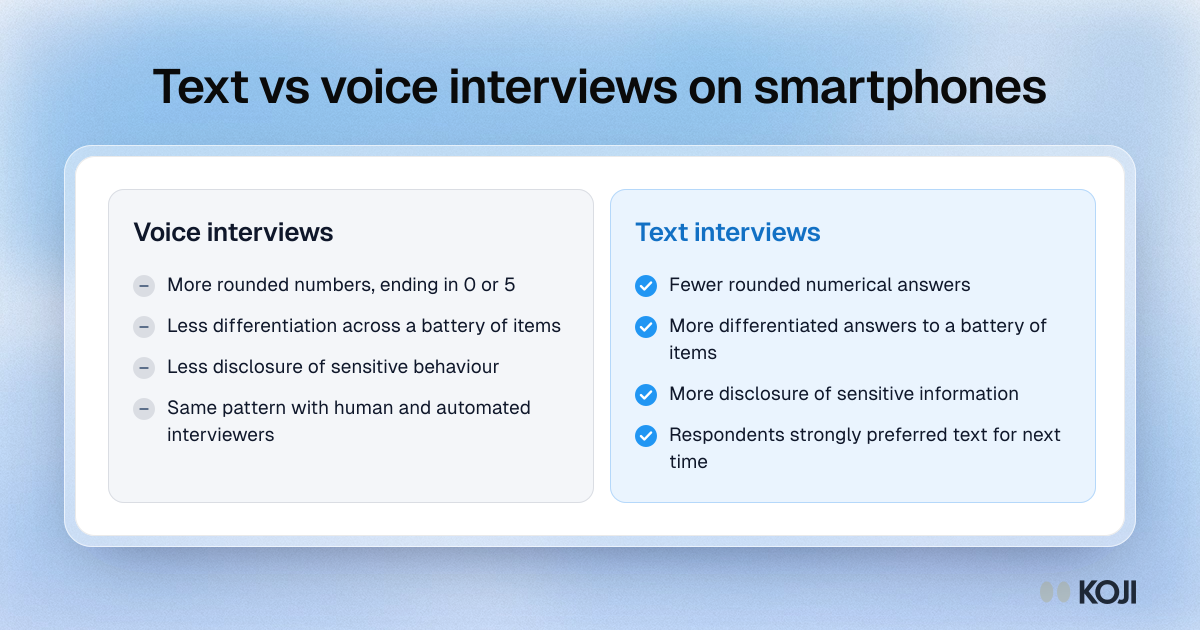
Text vs voice interviews on smartphones
Data quality differences from a randomised experiment with iPhone users
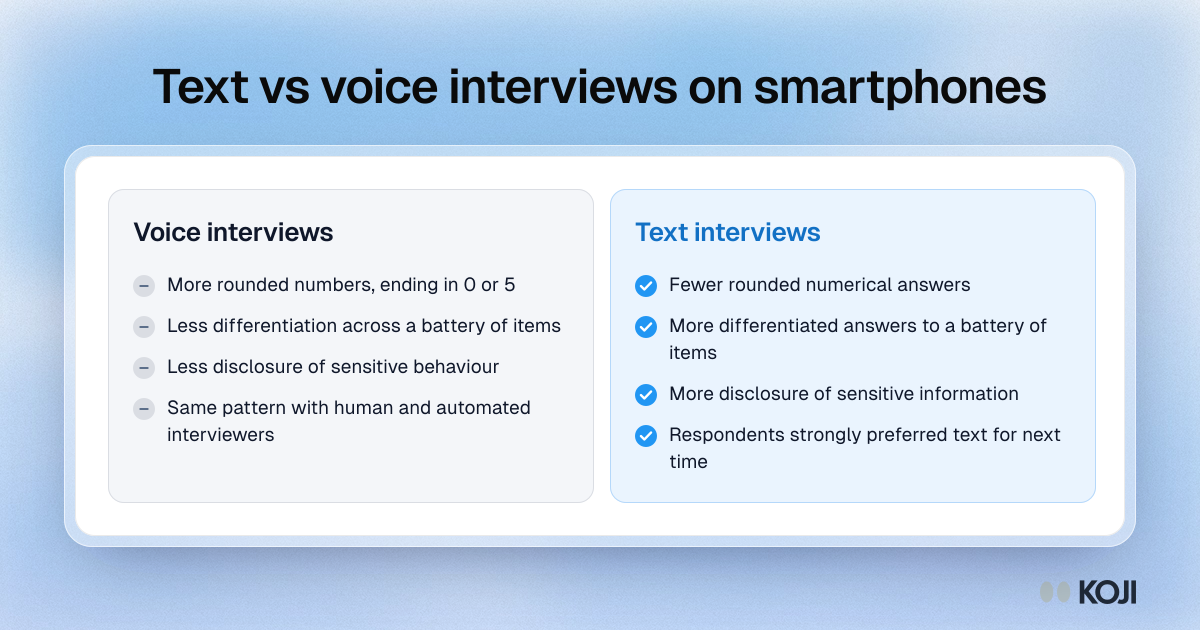
A comparison of data quality in text message and voice interviews, based on the randomised smartphone experiment by Schober, Conrad and colleagues published in PLoS ONE in 2015. It is for evaluation and survey staff choosing whether to offer students text, voice or both. The differences held with human and automated interviewers. Koji lets a study offer text, voice or both, and records scale and choice answers through on-screen buttons in either mode.
What's in this comparison
Voice interviews
- More rounded numbers, ending in 0 or 5
- Less differentiation across a battery of items
- Less disclosure of sensitive behaviour
- Same pattern with human and automated interviewers
Text interviews
- Fewer rounded numerical answers
- More differentiated answers to a battery of items
- More disclosure of sensitive information
- Respondents strongly preferred text for next time
Use this image
Free to use in your docs, decks and posts under CC BY 4.0, as long as you credit Koji with a link to this page. To embed it, paste this into your page:
html
<a href="https://www.koji.so/visuals/text-vs-voice-interviews-data-quality-comparison"><img src="https://www.koji.so/visuals/text-vs-voice-interviews-data-quality-comparison/text-vs-voice-interviews-data-quality-comparison.png" alt="Comparison of voice and text interviews on smartphones: text produced fewer rounded numbers, more differentiated answers and more disclosure." width="1200" height="630" /></a>
<p>Source: <a href="https://www.koji.so/visuals/text-vs-voice-interviews-data-quality-comparison">Text vs voice interviews on smartphones</a>, Koji</p>