Flowchart
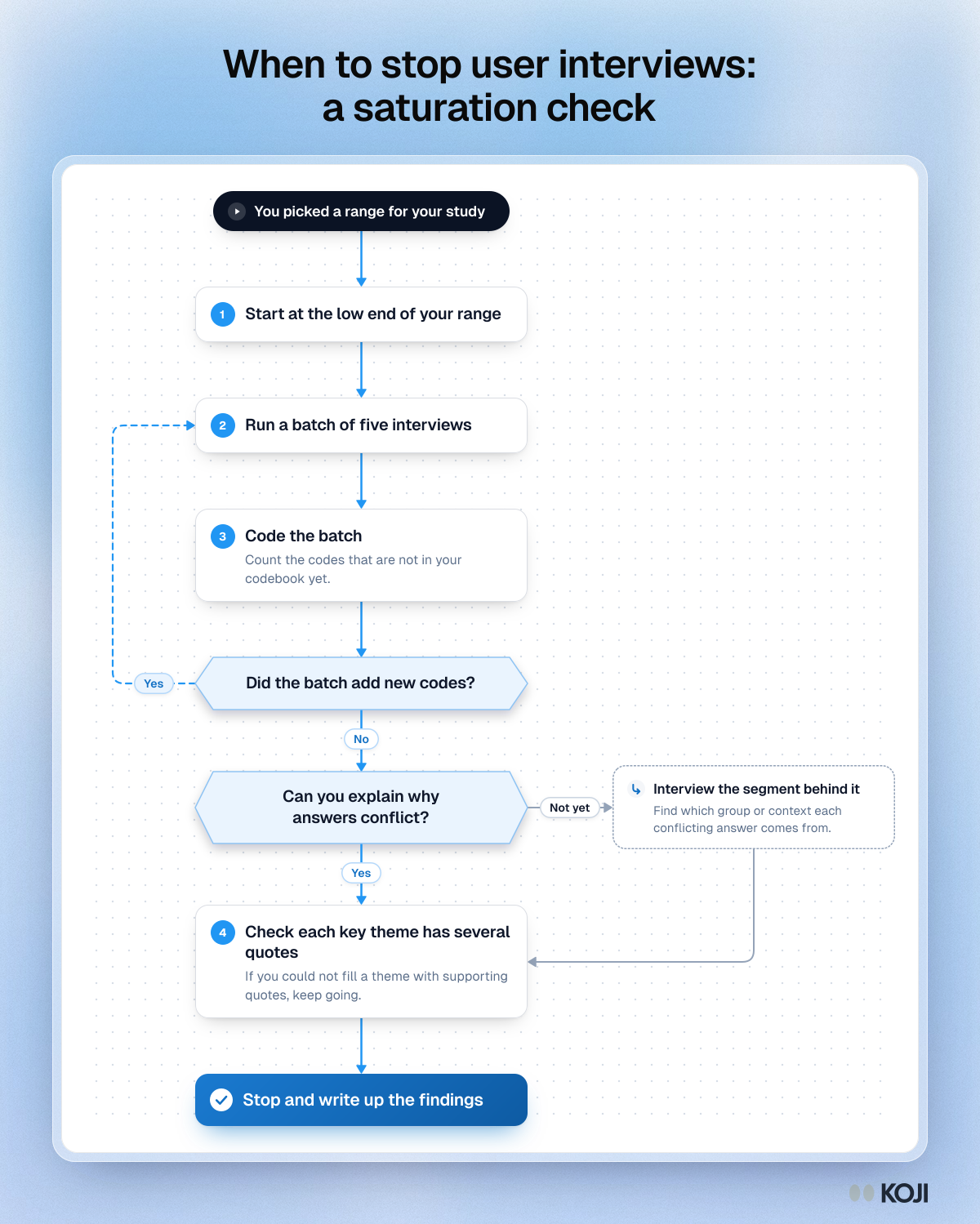
When to stop user interviews: a saturation check
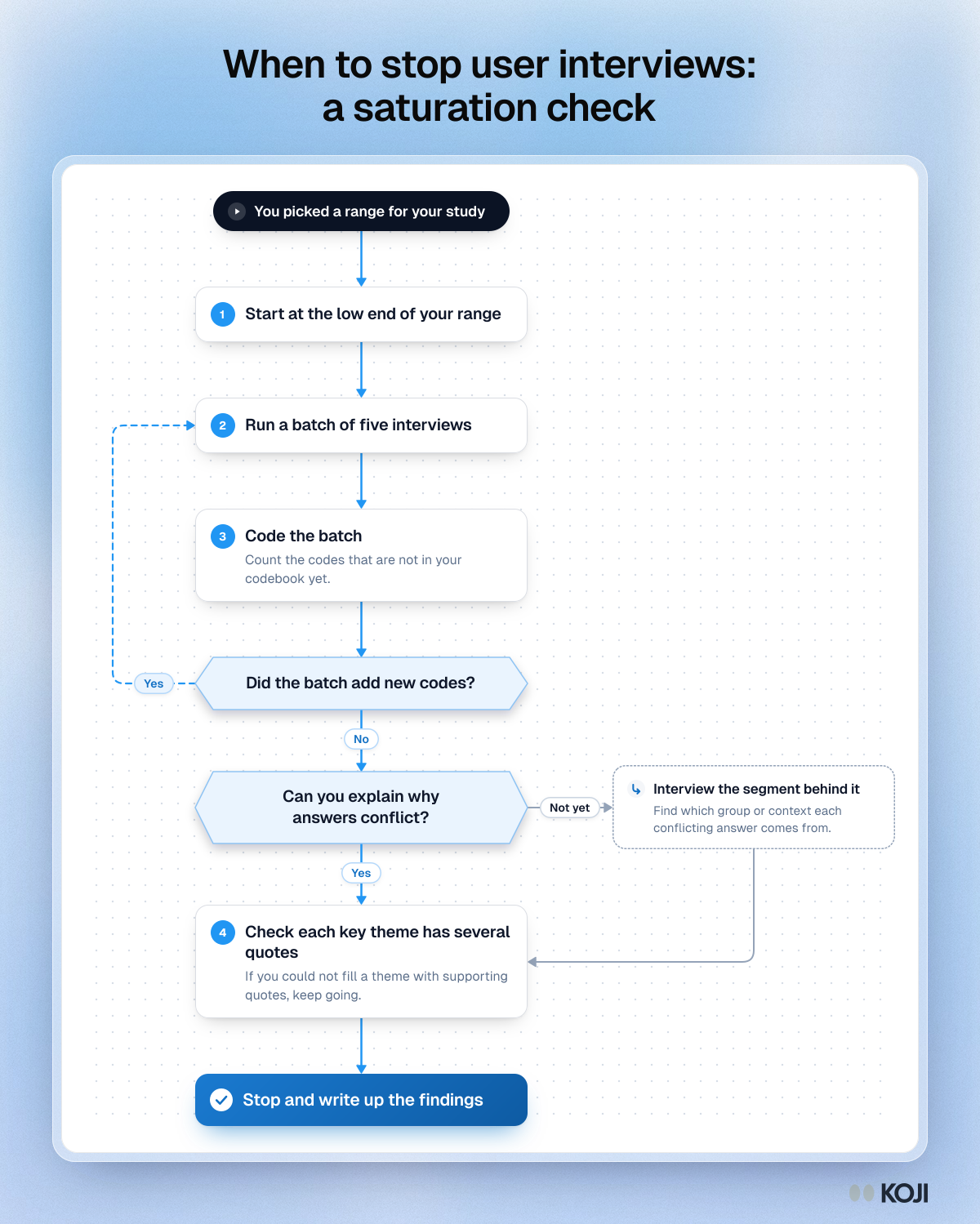
A flowchart for deciding when you have run enough user interviews. Start at the low end of the range for your study, run interviews in batches of five and code each batch. Keep going while batches add new codes. Stop once you can explain why answers conflict and every key theme has several supporting quotes. Koji codes each interview as it comes in, so you can see when new themes stop appearing.
Where this appears
What's in this flowchart
Start: You picked a range for your study
- Start at the low end of your range.
- Run a batch of five interviews.
- Code the batch. Count the codes that are not in your codebook yet.
- Did the batch add new codes?
- No: go to 5.
- Yes: go back to 2.
- Can you explain why answers conflict?
- Yes: go to 6.
- Not yet: Interview the segment behind it. Find which group or context each conflicting answer comes from. Then go to 6.
- Check each key theme has several quotes. If you could not fill a theme with supporting quotes, keep going.
- Finish: Stop and write up the findings.
Use this image
Free to use in your docs, decks and posts under CC BY 4.0, as long as you credit Koji with a link to this page. To embed it, paste this into your page:
html
<a href="https://www.koji.so/visuals/user-interview-saturation-check-flowchart"><img src="https://www.koji.so/visuals/user-interview-saturation-check-flowchart/user-interview-saturation-check-flowchart.png" alt="Flowchart for deciding when to stop user interviews: run batches of five, loop while new codes appear, explain conflicts, then write up." width="1200" height="1499" /></a>
<p>Source: <a href="https://www.koji.so/visuals/user-interview-saturation-check-flowchart">When to stop user interviews: a saturation check</a>, Koji</p>