How Many User Interviews Do You Need? The Sample Size Guide for Qualitative Research
Discover the right number of user interviews for your research. Learn about data saturation, theoretical saturation, and practical frameworks for knowing when you've collected enough qualitative data.
The short answer: For most user research studies, 5–8 interviews are the minimum for exploratory work with a tightly defined audience, 10–15 is the standard range for discovery research, and 20–30 are needed when studying multiple distinct user segments. The real answer depends on your research goals, population diversity, and a concept most researchers misunderstand: data saturation.
One of the most debated questions in qualitative research is also one of the most consequential: how many interviews do you actually need? Run too few and you risk missing critical patterns — anchoring on the idiosyncrasies of 3 participants instead of the real signal. Run too many and you waste time and budget on diminishing returns. The answer lies in understanding saturation, and in recognizing why your instinct to stop early may be the single biggest threat to your research quality.
Why There's No Universal Answer
Unlike quantitative research, qualitative interviews don't follow statistical power calculations. You cannot plug numbers into a formula and get a sample size. Qualitative research is iterative and inductive — you're building understanding, not measuring frequency.
The goal is not to statistically represent a population. It's to reach saturation: the point at which new interviews stop revealing new themes, patterns, or insights. When your 14th participant echoes what your 8th said, you've likely reached saturation for that topic and audience.
But saturation is notoriously hard to predict in advance. New research from 2025 published in the Journal of Marketing Research shows that data saturation and theoretical saturation are distinct milestones — and conflating the two is one of the leading causes of incomplete qualitative studies that produce weak, unsupported conclusions.
Data Saturation vs. Theoretical Saturation: Why Both Matter
These terms are used interchangeably, but they describe very different milestones:
Data saturation is the point at which no new information emerges from interviews. You've heard the same themes, quotes, and patterns enough times that new conversations add nothing novel. This can happen in as few as 9–12 interviews for a well-defined, homogeneous audience.
Theoretical saturation goes further: it means your emerging theory or explanation of the phenomenon is robust enough to stand on its own. The categories you've identified are fully developed, their properties are clearly understood, and the relationships between them are mapped. This typically requires 1.5–2x as many interviews as data saturation alone.
A 2025 study in SAGE journals found that relying solely on data saturation "often leads to premature closure and weak theorization." The practical implication: hearing repeated themes does not mean you fully understand why those themes exist. That deeper explanatory understanding — which drives better product decisions — requires more data.
"The challenge is that saturation is a property of the data, not of the sample size. You can't know in advance that 12 interviews will be enough — you discover it by coding as you go."
— Guest, Bunce & Johnson, foundational saturation research (2006)
What the Research Actually Shows
Despite the contextual nature of qualitative research, empirical studies produce useful benchmarks:
- A systematic review of 23 saturation studies (Guest, Bunce & Johnson, 2006) found that 94% of all codes emerged after just 12 interviews in a homogeneous population — a finding cited across UX research for nearly two decades
- JMIR research (2024) found that true code saturation required 16–24 interviews across diverse populations, while near-saturation occurred at 9–17
- Nielsen Norman Group advises 5 participants for usability testing (catching approximately 85% of interface problems), but explicitly states that interview-based studies require more due to higher variability in the information collected
- A 2021 systematic review of empirical tests of saturation found that most studies in behavioral and social research require between 9 and 17 interviews to reach data saturation — with the higher end required when participant populations are more diverse
The wide variance in these numbers reflects the single most important variable: how homogeneous your population is. The more similar your participants are in terms of experience, role, and context, the faster you will reach saturation.
The "5 Users" Rule: Why It Gets Misapplied
Jakob Nielsen's famous recommendation to test with 5 users is one of the most misunderstood heuristics in UX. The 5-user principle applies specifically to usability testing — where you're identifying discrete, observable problems with a known interface. In that context, a mathematical model shows that 5 users surface roughly 85% of all usability issues.
But Nielsen Norman Group itself is unambiguous: "In an interview-based study, because there's more variability in the kinds of information being collected, the point of saturation is often higher than for user tests, so 5 interviews are often not enough."
For open-ended research — understanding mental models, motivations, decision-making processes, pain points — 5 participants creates too thin a base. You risk confusing one participant's strong personality for a pattern. You risk your confirmation bias anchoring you to themes that appeared early and never got challenged.
This matters because many product teams use the 5-user heuristic as a shortcut to justify stopping research early. The result: insights that reflect the researcher's prior beliefs more than the user's actual reality.
4 Factors That Determine Your Actual Sample Size
1. Population Homogeneity
A tightly defined audience — say, "B2B SaaS product managers at 50–500 person companies evaluating project management software" — will converge on saturation far faster than a broad one like "anyone who has managed a project." The more defined your target participant profile, the fewer interviews you need to uncover consistent patterns.
2. Research Scope and Depth
Narrowly scoped studies (e.g., "understand friction in the onboarding flow") reach saturation faster than broad exploratory studies (e.g., "understand how PMs think about prioritization and trade-offs"). The latter has more dimensions, which means more conversations before patterns fully emerge.
3. Interview Structure
Highly structured interviews with specific, focused questions generate more repeatable data — saturation arrives sooner. Open-ended, exploratory interviews produce more varied data — you'll need more conversations before the landscape clarifies. Structured question types like scales and multiple-choice also help: quantitative patterns aggregate quickly across participants, even when qualitative probing continues.
4. Analysis Method
Inductive coding — developing themes from the data bottom-up — typically requires more interviews than deductive coding, where you test predefined hypotheses. Grounded theory studies usually need 20+ interviews. If you're testing a specific hypothesis with a pre-defined codebook, 8–12 may be sufficient.
Practical Guidance by Research Type
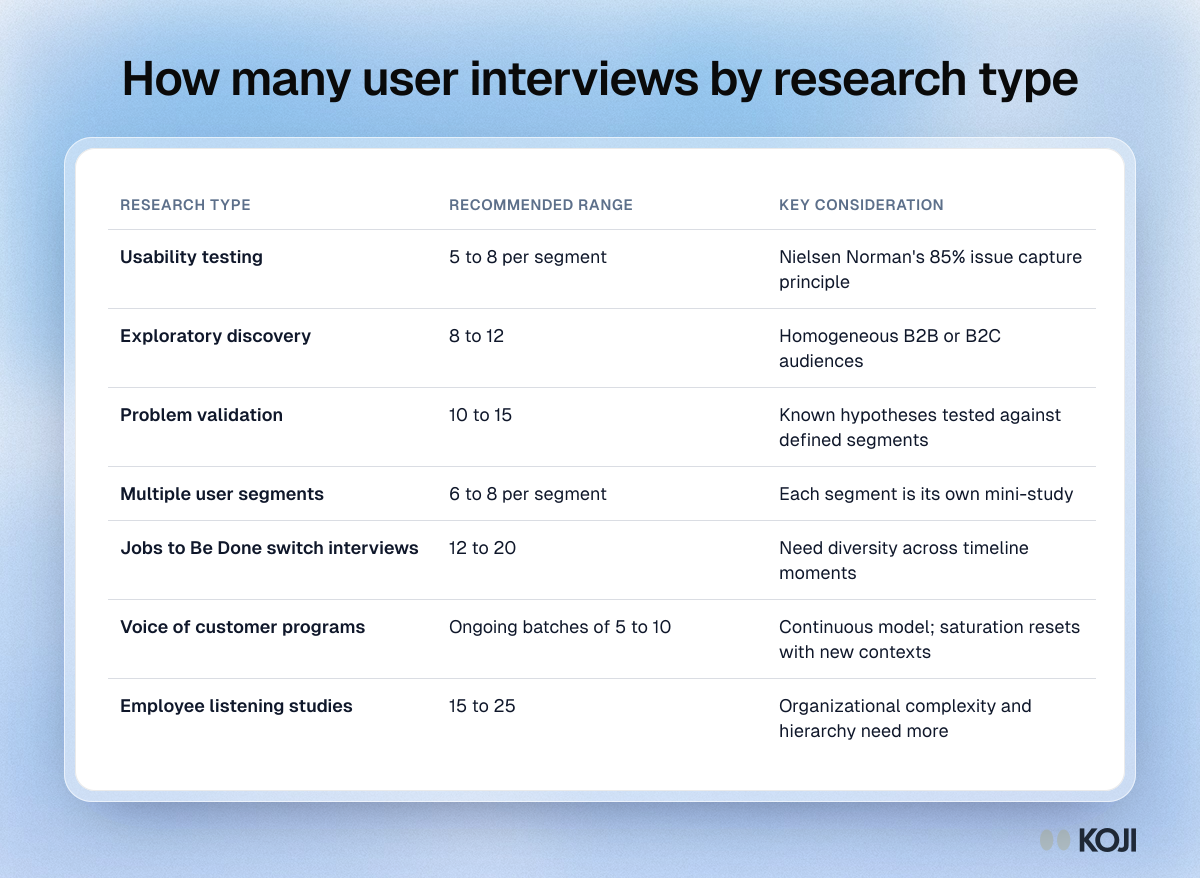
| Research Type | Recommended Range | Key Consideration |
|---|---|---|
| Usability testing | 5–8 per segment | Based on Nielsen Norman's 85% issue capture principle |
| Exploratory discovery | 8–12 | For homogeneous B2B or B2C audiences |
| Problem validation | 10–15 | Testing known hypotheses against defined segments |
| Multiple user segments | 6–8 per segment | Each segment treated as an independent mini-study |
| Jobs to Be Done switch interviews | 12–20 | Need diversity across timeline moments |
| Voice of customer (VoC) programs | Ongoing batches of 5–10 | Continuous model; saturation resets with new contexts |
| Employee listening studies | 15–25 | Organizational complexity and hierarchy require more |
How to Know When You've Reached Saturation
Reaching saturation isn't just a count — it's a judgment call requiring ongoing analysis. Here are the signals that tell you it's time to stop:
- New interviews produce no new codes. Your last 3–4 sessions generated no themes not already present in your codebook. Everything new participants share fits existing categories.
- You can predict what participants will say. When you start anticipating responses before they're given, you've likely heard enough.
- Contradictions have been resolved. Early interviews often surface conflicting data points. Saturation means you've interviewed enough to understand why those contradictions exist — which segment they belong to, what context drives them.
- You could write a complete, defensible report. If you sat down right now to write your findings and couldn't fill out each key theme with multiple supporting quotes, you haven't reached saturation.
A practical technique: analyze interviews in batches of 3–5. After each batch, assess how many new codes emerged. Plot this on a simple graph. When the new-code curve flattens toward zero, you've hit saturation.
How AI-Moderated Research Changes the Calculus
Traditional qualitative research is constrained by a simple economic reality: a 45-minute moderated user interview costs $150–$300 in researcher time plus $75–$200 per participant in recruiting costs. At that rate, running 20 interviews costs $4,500–$10,000 — which is why most teams stop at 5–7.
AI-native research platforms like Koji eliminate the per-interview labor cost entirely. When interviews run automatically — with an AI consultant conducting conversations at any hour, in any language, without scheduling overhead — the marginal cost of the 15th interview is the same as the 5th.
This changes what's possible for every research team:
- Run larger samples as standard practice, not as a special high-budget project
- Test across multiple segments simultaneously — run 8 interviews per segment across 4 segments in parallel, completing 32 interviews in the time it would take a human researcher to run 5 sequential sessions
- Recruit the sample in the same place: open Panel recruit, describe the segment, see the price per completed interview in credits before you launch, and Koji finds participants across 130+ countries (launching is on paid plans); quotas keep each segment balanced, or import your own users so each gets a personalized link and the report is already segmented
- Reach theoretical saturation, not just data saturation — because additional interviews cost almost nothing, there's no economic reason to stop at the first plateau
- Use structured questions — Koji's 6 question types (open_ended, scale, single_choice, multiple_choice, ranking, yes_no) let you mix quantitative patterns and qualitative depth in a single study, so scale responses aggregate automatically across 50+ participants while open-ended probing captures the why behind every number
With Koji's automatic thematic analysis, you don't manually code 25 interviews. The AI surfaces patterns, highlights where new themes stopped emerging, and flags outliers that suggest you need more participants from a specific segment — all in real time.
Teams using AI-assisted research report 60% faster time-to-insight compared to traditional manual research workflows — not because they run fewer interviews, but because analysis no longer creates a bottleneck.
A Practical Decision Framework
Use this four-step process to scope your next study:
Step 1: Rate your population tightness (1–5)
- 1 = very diverse (e.g., "US consumers aged 18–45")
- 5 = very specific (e.g., "enterprise procurement managers who evaluated 3+ vendors in the past 6 months")
Step 2: Rate your research depth (1–5)
- 1 = narrow and evaluative (usability test, concept test)
- 5 = broad and exploratory (new market discovery, understanding unmet needs)
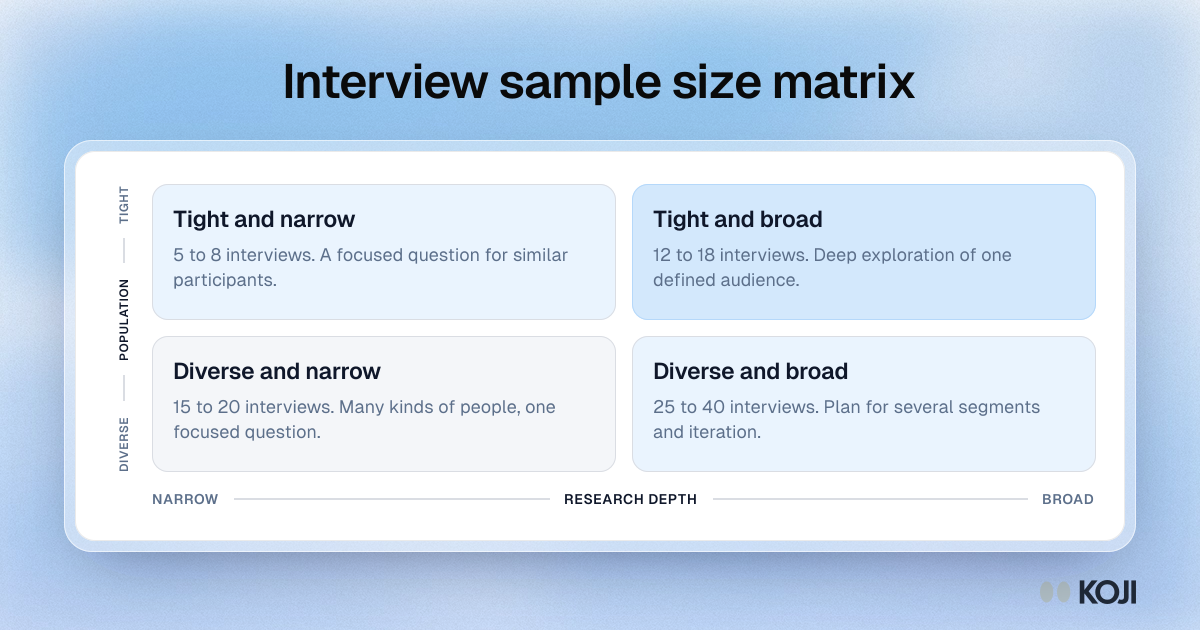
Step 3: Apply the matrix
- Tight population + shallow depth → 5–8 interviews
- Tight population + deep exploration → 12–18 interviews
- Diverse population + shallow depth → 15–20 interviews
- Diverse population + deep exploration → 25–40 interviews
Step 4: Plan for iteration. Start at the lower bound of your range. After every 5 interviews, assess whether new themes are emerging. Stop when new-code frequency drops to near zero. This iterative approach is more reliable than pre-committing to a fixed number.
The Cost of Stopping Too Early
Research teams that stop short of saturation often pay the price later — not in their research budget, but in product decisions made on incomplete data. A feature built for a "pattern" that turned out to be two idiosyncratic participants. A segment's unique needs missed entirely because the team talked to 6 people from one segment and assumed they represented all three. A pivot that looked obvious from 5 interviews and was refuted by the 10th.

The irony is that with AI-moderated research, running 20 interviews now costs less time and money than running 7 interviews through traditional means. The constraint has shifted from cost to willingness — and the teams who embrace larger samples are consistently reaching more reliable insights.
Key Takeaways
- There is no universal sample size for qualitative research — the right number depends on population homogeneity, research depth, and analysis method
- Data saturation (no new themes emerging) typically occurs at 9–17 interviews; theoretical saturation requires 1.5–2x that number
- The "5 users" rule applies to usability testing, not interview-based discovery research — for the latter, aim for 10–15 as a baseline
- Factors accelerating saturation: homogeneous audience, structured questions, narrow scope, deductive coding
- Factors requiring more interviews: diverse audiences, broad exploratory scope, grounded theory methods, multiple user segments
- AI-moderated interviews remove the cost barrier to running sufficient samples — with Koji, running 25 interviews is as feasible as running 5
Related Resources
- Structured Questions in AI Interviews — combine quantitative patterns and qualitative depth in a single study
- Thematic Analysis Guide — how to identify and validate patterns across your interview corpus
- How to Write User Interview Questions That Surface Real Insights — craft questions that accelerate saturation
- Semi-Structured Interviews: The Complete Guide — the most popular format for discovery research
- User Interview Guide Template — a ready-to-use interview plan structure
- How to Analyze Qualitative Data — what to do once you've collected enough interviews
Further reading on the blog
- How Many Customer Interviews Do You Really Need? — Learn exactly how many customer interviews you need for meaningful insights. From the 5-user myth to AI-powered scaling, get your sample siz
Related Articles
Capture-Recapture for Research: How to Estimate the Themes Your Study Never Found (2026)
Two independent coding passes turn "no new themes" into a number: the overlap between them estimates how many themes neither pass ever reached.
How Long Should User Interviews Be? Length and Duration Best Practices
How long user interviews should run by research type, with target durations for discovery, evaluative, and pulse research. Includes the science of fatigue, how AI moderation changes the math, and a calculator for picking your target length.
How to Analyze Qualitative Data: From Raw Interviews to Actionable Insights
A step-by-step guide to qualitative data analysis — from reviewing raw transcripts to synthesizing themes, generating insights, and presenting findings that teams act on.
Interim Analysis and Sequential Testing: How to Check a Running Study Without Inflating False Positives (2026)
Every modern research tool shows you results while the study is still collecting them. Repeatedly testing accumulating data inflates the false-positive rate from 5% to 25% and beyond. Here is the clinical-trials method for looking as often as you like and still trusting the answer.
Research Design Sensitivity: Would Your Study Have Caught It If You Were Wrong? (2026)
Coverage is the list of topics your guide touches. Sensitivity is whether any answer could have contradicted you. Measure it by seeding falsehoods into your own plan.
Semi-Structured Interviews: The Complete Guide
Learn how to design, run, and analyze semi-structured interviews — the gold standard for qualitative research that balances structure with flexibility.
Structured Questions in AI Interviews
Mix quantitative data collection — scales, ratings, multiple choice, ranking — with AI-powered conversational follow-up in a single interview.
The Complete Guide to Thematic Analysis
Learn how to systematically analyze qualitative data using Braun and Clarke's six-phase thematic analysis framework.
Why Your Theme Discovery Curve Flattens: Dependent Samples and the Illusion of Saturation (2026)
A flat theme curve measures your recruiting as much as your coverage. When both passes come from one channel, reported coverage rises to 99 percent while real coverage falls to 66.
User Interview Guide Template: How to Plan, Run, and Analyze Interviews
A practical template for creating user interview guides that produce consistent, actionable insights — whether you run 5 interviews or 500.
How to Write User Interview Questions That Surface Real Insights
A practical guide to writing user interview questions that uncover genuine insights — covering open vs closed questions, common mistakes (leading, double-barreled, hypothetical), and how Koji's 6 structured question types combine qualitative and quantitative research.
User Research Mistakes: 14 Pitfalls That Sabotage Your Insights (2026)
The most common user research mistakes that lead to misleading insights — and how to avoid each one with better methodology and AI-powered interviews.