The Mom Test: How to Talk to Customers Without Being Misled
Learn Rob Fitzpatrick's Mom Test methodology to ask questions that even your mother can't lie to you about.
Imagine you're building a new app. You describe your idea to your mom and ask, "Do you think this is a good idea?" She says, "Oh, that sounds wonderful, honey!" You walk away feeling validated.
But your mom wasn't being honest — she was being kind. And this happens in every customer conversation where you ask the wrong questions. That's the core insight of Rob Fitzpatrick's The Mom Test: it's your job as the interviewer to ask questions so good that even the people who love you most can't lie to you.
The Three Rules of The Mom Test
Fitzpatrick distills his methodology into three deceptively simple rules:
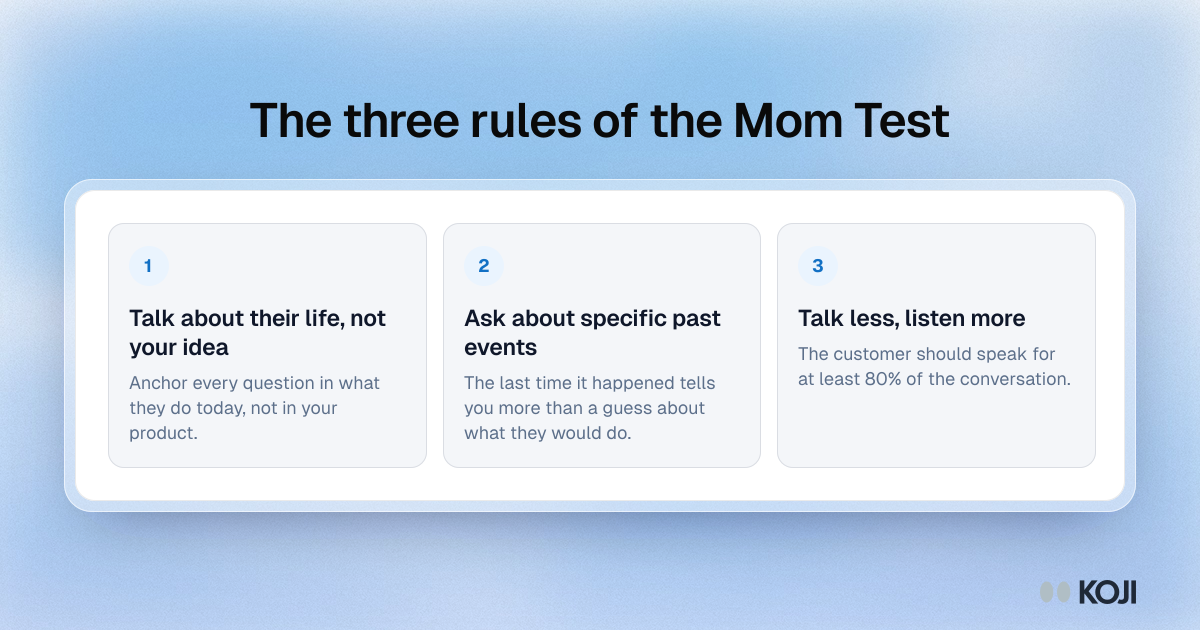
Rule 1: Talk About Their Life, Not Your Idea
The moment you start describing your product idea, you've contaminated the conversation. People will respond to your pitch, not to their own reality. They'll be polite, encouraging, and almost entirely unhelpful.
Instead of: "We're building a tool that helps teams track their decisions. Would you find that useful?"
Ask: "When a decision gets made on your team, how do people who weren't in the room find out? Walk me through a recent example."
The first question invites a polite yes. The second reveals the actual problem (or lack thereof) in their real life.
Rule 2: Ask About Specifics in the Past, Not Generics or the Future
People are terrible at predicting their future behavior. Research from Morwitz, Steckel, and Gupta published in the Journal of Marketing Research found that stated purchase intentions are poor predictors of actual behavior, with accuracy varying from 20% to 50% depending on the product category.
But people are reasonably good at recounting things that actually happened. Past behavior is the best predictor of future behavior.
Instead of: "How often would you use something like this?"
Ask: "When was the last time this problem came up? What did you do about it?"
Instead of: "Would you pay $20/month for this?"
Ask: "Have you looked for solutions to this before? What did you try? Did you pay for anything?"
If they haven't bothered to search for a solution, that tells you the problem isn't painful enough. If they've tried and failed with three competitors, that tells you the market is real but solutions are inadequate. Both are more valuable than a hypothetical "yes, I'd pay for that."
Rule 3: Talk Less, Listen More
If you're talking more than 20% of the time, you're doing it wrong. Every minute you spend talking is a minute you're not learning.
This is harder than it sounds. When someone describes a problem you're solving, the temptation to jump in and explain your solution is almost irresistible. Resist it. Let them keep talking. The gold is in the details they share when they think you're just listening.
Signals That Matter
Fitzpatrick makes a crucial distinction between compliments and commitments. Compliments are worthless; commitments are gold.
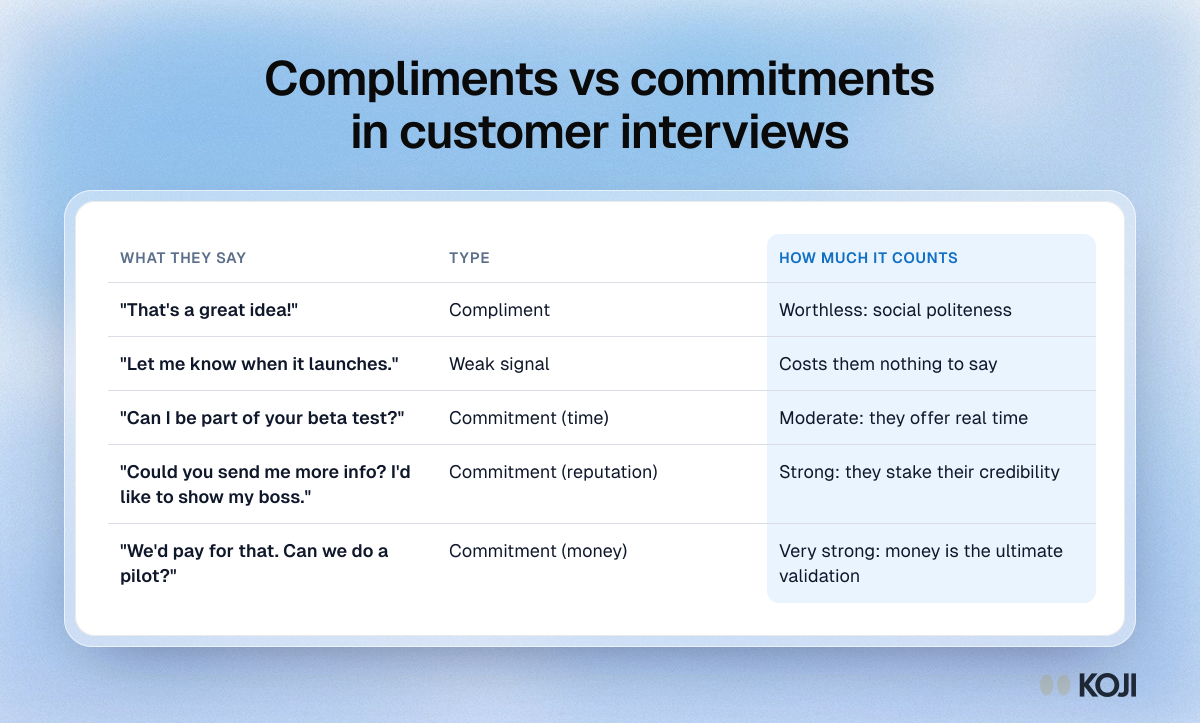
| Signal | Type | Value |
|---|---|---|
| "That's a great idea!" | Compliment | Worthless — social politeness |
| "Let me know when it launches." | Weak signal | Costs them nothing to say |
| "Can I be part of your beta test?" | Commitment (time) | Moderate — they're offering real time |
| "Could you send me more info? I'd like to show my boss." | Commitment (reputation) | Strong — they're staking their credibility |
| "We'd pay for that. Can we do a pilot?" | Commitment (money) | Very strong — money is the ultimate validation |
Don't count compliments. Count commitments. The most encouraging words in customer research aren't "That sounds amazing" — they're "When can I start using it?"
Anti-Patterns to Avoid
The Mom Test is as much about what not to do as what to do. Here are the most common mistakes:
1. Pitching Instead of Learning
The trap: You describe your idea and then ask "What do you think?"
Why it fails: You've anchored the conversation around your solution. Everything they say is now a reaction to your pitch, not a reflection of their reality. According to a study in Organizational Behavior and Human Decision Processes, anchoring effects are so powerful that even experienced professionals are significantly influenced by initial reference points.
The fix: Don't mention your product until the very end of the conversation, if at all. The best interviews feel like you're learning about someone's life, not selling something.
2. Fishing for Compliments
The trap: "Doesn't that process sound really annoying? Don't you wish someone would fix that?"
Why it fails: You're telegraphing the answer you want. Of course they'll agree — it costs them nothing and makes you happy.
The fix: Ask neutral questions and let the participant's energy guide you. If they describe a process matter-of-factly without frustration, it might not actually be a problem worth solving.
3. Accepting Fuzzy Data
The trap: "Yeah, that happens to us sometimes." You write it down as validation.
Why it fails: "Sometimes" could mean once a year or once a day. Without specifics, you have no idea.
The fix: Always drill into specifics. "When was the last time that happened? Walk me through it." "How often does this come up? Give me a rough number."
4. Talking to the Wrong People
The trap: You interview people who are easy to access rather than people who have the problem.
Why it fails: Someone without the problem will give you theoretical answers. Someone living with the problem will give you visceral, detailed ones.
The fix: Screen ruthlessly. Before the interview, verify that the participant has recent, relevant experience with the topic. See finding research participants for guidance.
5. Not Seeking Commitments
The trap: You have great conversations but never ask for a next step.
Why it fails: You accumulate encouraging quotes but no evidence of real demand.
The fix: End conversations by asking for a commitment appropriate to the stage: a referral to a colleague, a follow-up meeting, agreement to test a prototype, or a letter of intent.
Applying Mom Test Principles With Koji
The Mom Test principles apply to every interview you conduct, whether in person, over video, or through an asynchronous research platform. When running interviews through Koji, the same rules hold: your interview guide should focus on past behavior and real situations, not hypothetical scenarios or reactions to your idea.
Koji's AI analysis can help you identify when participants are giving you compliments versus commitments — flagging generic positive statements versus specific evidence of real demand. This makes it easier to separate signal from noise across multiple interviews.
Mom Test Quick Reference
| Do This | Not This |
|---|---|
| Ask about their life and behavior | Pitch your idea and ask for opinions |
| Ground questions in specific past events | Ask about hypothetical future behavior |
| Listen more than you talk (80/20 rule) | Dominate the conversation with your vision |
| Dig into specifics when answers are vague | Accept "sometimes" or "usually" at face value |
| Count commitments, not compliments | Feel validated by "That sounds great!" |
| Seek advancement (next steps, intros, money) | End with "Thanks, that was really helpful!" |
Further Reading
- User Interview Guide — the full interview methodology
- Writing Interview Questions — tactical question design that complements Mom Test thinking
- Choosing a Methodology — when to use Mom Test versus other interview approaches
Further reading on the blog
- The Mom Test for Customer Interviews: How to Ask Questions That Get Real Answers (2026) — The Mom Test is the founder's guide to customer interviews that actually work. This complete guide covers Rob Fitzpatrick's three rules, rea
- Best User Research Tools for Startups in 2026: The Complete Buyer's Guide — 43% of startups fail because of poor product-market fit. The fix isn't more guesswork — it's better customer research. Here are the best use
- Concept Testing: The Complete Guide for Product Teams (2026) — Concept testing validates whether your idea is worth building before you build it. This guide covers methods, question templates, analysis a
Related Articles
Avoiding Bias in Research Interviews
Understand the most common biases in qualitative research — confirmation bias, leading questions, and social desirability — and learn proven techniques to minimize their impact on your data.
Choosing a Methodology
An overview of every research methodology Koji supports and when to use each one.
Courtesy Bias: Why Respondents Tell You What You Want to Hear
Courtesy bias is when respondents give overly positive, agreeable answers to avoid offending the interviewer or sponsor. Learn where it shows up, the evidence, and how neutral moderation, anonymity, and behavior-based questions fix it.
Customer Discovery Interviews: The Complete Guide
Learn how to conduct customer discovery interviews to validate your product ideas before building. Covers Steve Blank methodology, question frameworks, sample sizes, and common mistakes.
How to Identify and Validate Customer Pain Points Through Research
A complete guide to discovering the real problems customers face — using AI interviews, structured questions, and proven frameworks to surface pain points that drive product decisions.
Demand Characteristics: When Participants Tell You What They Think You Want
Demand characteristics are the cues in a study that let participants guess your hypothesis and change their behavior to fit it. Learn where they come from, how they differ from social desirability and the Hawthorne effect, and how to design research that captures honest behavior.
MCP Workflow Guide for Product Managers
End-to-end guide for product managers using Koji MCP with Claude to automate customer discovery, validate hypotheses, and generate stakeholder-ready research reports — all from a single conversation.
How to Validate Product-Market Fit Through Qualitative Interviews
Learn how to design and run customer interviews specifically focused on measuring and moving your product-market fit score.
Prototype Testing and Concept Validation: A Researcher's Complete Guide
Learn how to validate product concepts and prototypes through research interviews before committing to build. Covers when to use each approach, question frameworks, and how AI interviews scale concept validation 10x faster.
Why a Vague Question Gets a Short Answer: Specificity and the Length Contract (2026)
Answer length is a property of the question, not of the participant. How the maxim of quantity sets an implied contract for how much detail is required, and how to write questions that earn it.
Solution Interviews: How to Validate Product Ideas Before You Build
A practical guide to running solution interviews — the second half of customer development — to test whether your proposed solution actually solves a real, painful problem.
Startup Idea Validation: How to Test Your Idea with Customer Interviews
A research-backed guide to validating startup ideas through customer interviews — before you write a line of code.
The Definitive Guide to User Interviews
Everything you need to plan, conduct, and analyze user interviews that produce actionable research insights.
How to Create Research-Backed User Personas from Customer Interviews
Learn how to build accurate user personas using qualitative interviews rather than assumptions. Includes a step-by-step process for recruiting, interviewing, clustering, and maintaining personas.
User Research Mistakes: 14 Pitfalls That Sabotage Your Insights (2026)
The most common user research mistakes that lead to misleading insights — and how to avoid each one with better methodology and AI-powered interviews.
How to Write Great Interview Questions
Learn to craft open-ended, neutral interview questions that surface genuine user insights instead of confirmation bias.