The Complete Guide to Thematic Analysis
Learn how to systematically analyze qualitative data using Braun and Clarke's six-phase thematic analysis framework.
You've conducted your interviews. You have hours of recordings and hundreds of pages of transcripts. Now what?
This is the moment where many research projects stall. The gap between raw data and actionable insights is where thematic analysis comes in — it's the most widely used method for making sense of qualitative data, and this guide will walk you through it step by step.
What Is Thematic Analysis?
Thematic analysis is a method for identifying, analyzing, and reporting patterns (themes) within qualitative data. It was formalized by Virginia Braun and Victoria Clarke in their landmark 2006 paper, which has been cited over 200,000 times according to Google Scholar — making it one of the most influential methodology papers in social science.
Unlike content analysis (which counts occurrences) or grounded theory (which builds theory from data), thematic analysis offers a flexible approach that works across different epistemological positions. You don't need to subscribe to a specific theoretical framework to use it effectively.
At its core, thematic analysis answers the question: What are the recurring patterns across my data, and what do they mean?
When to Use Thematic Analysis
Thematic analysis is appropriate when you:
- Have qualitative data from user interviews, focus groups, open-ended surveys, or similar sources
- Want to identify patterns across multiple participants or data sources
- Need to produce findings that are accessible to non-researcher stakeholders
- Want a flexible method that doesn't require deep expertise in a specific theoretical tradition
It's less suitable when you need to preserve individual narratives (use narrative analysis), when you're building theory from scratch (use grounded theory), or when you need to analyze language use itself (use discourse analysis).
Braun and Clarke's Six-Phase Framework
Braun and Clarke's framework provides a clear, systematic process. These phases are sequential but not strictly linear — you'll often move back and forth between them as your understanding deepens.
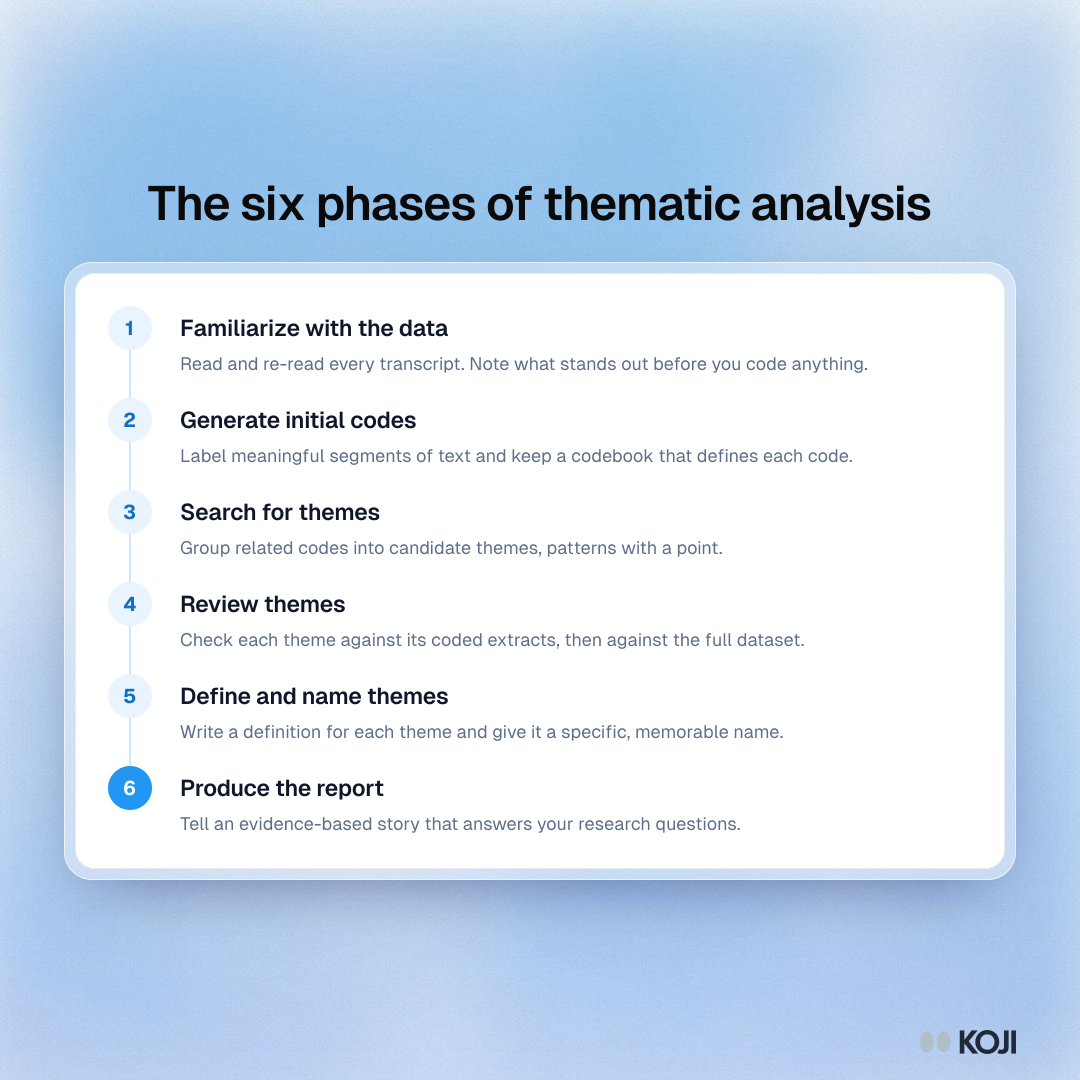
Phase 1: Familiarization with the Data
Goal: Immerse yourself in the data so deeply that you begin noticing patterns intuitively.
This phase is about reading and re-reading your data. If you conducted the interviews yourself, you already have a head start, but don't skip the careful re-reading — you'll notice things you missed in the moment.
What to do:
- Transcribe all audio/video recordings if you haven't already
- Read through every transcript at least twice
- Take initial notes — jot down things that strike you as interesting, surprising, or recurring
- Don't start coding yet; stay open and curious
According to a 2020 study published in the International Journal of Qualitative Methods, researchers who spend more time on familiarization produce significantly more nuanced and well-supported themes. Rushing this phase is the most common cause of shallow analysis.
Time investment: Plan for 1–2 hours per transcript during familiarization. For a study of 10 interviews, that's 10–20 hours before you even begin formal coding.
Phase 2: Generating Initial Codes
Goal: Systematically label meaningful segments of your data.
Coding is the process of attaching short labels to segments of text that capture something relevant to your research questions. A single passage might receive multiple codes.
What to do:
- Work through each transcript systematically
- Highlight data segments that relate to your research questions
- Assign descriptive codes to each segment
- Code for as many potential themes as possible — you can always merge or discard later
- Keep a codebook that defines each code
Example of coding in practice:
| Data Excerpt | Codes |
|---|---|
| "I spend half my Monday just trying to figure out what everyone else did last week." | Time waste, Status visibility gap, Monday friction |
| "The dashboard shows numbers but I don't know what to actually do with them." | Data without context, Actionability gap, Dashboard frustration |
| "I just ask Sarah because she always knows what's going on." | Informal information networks, Key-person dependency, Workaround behavior |
Coding approaches:
| Approach | Description | Best For |
|---|---|---|
| Inductive | Codes emerge from the data itself | Exploratory research, new domains |
| Deductive | Codes come from existing theory or a predefined framework | Testing hypotheses, building on prior research |
| Hybrid | Start with some deductive codes, allow inductive codes to emerge | Most product research scenarios |
Phase 3: Searching for Themes
Goal: Group your codes into potential themes — broader patterns that tell a story about your data.
A theme captures something important about the data in relation to your research question. It's not just a topic (like "onboarding") — it's a pattern with a point (like "users feel abandoned after initial setup because documentation assumes prior expertise").
What to do:
- Gather all codes and their associated data into one view
- Look for codes that cluster together or relate to a similar concept
- Create candidate themes by grouping related codes
- Some codes won't fit anywhere — that's fine; set them aside
- Consider both semantic themes (surface-level) and latent themes (underlying assumptions or ideologies)
This is where affinity mapping can be incredibly valuable — physically or digitally grouping coded data to see patterns emerge.
Phase 4: Reviewing Themes
Goal: Refine your themes so they are coherent, distinct, and well-supported by data.
This is a quality-control phase. You're checking that your themes actually work — that they hold together internally and are clearly distinguishable from each other.
Two levels of review:
-
Level 1 — Review coded extracts. Read all the data segments assigned to each theme. Do they form a coherent pattern? If not, consider splitting the theme, moving some codes to another theme, or discarding codes that don't fit.
-
Level 2 — Review against the full dataset. Re-read the entire dataset with your theme map in mind. Do the themes accurately represent the data as a whole? Are there patterns you missed?
Signs a theme needs work:
- It's too broad (captures everything but says nothing)
- It overlaps significantly with another theme
- It's supported by only one or two data points
- You can't explain it in one or two sentences
Phase 5: Defining and Naming Themes
Goal: Write clear, concise definitions and give each theme a compelling name.
Each theme should have:
- A name that captures the essence (avoid generic labels like "Communication Issues" — try "The Information Black Hole Between Teams" instead)
- A definition of what the theme captures and what it doesn't
- A narrative that explains the story this theme tells, with supporting data
Good theme names are specific, evocative, and instantly understandable. They help stakeholders grasp the insight without reading the full analysis.
Phase 6: Producing the Report
Goal: Tell a compelling, evidence-based story that answers your research questions.
Your report isn't just a list of themes — it's a narrative that weaves together your findings into a coherent answer to your research questions. Each theme should be illustrated with vivid data extracts that bring the pattern to life.
A strong thematic analysis report includes:
- An overview of the research questions and methodology
- A presentation of each theme with supporting evidence
- An analysis of how themes relate to each other
- Implications for design, product, or business decisions
- Limitations and areas for further research
The Time Problem — And How to Solve It
Let's be honest: traditional thematic analysis is slow. Research published in Qualitative Research journal estimated that a full thematic analysis of 10 interviews takes between 60 and 120 hours when done manually — from transcription through reporting.
For product teams operating on sprint timelines, that's often not feasible. This is where the analysis process has evolved significantly:
AI-assisted analysis can reduce the mechanical parts of the process — transcription, initial coding, and code clustering — from days to hours. A 2023 study in the Journal of Medical Internet Research found that AI-assisted qualitative coding achieved 78% agreement with expert human coders, and that human-AI collaborative coding was faster than either alone.
Koji applies this principle to research analysis: after your interviews are complete, AI generates initial codes and theme suggestions that you can review, refine, and build upon. This keeps the researcher's judgment at the center while eliminating the repetitive mechanical work. The result is thematic analysis in hours rather than weeks — without sacrificing rigor.
Inductive vs. Deductive Thematic Analysis
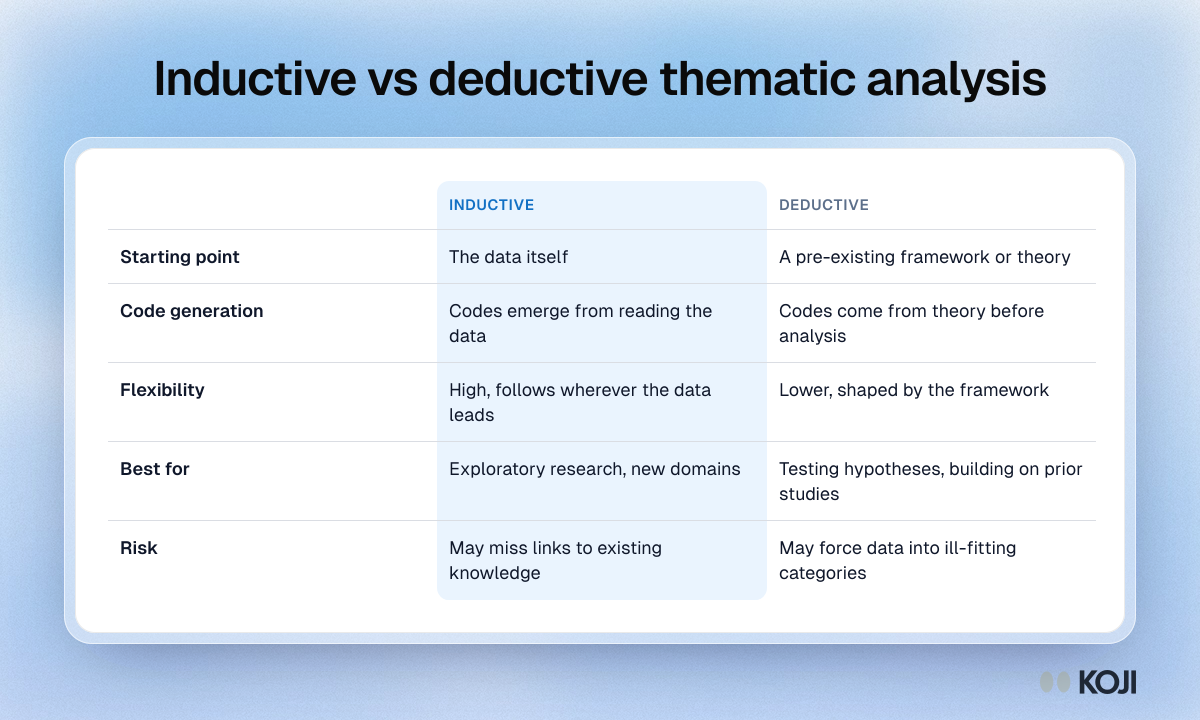
| Dimension | Inductive | Deductive |
|---|---|---|
| Starting point | The data itself | A pre-existing framework or theory |
| Code generation | Codes emerge from reading data | Codes derived from theory before analysis |
| Flexibility | High — follows wherever data leads | Lower — constrained by the framework |
| Best for | Exploratory research, new domains | Testing specific hypotheses, building on prior studies |
| Risk | May miss connections to existing knowledge | May force data into ill-fitting categories |
Most product research benefits from a hybrid approach: start with a few deductive codes based on your research questions, but remain open to inductive codes that emerge from the data.
Quality Criteria for Thematic Analysis
How do you know if your analysis is good? Braun and Clarke outlined a 15-point checklist, but here are the essentials:
- Transcriptions are accurate and retain enough detail for analysis
- Each data item has been given equal attention during coding
- Themes are not just paraphrases of questions — they capture patterns
- Data has been analyzed, not just described — you've interpreted what patterns mean
- There is a good balance between analytic narrative and data extracts
- Enough time has been allocated to complete all phases adequately
Common Pitfalls
- Using data collection questions as themes. "What participants said about onboarding" is a topic, not a theme. A theme captures a pattern with a point.
- Weak or unconvincing themes. Every theme needs substantial supporting evidence from multiple participants.
- Mismatch between data and claims. Don't claim a theme is prevalent if only two people mentioned it.
- Not going beyond description. Description says what the data contains. Analysis says what the data means.
Getting Started with Thematic Analysis
If you're new to thematic analysis, here's a practical starting point:
- Start with a small dataset — 5 to 6 interviews from a focused study
- Use a hybrid coding approach with 3–5 deductive codes and room for inductive codes
- Keep a reflexive journal noting your interpretive decisions
- Discuss emerging themes with a colleague — external perspective improves quality
- Practice naming themes with specificity
For related techniques, explore our guide to affinity mapping, which provides a complementary approach to organizing qualitative data into themes.
Next Steps
- User Interview Guide — ensure your data collection supports strong analysis
- Affinity Mapping — a visual approach to theme identification
- Writing Interview Questions — better questions lead to richer data for analysis
Further reading on the blog
- How to Analyze Customer Interview Data: A Complete Guide — You ran the interviews. Now what? Here is a step-by-step process for turning raw transcripts into clear, actionable insights your team will
- How to Analyze User Interview Data: A Complete Guide (2026) — You ran the interviews. Now what? This step-by-step guide covers how to turn raw interview data into clear, actionable insights — with and w
- Best AI Thematic Analysis Tools in 2026: The Complete Buyer's Guide — A side-by-side review of the top AI thematic analysis platforms in 2026 — what each does well, where they fall short, and why AI-native rese
Related Articles
Affinity Mapping: Organize Qualitative Data Into Themes
Learn how to use affinity mapping to group qualitative research data into meaningful clusters and uncover actionable patterns.
Agent Trajectory Evaluation: How to Judge Multi-Step AI Agents with Real Users (2026)
Outcome-only scoring hides where AI agents actually break. Learn how to evaluate the full trajectory - every reasoning step, tool call, and hand-back to the user - using step-level rubrics and real participant evidence.
AI Auto-Tagging for Customer Interviews: Code 100 Interviews in Minutes
How AI auto-tagging compresses 40+ hours of manual qualitative coding into minutes. Covers the two-cycle coding approach Koji uses (descriptive cycle-1 + axial cycle-2), the difference between auto-tagging and thematic analysis, building a codebook the AI respects, and how to validate AI-generated tags against your standards.
AI Transcription for Research Interviews: Speed Up Analysis by 10x
Learn how AI transcription transforms research interviews — from audio to analysis in minutes. Covers accuracy, speaker identification, theme extraction, quality scoring, and how Koji automates the entire pipeline.
The Average of a Ratio Is Not the Ratio of the Averages (2026)
Averaging percentages across segments, or averaging through a curve, produces a number that describes nobody. Two distinct failure modes, two different fixes.
The Bradford Hill Criteria: Making Causal Claims When You Cannot Run the Experiment (2026)
Most of what matters in product research cannot be randomised. Bradford Hill nine viewpoints are the framework for building a defensible causal case without an A/B test.
How to Code Qualitative Data: A Step-by-Step Guide
Learn the complete process of qualitative coding — from building a codebook to identifying themes — and how AI tools like Koji automate the most time-consuming parts.
What Participants Mean But Never Say: Implicature in Interview Answers (2026)
Participants routinely convey more than their words state. Learn to read conversational implicature, run the cancellation test, and stop coding interviews literally.
When the Number Is Right and the Answer Is Wrong: Counting Themes by Mention or by Participant (2026)
One set of transcripts, two legitimate counting rules, two rankings with a Spearman correlation of -0.10. Both are correct. Only one answers your question.
Customer Feedback Analysis: How to Turn Raw Input Into Actionable Insights
A complete guide to analyzing customer feedback — from coding and theming to prioritizing findings and sharing insights with stakeholders. Includes how AI compresses weeks of manual analysis into hours.
Diagnostic Overshadowing: Why One Known Problem Hides Every New One (2026)
A known problem absorbs the evidence for a new one. How diagnostic overshadowing hides novel issues in feedback analysis, and four checks that detect it.
Diary Studies: The Complete Guide to Longitudinal User Research
Learn how to design, run, and analyze diary studies that capture real user experiences in context. Includes how AI interviews complement diary research at scale.
Why the Loudest Complaint Hides the Real One: Masking in Customer Interviews (2026)
One dominant complaint does not just take up airtime - it raises the threshold for everything quieter, asymmetrically, and your analysis then discards what was buried. A protocol for hearing the masked signal.
Evidence Synthesis: How to Combine Findings Across Multiple Research Studies (2026)
Most teams have dozens of studies and no way to say what they collectively know. Evidence synthesis is the discipline of pooling findings across studies into a single rated conclusion - adapted from GRADE and systematic review practice for product research.
Why the Feature Request That Reaches You Is Bigger Than the Problem (2026)
Relayed feedback does not fade, it amplifies. The bullwhip effect explains why a request arrives louder and lumpier than the experience behind it.
The Five Whys Technique: How to Find Root Causes in User Research (with AI)
The Five Whys is a root-cause analysis technique that turns surface-level user feedback into actionable insight. Learn how to apply it in interviews and run it with AI-powered probing at scale.
Framework Analysis: The Complete Guide to the Matrix Method for Qualitative Data (2026)
A step-by-step guide to framework analysis (the Framework Method) for qualitative research — the five stages, the charting matrix, when to use it, and how AI speeds it up.
Function Allocation: Deciding What AI Should Do in Your Research and What You Keep (2026)
The Fitts List asked which tasks humans are better at and which machines are better at. Seventy five years of human factors research says that framing is the problem. This guide replaces the who-does-what question with a stage-by-stage allocation method for research work, and explains why the tedious-versus-judgment split is the wrong seam.
Grounded Theory in Qualitative Research: A Practical Guide
A practical guide to grounded theory methodology — how to collect, code, and analyze qualitative data to develop theory from the ground up, and how AI-powered tools accelerate the iterative analysis process.
How to Analyze Focus Group Data: A Step-by-Step Guide (2026)
Learn how to analyze focus group data and transcripts step by step — transcription, coding, theme development, handling group dynamics, and reporting. Plus how AI tools like Koji automate the whole process.
How to Analyze Qualitative Data: From Raw Interviews to Actionable Insights
A step-by-step guide to qualitative data analysis — from reviewing raw transcripts to synthesizing themes, generating insights, and presenting findings that teams act on.
How to Quantify Qualitative Data Without Overclaiming
How to turn coded interview themes into counts you can defend: count people not mentions, give the base, add the uncertainty, and know when a survey is the better tool.
The Illusion of Explanatory Depth: Why Users Explain Confidently and Wrongly (2026)
Asking users why is asking the one question people are most overconfident about. Why mechanism probes work, reason questions do not, and what to ask instead.
When the Human Baseline Is Wrong: Validating AI Analysis Against an Imperfect Gold Standard (2026)
Checking AI coding against one senior researcher does not measure accuracy - it measures agreement with that person, errors included. Here is how imperfect reference standards bias the number, which direction, and what to do instead.
The Assemblage and the Type Fossil: Which Quotes Actually Carry Information (2026)
Your most-mentioned theme is usually your least informative, because a signal present in every period cannot tell you which period you are in. The index-fossil test for diagnostic feedback.
Inter-Rater Reliability in Qualitative Research: A Practical Guide to Coding Agreement
Learn how to measure inter-rater (intercoder) reliability in qualitative research using Cohen's kappa and Krippendorff's alpha, what thresholds count as reliable, and how AI-native tools make consistent coding the default.
MCP Workflow Guide for UX Researchers
How UX researchers use Koji MCP with Claude to scale qualitative research. Manage multiple studies, analyze transcripts across projects, generate themed reports, and maintain a living research repository.
Member Checking in Qualitative Research: How to Validate Findings With Participants
What member checking is, the four main types, a step-by-step process, how to handle participant disagreement, and how to run a member check at scale with AI interviews.
Miro + Koji: Take AI-Clustered Themes Straight Onto an Affinity Board
How to move Koji AI interview themes and verbatim quotes into Miro as sticky notes, and which parts of affinity mapping are now redundant.
Narrative Analysis: A Complete Guide for Qualitative Research
Learn what narrative analysis is, how it differs from thematic analysis, the four main approaches (thematic, structural, dialogic, visual), a step-by-step process, and how to do it at scale with AI.
Has Your Open-End Data Gone Flat? Measuring Lexical Diversity Instead of Accusing Participants
You cannot judge whether one response was AI-written, but you can measure whether a whole batch has lost its variance. A practical guide to lexical diversity and near-duplicate monitoring for open-ended research data.
Qualitative Data Analysis Software: The AI-Native Alternative to NVivo and ATLAS.ti (2026)
A practical guide to qualitative data analysis (QDA) software in 2026 — what it does, how legacy CAQDAS tools like NVivo and ATLAS.ti compare, and why AI-native platforms like Koji collapse coding, theming, and reporting into one automated workflow.
Qualitative vs. Quantitative Research: When to Use Each Method
A clear breakdown of qualitative and quantitative research — what each method reveals, when to use each, and how to combine them for the most complete picture of your users.
Rapid Qualitative Analysis: How to Get From Interviews to Findings in Days
Rapid qualitative analysis replaces line-by-line coding with summary templates and a participant-by-topic matrix. How the Hamilton method works, what the evidence says, and how to run one.
Reflexive Thematic Analysis: Braun and Clarke's Approach in Practice
How to do reflexive thematic analysis: the six phases, how it differs from codebook and coding reliability TA, common reporting mistakes, and where AI tools fit.
Blanks and Spikes: Two Control Samples That Audit Your Research Instrument (2026)
Analytical labs run two different controls because there are two different ways to be wrong. A spike measures what your process misses; a blank measures what it invents. Here is how to run both on a research pipeline.
How to Build a UX Research Repository: The Complete Guide
A research repository transforms scattered insights into a searchable organizational asset. Learn how to build one that teams actually use.
No Summary Preserves Everything: What Map Projections Teach About Research Reporting (2026)
Every research summary is a projection, and the impossibility of a lossless one is a theorem rather than a craft failure. Why spot-checking quotes cannot detect the distortion, and what to publish instead.
Research Synthesis: How to Combine Multiple Studies Into Clear Insights
A practical guide to synthesizing findings across multiple research studies — using thematic synthesis, triangulation, and structured data aggregation to build compounding organizational knowledge.
Singleton Themes: Why One-Off Comments Are the Only Estimate You Have of What You Missed (2026)
Good-Turing says the chance the next respondent raises something new is the singleton count divided by total mentions. Every synthesis step deletes singletons first.
Survey Data Analysis: How to Turn Raw Responses Into Decisions (Methods + AI)
A step-by-step guide to survey data analysis in 2026 — how to clean, analyze, and report both quantitative and open-ended survey data, the core methods to know, and how AI-native research turns raw responses into decisions faster.
Surveys vs. Interviews: How to Choose the Right Research Method
A comprehensive comparison of surveys and interviews as research methods. Understand when to use each, the key trade-offs, how to combine them in mixed-methods studies, and why the choice matters for research quality.
Theme Dispersion: Why 47 Mentions Can Mean Three Customers (2026)
A mention count hides how many people produced it. 47 mentions can be 41 customers or 3. Report distinct speakers beside every count, choose your dispersion unit deliberately, and use Gries DP when the decision is expensive.
Turning Interviews Into Insights: From Raw Data to Action
A complete guide to transforming raw interview transcripts into structured, actionable insights — covering manual analysis, AI-assisted workflows, and frameworks for prioritizing findings.
The Definitive Guide to User Interviews
Everything you need to plan, conduct, and analyze user interviews that produce actionable research insights.
Verbatim Analysis: How to Code and Analyze Open-Ended Responses at Scale (2026)
Verbatim coding turns messy open-ended answers into countable themes — but manual coding is slow, expensive, and bias-prone. Learn the code-frame workflow, the manual vs AI tradeoff, and how Koji auto-codes verbatims and captures the depth a survey verbatim never could.
How to Write Great Interview Questions
Learn to craft open-ended, neutral interview questions that surface genuine user insights instead of confirmation bias.