Jobs to Be Done Framework: The Complete Guide
The definitive guide to the Jobs to Be Done (JTBD) framework — its history, two schools of thought, how to write JTBD statements, famous examples, how to conduct JTBD research, and how AI interviews enable JTBD at scale.
Why 95% of Products Fail — and What JTBD Does About It
95% of new products fail. Not because teams can't build, design, or ship. Because they build the wrong thing for the wrong reason.
Clayton Christensen, who spent decades studying innovation failure, identified the root cause: correlation-based market research. Companies collect enormous data about customers — demographics, behaviors, stated preferences — but data doesn't causally explain why customers buy. Without a causal framework, product teams optimize around the wrong signals.
Jobs to Be Done (JTBD) provides that causal framework.
"When we buy a product, we essentially 'hire' it to help us do a job. If it does the job well, the next time we're confronted with the same job, we tend to hire that product again. And if it does a crummy job, we 'fire' it and look for an alternative." — Clayton Christensen, Competing Against Luck
The insight is deceptively simple: customers don't buy products. They hire them to make progress in specific situations in their lives. Understanding the job — with its functional, emotional, and social dimensions — is what makes innovation predictable instead of accidental.
The History of JTBD
Tony Ulwick: The Originator (1990)
The Jobs to Be Done framework was originated by Tony Ulwick, not Christensen, though Christensen later popularized it widely. Ulwick's story begins inside IBM in the 1980s, where he witnessed a deeply inefficient innovation process generating far more failures than successes. In 1990, he left IBM and began applying Six Sigma thinking to innovation — treating the customer's underlying process (the "job") as the subject of investigation, breaking it into discrete steps, and attaching measurable metrics to each step.
He formalized this as Outcome-Driven Innovation (ODI) and introduced it to Clayton Christensen at Harvard Business School in 1999. Philip Kotler called Ulwick "the Deming of innovation"; Christensen credited him with "bringing predictability to innovation."
Clayton Christensen: The Popularizer (2003–2016)
Christensen spread the JTBD concept widely through The Innovator's Solution (2003) and Competing Against Luck (2016) — his most comprehensive treatment. His central argument: companies track customers and products exhaustively but data doesn't causally explain why customers make choices. JTBD provides that causal explanation.
Bob Moesta: The Practitioner (2003–present)
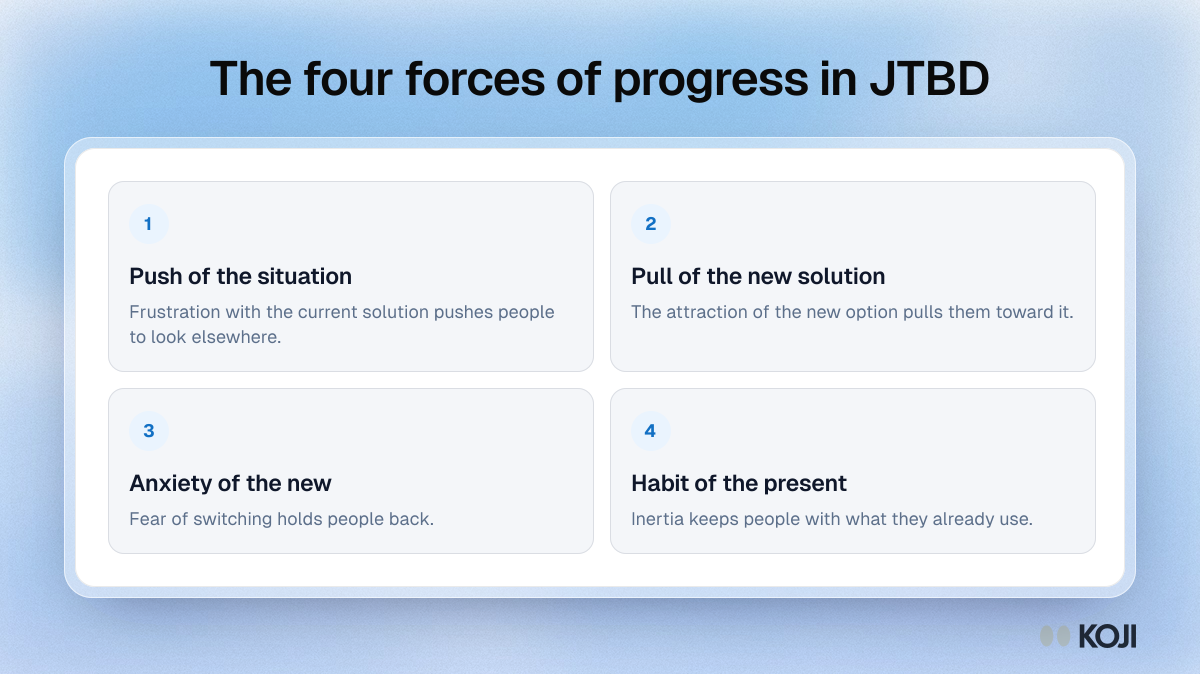
Bob Moesta worked directly with Christensen and became one of the most influential JTBD practitioners. He developed the Switch Interview — a structured, timeline-based qualitative interview that reconstructs the exact moment a customer decided to change solutions — and the Four Forces of Progress model explaining the push/pull/anxiety/habit forces acting on any purchase decision.
"Demand is actually created by a struggling moment. When people struggle, that's when they want to switch... You don't just wake up out of bed saying 'I need to buy a mattress.' When you press people enough, they say, 'Well actually, the spring dug into my back.'" — Bob Moesta, The Rewired Group
The Two Schools of JTBD
The JTBD community has a well-documented internal division between two interpretations, each emphasizing different aspects of the framework:
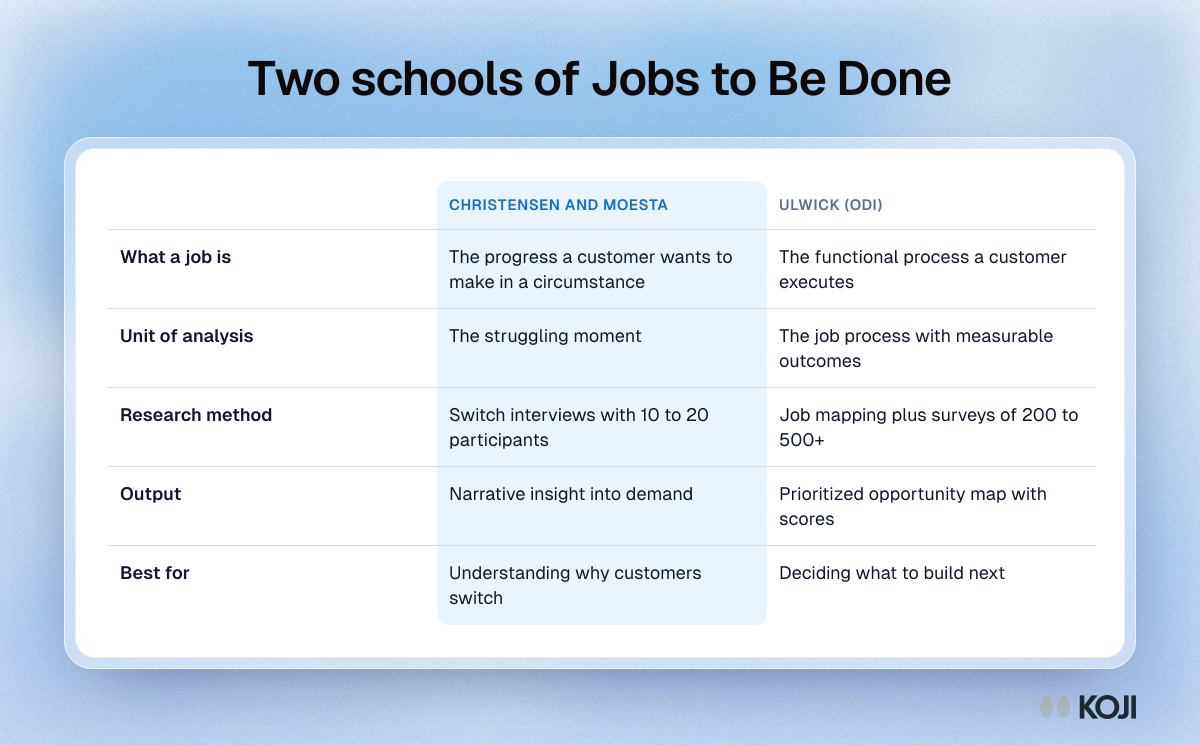
| Dimension | Christensen/Moesta: Jobs-as-Progress | Ulwick/ODI: Jobs-as-Activities |
|---|---|---|
| What is a "job"? | The progress a customer desires to make in a circumstance | The underlying functional process a customer executes |
| Unit of analysis | The struggling moment | The functional job process with measurable outcomes |
| Research method | Qualitative switch interviews (10–20 participants) | Qual job mapping + quantitative outcome surveys (200–500+) |
| Output | Narrative insight, demand understanding | Prioritized opportunity map with opportunity scores |
| Best for | Understanding WHY customers switch | Identifying WHAT to build next |
In practice, most teams benefit from both approaches: Christensen/Moesta's switch interviews to understand demand-side dynamics and switching motivation, and Ulwick's outcome mapping to identify which specific gaps are most worth closing.
The Three Dimensions of Every Job
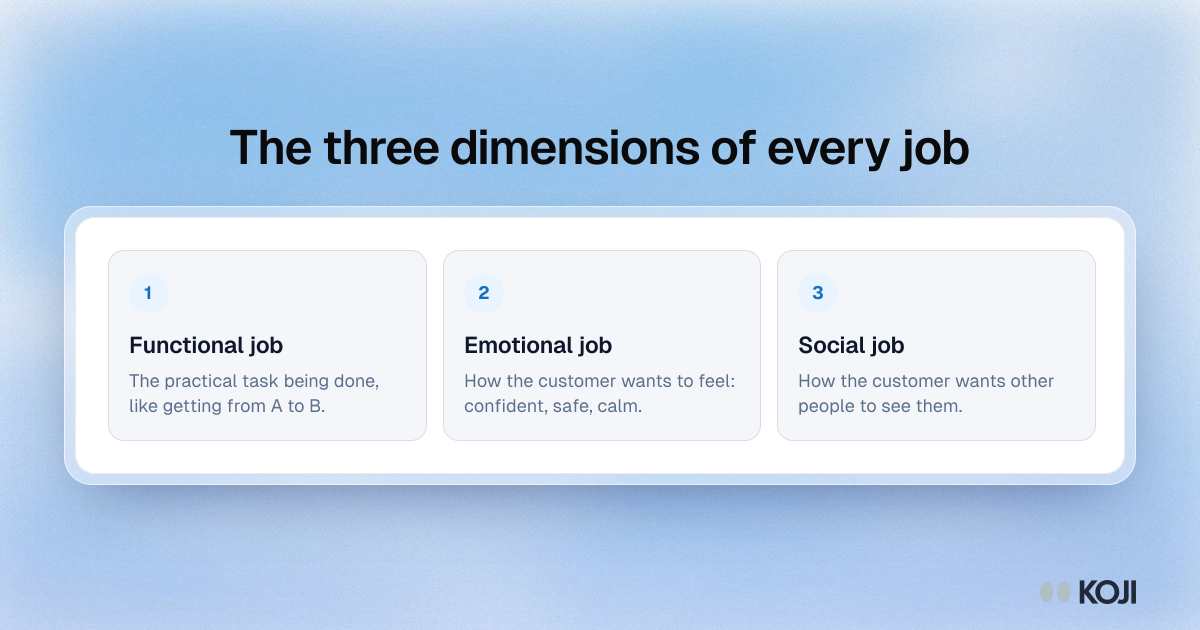
A complete job has three dimensions. Focusing only on the functional dimension is the most common JTBD implementation mistake.
Functional job — the practical task being accomplished: "get from A to B," "restore blood flow in a blocked artery," "manage inventory efficiently."
Emotional job — how the customer wants to feel: confident, safe, accomplished, calm, excited.
Social job — how the customer wants to be perceived by others: successful, responsible, innovative, caring.
All cars address the same functional job: transport from A to B. Tesla attracts buyers whose social job is projecting environmental responsibility. Porsche addresses the emotional job of driving pleasure. Rolls-Royce serves the social job of projecting success. The functional job is identical; the jobs that drive brand choice are entirely different.
How to Write JTBD Statements
Three formats serve different purposes:
1. The Job Statement (Ulwick format)
Structure: [Action Verb] + [Object of the Verb] + [Contextual Clarifier]
Examples:
- "Listen to music while commuting"
- "Restore blood flow in a blocked artery"
- "Organize and access music in any sequence while doing other things"
2. The Desired Outcome Statement (ODI format)
Structure: [Minimize/Maximize] + [Metric] + [Object of Control] + [Contextual Clarifier]
Examples:
- "Minimize the time it takes to get songs in the desired order for listening"
- "Minimize the likelihood of missing the optimal time to perform the procedure"
- "Minimize the effort required to understand what a pet needs to address existing health problems"
Outcome statements are the foundation of ODI's quantitative research — each one is rated by importance and current satisfaction to generate opportunity scores.
3. The Job Story (Klement/Intercom format)
Structure: "When [situation], I want to [motivation], so I can [expected outcome]"
This format, popularized by Alan Klement and Intercom, replaces traditional user stories ("As a [persona], I want [feature] so that [benefit]"):
- "When I'm preparing for a board presentation, I want to quickly synthesize customer interview data, so I can tell a coherent story without spending two days on analysis."
- "When my support team's workload spikes unexpectedly, I want to see trend data on ticket volume, so I can make a staffing decision before we fall behind."
- "When I'm recruiting participants for UX research, I want to automate screening and scheduling, so I can move participants through the study without the manual time sink."
The job story format's power is its situational specificity. "When [situation]" anchors the job to a real circumstance, preventing the vagueness that makes traditional user stories difficult to act on.
Famous JTBD Examples
The Milkshake (Christensen/McDonald's)
The most cited JTBD case study. McDonald's was trying to increase milkshake sales using traditional methods — flavor variants, discounts, bundling. All failed. Christensen's team observed that a significant share of milkshakes sold in the morning went to solo commuters. Customers were not in the "milkshake market" — they were hiring a milkshake to do the job: "make my long, boring commute interesting and keep me full until lunch." With this insight, the product was redesigned to extend consumption time, directly serving the functional and emotional job.

Photo by Brian Dys Sahagun on Unsplash
Intercom
After three years, Intercom's growth stalled. Switch interviews revealed customers were hiring Intercom to do one of four distinct jobs. Intercom rebuilt its product, go-to-market strategy, and pricing structure around each job. Result: 500% company growth in 18 months and 3× revenue increase.
Airbnb
Airbnb recognized travelers were hiring accommodation not for "a bed" but to "feel like a local and belong somewhere while traveling." This reframing drove every product and brand decision — and created a category now worth over $100 billion.
Spotify
Spotify's core insight: people don't hire a music service to "own songs." They hire it to have "the right music for any mood, moment, or activity without friction." This drove Discover Weekly, Release Radar, mood-based playlists, and collaborative playlists — all serving specific situational jobs.
Cordis Corporation (ODI, 1992)
Ulwick's first ODI engagement. By mapping the interventional cardiologist's job of "restoring blood flow in a blocked artery" into discrete outcome statements, Cordis launched 19 new products, all of which became #1 or #2 in their market segments. Market share rose from 1% to over 20%; stock price more than quadrupled.
JTBD vs. User Personas
| Dimension | Traditional Personas | Jobs to Be Done |
|---|---|---|
| Core question | Who is the user? | What progress does the user want to make? |
| Unit of analysis | Demographic/behavioral archetype | Situational struggling moment |
| Stability | Static (defined once, drifts over time) | Dynamic (tied to circumstances, not people) |
| Cross-demographic insight | No — one persona = one segment | Yes — different people share the same job |
| Explains switching behavior | Weak | Strong |
| Drives product roadmap | Indirectly | Directly |
The complementary view: Most mature product teams use both. JTBD drives what to build and why. Personas help with stakeholder alignment and marketing messaging. Nielsen Norman Group frames it precisely: "Personas tell you who your user is and what they want, but they're weak at explaining why users switch products or what underlying motivation drives behavior."
If you are deciding what to build, use JTBD. If you are aligning stakeholders or writing marketing copy, use personas.
How to Conduct JTBD Research
The Switch Interview (Moesta Method)
The Switch Interview is the gold-standard JTBD qualitative method. It reconstructs the timeline of a customer's decision to switch from one solution to another.
Key principles:
- Interview 10–20 recent buyers — people who just made a purchase decision, not long-term users
- Focus on the specific switching event, not abstract preferences
- Use "how" and "what" questions, not "why" — why questions produce rationalized, post-hoc answers
- "Freeze time" at key moments: "Walk me back to the moment you first thought you needed a change..."
- Map the Four Forces immediately after: push (frustration with current solution), pull (attraction to new solution), anxiety of the new (fear of switching), habit of the present (inertia)
The Switch Timeline to explore:
- First thought — when did the current solution first feel inadequate?
- Passive looking — early signs of dissatisfaction and casual awareness of alternatives
- Active looking — what triggered the actual search?
- Decision — what was evaluated and why was the new solution chosen?
- First use — what happened in the first hours/days of the new solution?
Core interview questions:
- "Walk me through the day you decided to switch."
- "What was happening in your life at that point?"
- "Had you thought about switching before? What held you back?"
- "What almost made you not make the switch?"
ODI Research Method (Ulwick)
- Define the job executor and the core functional job
- Conduct qualitative interviews to map the job process into 10–15 discrete steps (10–30 interviews)
- Derive desired outcome statements from each step
- Run a quantitative survey (200–500 respondents) measuring importance and current satisfaction for each outcome
- Apply the Opportunity Algorithm: Opportunity Score = Importance + max(Importance – Satisfaction, 0)
- Identify underserved outcomes (high importance, low satisfaction) = innovation opportunity
- Segment customers by outcome priorities to identify distinct, actionable market segments
8 Common JTBD Misconceptions
"A job is just a user need." A need is vague ("more storage"). A job is precise, goal-directed, and has measurable outcomes. Jobs have functional, emotional, and social dimensions.
"JTBD is mainly a marketing tool." JTBD is most powerful as a product strategy and innovation tool — directly informing what to build, how to price, and how to segment markets.
"JTBD replaces personas." False. They answer different questions and work best together.
"You need the full ODI process to get value." Even 8–10 switch interviews with recent buyers surface actionable jobs-based insight. You don't need a $100K Strategyn engagement to start.
"Customers will tell you their jobs directly." People are poor at articulating jobs in direct surveys. The switch interview exists because direct questioning yields rationalized answers. The job is revealed through behavior reconstruction.
"The job is the product." The job is stable over time; the product that serves it changes. The job of "making the commute interesting" existed before podcasts, smartphones, and audiobooks.
"JTBD leads to bad design." A complete job definition explicitly includes emotional and social dimensions — how users want to feel and be perceived. JTBD does not produce purely utilitarian products.
"JTBD only applies to new products." JTBD is equally valuable for understanding churn, designing onboarding, pricing existing features, and identifying expansion opportunities.
The ROI of JTBD: What the Data Shows
- ODI achieves an 86% innovation success rate — compared to an industry baseline of ~17%, a five-fold improvement (Strategyn independent study)
- Intercom: 500% growth in 18 months, 3× revenue after rebuilding around four core JTBD insights
- Cordis Corporation: market share from 1% to 20% with 19 new #1/#2 products from a single ODI engagement
- Kroll Ontrack: $11M to $200M+ revenue over six years using JTBD-based market segmentation
- Cox Automotive vAuto: 20× increase in product install base by identifying underserved outcomes in a new segment
These are not outliers. ODI's documented success rate of 86% vs. 17% industry baseline is the most rigorously validated innovation methodology result in the literature.
JTBD at Scale with AI Interviews
Traditional JTBD research has a scaling constraint: switch interviews require skilled human moderators who can probe behavioral timelines and force mapping in real time. A professional JTBD engagement typically takes 4–8 weeks and $80,000–$120,000 in consulting fees.
AI-powered interview platforms change this equation fundamentally.
Speed: AI-moderated interview platforms conduct 100–200 voice JTBD interviews in 48–72 hours — compressing timelines from months to days.
Cost: Research that previously cost $80K–$120K now completes for a small fraction of that. With Koji, a voice interview starts as low as €3 (3 credits, from €1.00 per credit on annual plans up to €2.00 pay as you go), so a 100-interview study runs a few hundred euros rather than six figures.
Consistency: AI interviewers never ask leading questions, never skip follow-up probes, and maintain consistent methodological rigor across hundreds of simultaneous conversations.
Depth: Voice-based AI interviews produce 40% more contextual detail than written responses. And over 70% of breakthrough JTBD insights emerge from the AI's ability to probe deeper when a participant hints at something important — moments a traditional survey would miss entirely.
Platforms like Koji are purpose-built for this. Koji's AI consultant conducts conversational interviews that adapt in real time — probing the switching timeline, exploring competing alternatives, and surfacing the struggling moments that define real JTBD insights. Koji's structured questions — including ranking, single_choice, and scale types — let you quantify job importance and satisfaction alongside qualitative exploration, enabling the Opportunity Algorithm calculation at a fraction of traditional research cost.
Combine this with Koji's automatic thematic analysis and you have the equivalent of a JTBD consulting engagement — delivered continuously, at scale, integrated into your product cycle.
Getting Started With JTBD
Step 1: Define the job to research. Choose one core job you believe your product is hired to do. Be specific: "organize and access music" is a job; "better music experience" is not.
Step 2: Identify recent switchers. Find 10–15 customers who recently made a purchase decision — either switching to your product or away from it. Recent events are most accessible to memory reconstruction.
Step 3: Run switch interviews. Focus on the timeline: first thought → passive looking → active looking → decision → first use. Use "what" and "how" questions. Probe for the struggling moment.
Step 4: Map the Four Forces. After each interview, map what pushed them away from the old solution, what pulled them toward the new one, what created anxiety, and what habit/inertia they had to overcome.
Step 5: Cluster the jobs. Across 10–15 interviews, common job patterns will emerge. These clusters are your starting JTBD map.
Step 6: Scale with AI. Use AI-powered interviews to validate and expand your JTBD map across hundreds of customers — quickly and continuously, not as a one-time project.
Related Resources
- Jobs to Be Done vs Personas: when to use each, and how to build job-based personas
- The Universal Job Map: break a job into eight steps and find where customers struggle
- Structured Questions in AI Interviews — quantify job importance and satisfaction within AI interviews
- Jobs-to-Be-Done Interview Guide — deep dive on JTBD interview methodology and question design
- How to Run 50 Switch Interviews in a Week Without a Research Team — JTBD at scale with AI
- Customer Discovery Interviews: The Complete Guide — foundational customer discovery before JTBD
- The Mom Test: How to Talk to Customers Without Being Misled — complementary methodology for behavioral interviewing
- How to Create Research-Backed User Personas from Customer Interviews — when to use personas alongside JTBD
Further reading on the blog
- The Complete Guide to Jobs-to-Be-Done Interviews (JTBD Framework 2026) — Jobs-to-be-done interviews reveal why customers really switch to — or away from — your product. This complete guide covers the JTBD framewor
- Can I Paste User Interviews into ChatGPT? A Guide to GDPR and LLMs — Every product manager wants to ask an LLM about their user feedback. But pasting customer transcripts into public models is a GDPR nightmare
- The Strategic Guide to Planning User Interviews: From Hypothesis to Insight — Great user research doesn't happen by accident; it happens by design. Whether you are a Product Manager, a UX Researcher, or a Founder, the
Related Articles
AI-Generated Customer Personas: From Real Interview Data to Persona
Stop inventing personas in workshops. Learn how AI generates evidence-backed customer personas directly from interview transcripts — and why personas built from real conversations beat synthetic AI personas every time.
Blue Ocean Strategy: How to Find Uncontested Market Space with Customer Research (2026)
Blue Ocean Strategy is a framework for creating new, uncontested market space instead of fighting rivals in a crowded red ocean. Learn value innovation, the ERRC grid, the strategy canvas, and how to validate a blue ocean by researching noncustomers with AI interviews.
Customer Discovery Interviews: The Complete Guide
Learn how to conduct customer discovery interviews to validate your product ideas before building. Covers Steve Blank methodology, question frameworks, sample sizes, and common mistakes.
Customer Interview Questions: 60+ Examples for Discovery, Validation, Pricing, and Churn
A reference library of 60+ proven customer interview questions for discovery, validation, pricing, NPS follow-up, and churn — plus the principles that separate questions that surface real insight from ones that produce polite lies.
Customer Needs vs. Wants: How to Tell What Users Actually Need (2026)
Customers ask for wants but buy to satisfy needs. This guide explains the difference between customer needs and wants, why building to stated wants leads to feature bloat, and how to uncover the underlying need with Jobs-to-Be-Done, laddering, and AI-moderated research.
Customer Segmentation Research: How to Build Segments That Actually Drive Decisions
How to use qualitative interviews — rather than demographic surveys — to build behavioral and motivational customer segments that product, marketing, and sales teams actually use.
Customer Validation: The Complete 2026 Guide to Validating Your Product With Real Customers
A practical guide to customer validation — Steve Blank's second phase of customer development, validation methods, sales-led tests, and how Koji runs validation interviews in days, not months.
Ideal Customer Profile (ICP): Definition, Template, and How to Build One with AI Interviews (2026)
A complete guide to building an Ideal Customer Profile — definition, B2B and B2C templates, ICP vs persona, real examples, and how to validate your ICP with Koji's AI interviewer in days, not months.
Job Stories vs User Stories: Which Format Should Your Team Use?
A practical comparison of job stories and user stories — the two dominant formats for capturing what software needs to do. Includes when each format wins, how to convert one to the other, and how to source job stories directly from customer interviews.
Jobs-to-Be-Done Interview Guide
Learn the JTBD interview methodology to uncover why customers switch products and what progress they're trying to make.
Jobs to Be Done vs Personas: Which One Should Your Team Use?
How Jobs to Be Done and personas differ, where each one fails, and how to get both from one round of customer interviews.
How to Run 50 Switch Interviews in a Week Without a Research Team
The JTBD Switch Interview captures the Forces of Progress behind every customer decision. This guide shows how AI interviewers automate the technique at 10x scale while maintaining methodological rigor.
Lean Startup Methodology: The Complete 2026 Guide to Build-Measure-Learn
A practical guide to Lean Startup — Eric Ries's Build-Measure-Learn loop, validated learning, MVPs, pivot vs persevere, and how Koji's AI interviewer accelerates every loop.
The Mom Test: How to Talk to Customers Without Being Misled
Learn Rob Fitzpatrick's Mom Test methodology to ask questions that even your mother can't lie to you about.
Outcome-Driven Innovation (ODI): The Ulwick Method for Identifying Unmet Customer Needs
A practical guide to Anthony Ulwick's Outcome-Driven Innovation methodology — how to capture desired outcome statements, prioritize unmet needs, and turn JTBD theory into a measurable roadmap.
Pricing Research Interviews: How to Understand What Customers Will Pay
Discover how to run qualitative pricing research interviews that reveal willingness to pay, price anchors, and the emotional logic behind buying decisions — beyond what surveys can surface.
Structured Questions in AI Interviews
Mix quantitative data collection — scales, ratings, multiple choice, ranking — with AI-powered conversational follow-up in a single interview.
Trigger Event Interviews: How to Find the Moment Customers Decide They Need You
Learn how to run trigger event interviews to uncover the exact moment customers move from tolerating the status quo to actively buying — and how to run enough of them, fast, with AI-moderated interviews.
The Universal Job Map: How to Map a Customer Job Step by Step
How to build a Jobs to Be Done job map with Ulwick's eight steps, run job mapping interviews and find the steps where customers struggle most.
How to Create Research-Backed User Personas from Customer Interviews
Learn how to build accurate user personas using qualitative interviews rather than assumptions. Includes a step-by-step process for recruiting, interviewing, clustering, and maintaining personas.