

Most customer research asks the wrong question.
It asks: "What features do you want?" or "How satisfied are you?" These questions generate noise. They produce polite, optimistic answers that have no predictive value for product decisions.
The Jobs-to-Be-Done (JTBD) framework asks a different question entirely: What job is the customer hiring your product to do?
This reframe changes everything. And JTBD interviews — specifically the "switch interview" technique — are the most reliable method for answering it.
This guide explains the full JTBD approach, gives you a proven interview structure, and shows how modern teams are running JTBD research 10x faster using AI-moderated interviews.
What Is the Jobs-to-Be-Done Framework?
JTBD was developed by Harvard Business School professor Clayton Christensen and refined by Tony Ulwick (Outcome-Driven Innovation) and Bob Moesta (switch interviews). The core insight: customers do not buy products — they hire products to make progress in their lives.
When someone buys a project management tool, they are not buying features. They are hiring a solution to the job "help me look competent in front of my manager" or "eliminate the anxiety of missed deadlines." Understanding the actual job — functional, emotional, and social — is what drives product-market fit.
The JTBD framework demonstrates an 86% innovation success rate, compared to just 17% for traditional feature-driven approaches. That gap exists because JTBD research reveals demand rather than just preferences.
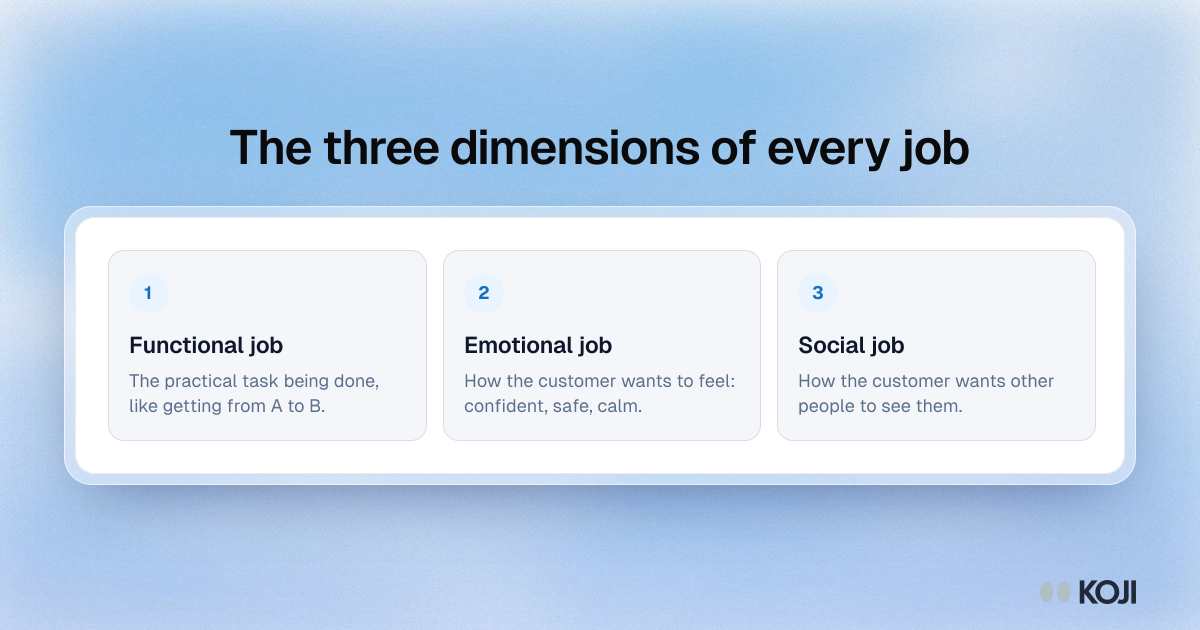
The Three Layers of Every Job
- Functional job: The practical task the customer is trying to accomplish ("I need to track which tasks are done")
- Emotional job: How they want to feel while doing it ("I want to feel in control and calm")
- Social job: How they want to be perceived ("I want my team to see me as organized and reliable")
Most products optimize for functional jobs. The teams that win optimize for all three.
Why JTBD Interviews Are Different
A standard user interview asks about opinions, preferences, and hypothetical future behavior: "Would you use X feature?" "How would you rate this on a scale of 1–10?"
Hypothetical questions produce hypothetical answers — and hypothetical answers do not predict real purchasing behavior.
JTBD interviews focus on specific past events: the moment a customer switched from one solution to another. This is called the switch interview (or switch event interview), and it is the most reliable method for understanding what actually drives behavior.
The logic: if you want to understand why someone hired your product, the most accurate data point is the specific moment they made that decision — and the full context surrounding it.
The Switch Interview: Core Technique
Bob Moesta, who refined the switch interview at the Rewired Group, teaches that every purchase involves four forces:
- Push: What frustration with the old solution pushed them to consider switching?
- Pull: What attracted them to the new solution?
- Anxiety: What hesitation or fear almost stopped them from switching?
- Habit: What inertia from the old solution almost kept them stuck?
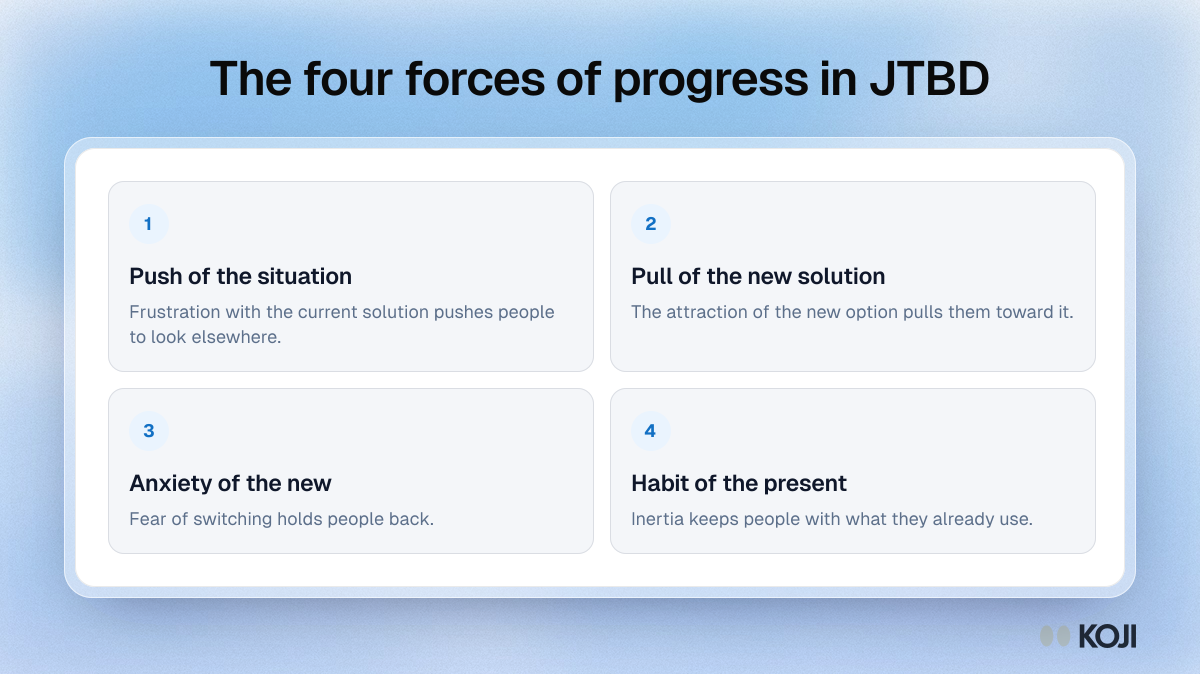
A JTBD interview systematically explores all four forces around a specific switching event. Done well, 10–15 switch interviews reveal the vast majority of actionable patterns in your customer base.
JTBD Interview Structure: The Full Question Framework
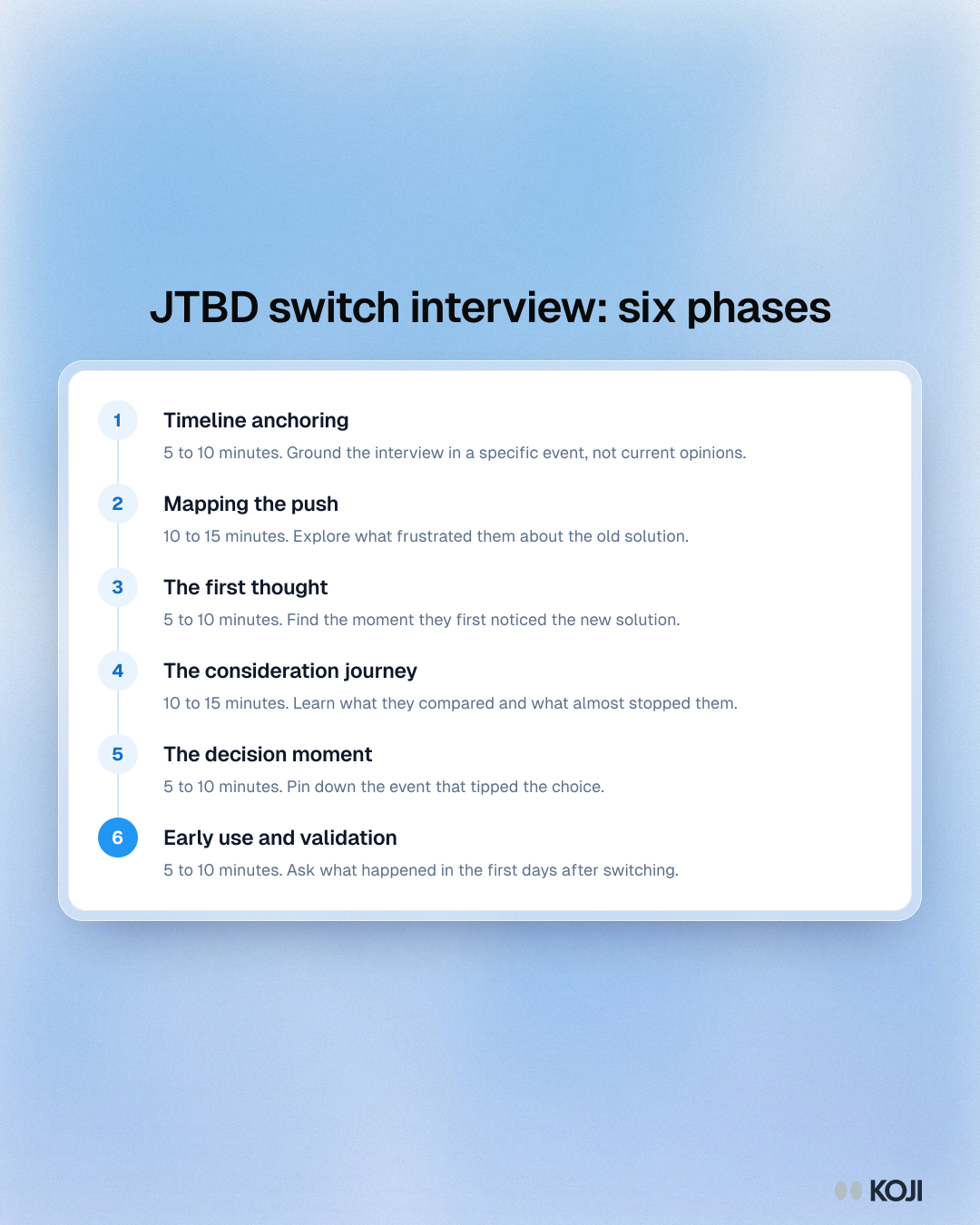
Phase 1: Timeline Anchoring (5–10 minutes)
Begin by grounding the interview in a specific event — not opinions about the present.
- "Think back to the last time you started using [product/solution]. When was that approximately?"
- "Walk me through what was going on in your work/life around that time."
- "What was the trigger that made you start thinking there was a problem to solve?"
- "What were you using before?"
The goal is to establish a clear timeline: what existed before, what triggered the first thought, what happened next.
Phase 2: Mapping the Push (10–15 minutes)
Explore the frustrations and limitations of the previous solution:
- "What was getting frustrating about [previous solution]?"
- "Was there a specific moment when you thought — I need to find something different?"
- "Tell me what happened that day. What were you trying to do?"
- "What workarounds were you using to deal with the limitations?"
- "How long had those frustrations been building?"
Probing tip: When they describe a frustration, always ask "And then what happened?" to trace the causal chain.
Phase 3: The First Thought (5–10 minutes)
Identify the moment awareness of the new solution began:
- "When did you first hear about [product/solution]?"
- "What made you pay attention to it at that moment specifically?"
- "Had you heard of it before but ignored it? What was different this time?"
- "Did someone recommend it to you? What did they say?"
Phase 4: The Consideration Journey (10–15 minutes)
Understand the evaluation process and anxiety forces:
- "What else did you look at when you were evaluating your options?"
- "What made you keep [product] in consideration vs. eliminating others?"
- "What was your biggest concern or hesitation about [product]?"
- "What almost stopped you from going with it?"
- "How did you get over that concern?"
Phase 5: The Decision Moment (5–10 minutes)
Nail down the specific decision event:
- "Walk me through the moment you decided to go with [product]."
- "Who else was involved in the decision?"
- "Was there a specific thing that tipped you over the line?"
- "How did you feel after you decided?"
Phase 6: Early Use and Validation (5–10 minutes)
Understand what success looks like after switching:
- "What happened in the first few days of using it?"
- "Was there a moment when you knew you had made the right choice?"
- "What do you now use it for that you could not do before?"
- "What is still not perfect?"
JTBD Interview Best Practices
1. Interview switchers, not just current users
Your happiest long-term customers have forgotten why they switched. The most valuable JTBD interviews come from:
- Recent switchers-in: Customers who started using your product in the last 30–90 days
- Switchers-out: Former customers who left for a competitor
- Non-switchers: People who evaluated your product and chose not to switch
All three reveal different forces. Most teams only talk to the first group and miss the most valuable data.
2. Focus on past events, never hypotheticals
The most common mistake in JTBD interviews is asking "what would you do if..." or "would you use a feature that...". These questions produce confabulated answers — the participant constructs a plausible response based on what sounds reasonable, not on real behavior.
Every question should be anchored in something that actually happened: "Tell me about a time when..." or "Walk me through the moment you..."
3. Follow the energy
In a JTBD interview, the most emotionally charged moments are the most data-rich. When a participant's voice changes, when they lean in, when they say "actually, this is the thing that really got me..." — that is where you probe deeper.

Photo by Rizky Subagja on Unsplash
Do not rush to the next question. Sit with the discomfort of silence. Ask: "Tell me more about that."
4. Run 10–15 interviews per segment
JTBD researchers consistently find that 10–15 switch interviews within a defined customer segment reveal the dominant patterns. After 10, you will start hearing the same push/pull forces repeatedly. That repetition is signal.
For different customer segments — enterprise vs. SMB, different use cases, different geographies — run a separate set of 10–15 interviews per segment.
5. Record and analyze for forces, not features
When analyzing JTBD interviews, resist the temptation to extract feature requests. Instead, build a forces map for each interview:
- What push forces were present?
- What pull forces attracted them?
- What anxieties did they express?
- What habits did they have to overcome?
Aggregate across interviews to find which forces appear most frequently. These are your product strategy inputs.
Running JTBD Interviews at Scale with AI
The traditional limitation of JTBD research is the same as all qualitative research: it does not scale well. Conducting 15 switch interviews manually — recruiting, scheduling, recording, transcribing, analyzing — takes 3–6 weeks and requires a skilled interviewer.
Koji solves the scaling problem for JTBD research specifically:
Structured + open-ended in the same session: Koji supports all 6 question types — including open_ended questions that prompt AI follow-up probing, and scale/choice questions that benchmark quantitative measures across respondents. This means you can run a JTBD timeline exploration (fully conversational) alongside a satisfaction scale and a single_choice question about the previous solution — all in one study.
AI probing that goes deeper: Koji's AI interviewer is trained to follow up on unexpected answers rather than mechanically moving to the next question. When a participant mentions a surprising frustration, the AI probes: "Can you tell me more about that?" This replicates the most valuable part of human JTBD interviewing — following the energy — at scale.
Voice interviews for natural recall: Spoken interviews consistently produce richer narrative data than written responses, particularly for timeline and emotional recall. Koji's voice interview mode conducts natural spoken conversations, making it ideal for the timeline-heavy structure of JTBD switch interviews.
Automatic forces analysis: Instead of manually building a forces map from 15 transcripts, Koji's automatic thematic analysis identifies recurring patterns across all responses — push forces, pull factors, anxieties, and habits — and surfaces them in a shareable report.
From question to insight in hours, not weeks: With Koji, you can send a JTBD interview study to recent customers, collect 15–20 switch interviews within 48–72 hours, and have a synthesized report ready for your product team by end of week.
JTBD Question Templates: Ready to Use
Here are template questions you can adapt for a Koji JTBD study:
Timeline anchor (open_ended): "Think back to when you first started using [product/solution]. What was going on in your work at that time that made you start looking for something new?"
Push exploration (open_ended): "What was getting most frustrating about what you were using before? Walk me through a specific moment when that frustration hit you."
Pull identification (open_ended): "What was the main thing that made you decide to try [product]? What were you hoping it would do for you?"
Anxiety probe (open_ended): "What was your biggest concern or hesitation before you committed? What almost stopped you?"
Previous solution (single_choice): "What were you using to solve this problem before [product]?" Options: [Competitor A, Competitor B, Spreadsheets, Nothing, Built in-house, Other]
Switch timeline (scale): "How long had you been thinking about switching before you actually made the decision?" Scale: 1 (Same week) to 5 (More than a year)
Satisfaction after switching (scale): "How well does [product] do the job you hired it to do?" Scale: 1 (Not at all) to 10 (Perfectly)
Key outcome (yes_no): "Would you say that switching solved the core problem you were experiencing?"
Common JTBD Mistakes to Avoid
Mistake 1: Asking about features instead of jobs Asking "what features do you use most?" confuses usage with the underlying job. A customer might use the reporting feature most — but the job they hired the product for is "give me credibility in executive meetings."
Mistake 2: Interviewing your biggest fans Long-term loyal customers make poor JTBD interview subjects. They have rationalized their decision and forgotten the push forces. Recent switchers-in and switchers-out are where the real insight lives.
Mistake 3: Stopping at the functional job Functional jobs ("I need to track tasks") are table stakes. The emotional and social jobs are where differentiation lives. Always ask: "How did you want to feel when this was working?" and "How did you want to be seen by your team/manager/clients?"
Mistake 4: Running too few interviews Five interviews is not enough. Patterns in JTBD research become clear at 10–15 interviews per segment. Teams that run 5 interviews and call it JTBD research are drawing conclusions from statistical noise.
JTBD Research Output: What You Should Produce
A well-executed JTBD study produces three deliverables:
- Forces map: A summary of push, pull, anxiety, and habit forces across all interviews, with frequency counts and representative quotes
- Job statement: A one-sentence articulation of the core functional, emotional, and social job your product is hired to do
- Opportunity gaps: Moments in the switch journey where customers experienced friction that your product (or a new feature) could address
Koji's report generation automatically surfaces the themes and quotes needed to build the forces map — dramatically reducing the synthesis time from days to minutes.
Getting Started with JTBD Research Today
JTBD interviews are the most reliable method for understanding what customers actually want — not what they say they want in a survey, but the real forces that drive real behavior.
The best place to start: identify 10 customers who joined in the last 60 days and 5 who recently churned. Set up a Koji voice interview study with a JTBD timeline structure. Run it for 48 hours. You will have more actionable product insight than a year of NPS scores.
Start your first JTBD study on Koji — free at koji.so — 10 free credits on signup, no research expertise required.
For more on customer interview methodology, explore the guide to How to Write User Interview Questions That Get Real Answers and How to Analyze Customer Interview Data.
Frequently Asked Questions
What is a Jobs-to-Be-Done interview?
A JTBD interview — specifically a switch interview — is a one-on-one conversation that maps the exact sequence of events, emotions, and forces that led a customer to hire (or fire) a product. Rather than asking about opinions or hypothetical features, it focuses on a specific past switching event to reveal the real motivations behind behavior.
How many JTBD interviews do you need?
For a defined customer segment, 10–15 switch interviews typically reveal the dominant patterns. After 10 interviews, you will start hearing the same push and pull forces repeated. For different segments — enterprise vs. SMB, different use cases — run a separate set of 10–15 per segment.
What is the difference between JTBD and user interviews?
Standard user interviews ask about preferences, opinions, and hypothetical behavior. JTBD interviews (specifically switch interviews) focus exclusively on past switching events — the specific moment a customer decided to change solutions — and explore the four forces: push, pull, anxiety, and habit. This produces more predictive insights about purchasing behavior.
Can you run JTBD interviews with AI?
Yes. AI-moderated interview platforms like Koji can conduct JTBD-structured switch interviews at scale, with probing follow-up questions on unexpected answers, voice interview support for natural timeline recall, and automatic synthesis of push/pull/anxiety/habit forces across all responses. This makes it feasible to run 15–20 JTBD interviews in 48 hours rather than 3–6 weeks.
What is the JTBD innovation success rate?
Research using the Jobs-to-Be-Done framework shows an 86% innovation success rate, compared to approximately 17% for traditional feature-driven product development approaches. The difference comes from targeting demand (specific jobs customers need done) rather than preferences (features customers say they want).
Who created the Jobs-to-Be-Done framework?
JTBD was developed by Harvard Business School professor Clayton Christensen and refined by Tony Ulwick (Outcome-Driven Innovation) and Bob Moesta (switch interview technique at the Rewired Group). The framework has been adopted by companies including Apple, Google, and Intercom as a core product research methodology.


