Every agile team knows they should be talking to users regularly. The Agile Manifesto emphasizes customer collaboration. Teresa Torres made continuous discovery a mainstream concept. Yet a 2026 survey by Lyssna found that 88% of researchers identified AI-assisted analysis as a critical gap — with research still happening in bursts, not continuously, at most organizations.
The problem isn't intent. It's logistics. Traditional user research doesn't fit inside a sprint. Scheduling interviews takes days. Moderating them takes hours. Analyzing transcripts takes more hours. By the time you have findings, the sprint is over and the build decision was already made.
This guide is the practical playbook for fixing that. How to do meaningful user research every sprint, without burning out your researcher or blowing your sprint timeline.
Why Agile and User Research Have Always Clashed
The tension is structural. Agile operates in tight two-week cycles (nearly 65% of teams choose two-week sprints, according to a 2026 EasyAgile study). Traditional user research is a longer-form process:
- Recruiting participants: 3–7 days
- Scheduling moderated sessions: 1–3 days
- Running sessions: 1–2 days
- Transcribing and analyzing: 2–5 days
- Writing up findings: 1–2 days
Total: 2–3 weeks minimum for a standard research cycle. That's longer than a sprint.
Nielsen Norman Group identifies several core challenges:
- Research work spans multiple sprints, making it hard to show within-sprint value
- Short sprint cycles put researchers under pressure to deliver unrealistically fast
- When research isn't on the backlog, it gets deprioritized — every time
- Product teams need to stay 2–3 sprints ahead of development, which requires foresight most teams don't have
The result: research gets done in big batch cycles (quarterly, or before a major launch) rather than continuously. Teams build first, learn second. Expensive mistakes happen.
The Continuous Discovery Model
The solution isn't to compress traditional research into sprint-sized chunks. It's to change the research methodology itself.
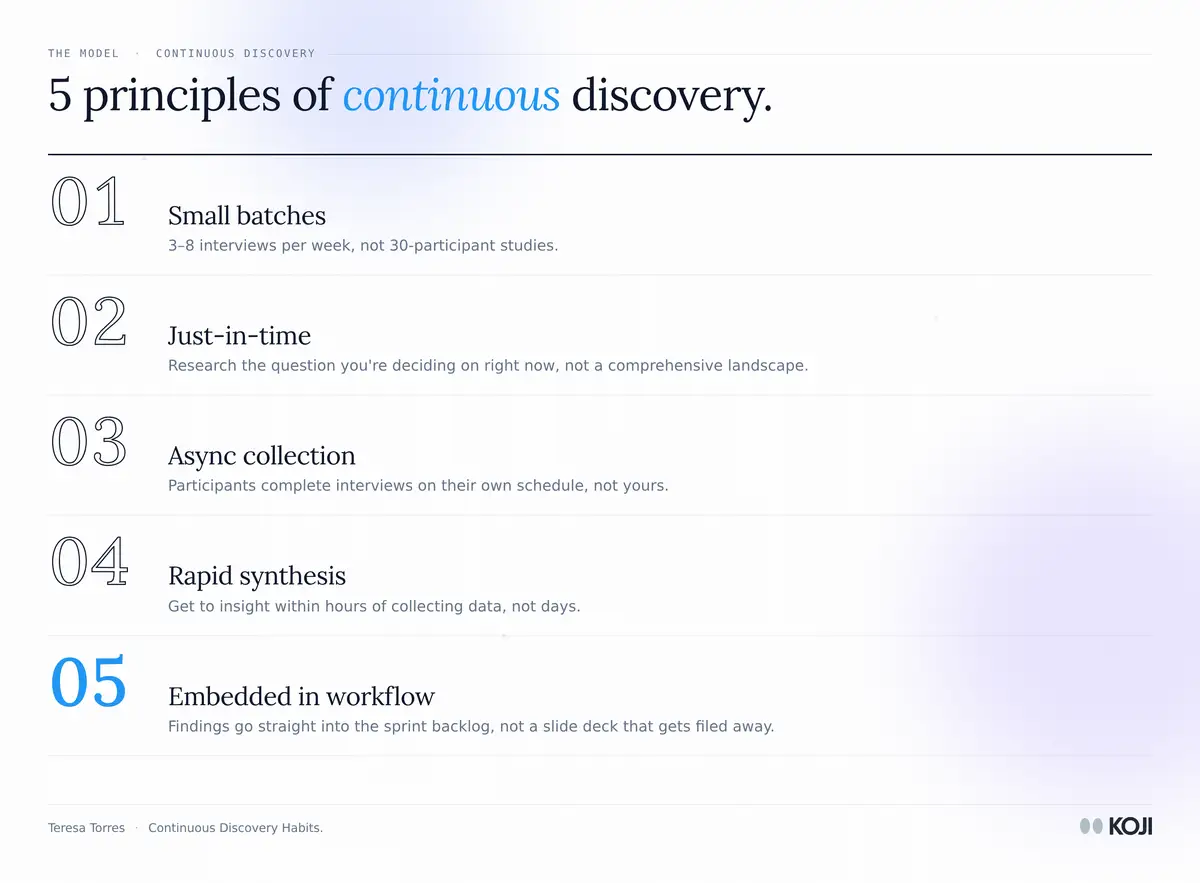
Continuous discovery (popularized by Teresa Torres in Continuous Discovery Habits) means doing small amounts of research every week — focused on the questions your team is currently facing, not comprehensive studies.
The core principles:
- Small batches: 3–8 interviews per week, not 30-participant studies
- Just-in-time: Research the question you're deciding on right now, not a comprehensive landscape
- Async collection: Participants complete interviews on their own schedule, not yours
- Rapid synthesis: Get to insight within hours of collecting data, not days
- Embedded in workflow: Research findings go directly into your sprint backlog, not a slide deck that gets filed away
This model works. Teams that do even brief research every sprint are 24% more responsive and 42% more consistent in delivery quality (EasyAgile, 2026).
The Sprint Research Cadence
Here's how to map research to a two-week sprint cycle:
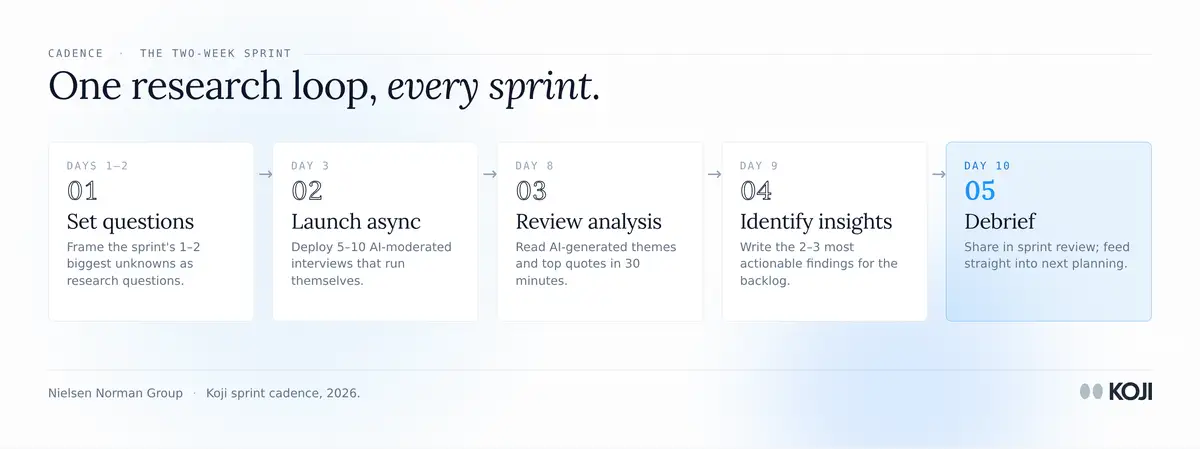
Sprint Week 1: Set Research Questions
Day 1–2: In sprint planning, identify the 1–2 biggest unknowns your team is deciding on. Frame them as research questions, not feature requirements. Bad: "Should we add a bulk export feature?" Good: "What are the biggest friction points in our current data export workflow?"
Day 3: Launch async research. Using Koji or a similar tool, deploy 5–10 participant interviews on your research question. If the question is about your own users, the churned cohort or the people who used the new feature, import that segment so each person gets a personalized link and the report is already cut by it. If it is about people you do not have yet, open Panel recruit, describe them, and approve the price per completed interview in credits before you launch. Async interviews run themselves — participants complete them over the next 48–72 hours without your involvement.
Sprint Week 2: Collect and Apply
Day 8 (Nielsen Norman Group identifies Day 8 of a 10-day sprint as the optimal research day): Review AI-generated analysis from async interviews. 30 minutes to read themes and top quotes.
Day 9: Analysis. Identify the 2–3 most actionable insights. Write them as brief insight statements for the backlog.
Day 10: Debrief and planning. Share insights in sprint review. Feed directly into next sprint planning.
This cadence requires 30–60 minutes of researcher time per sprint for ongoing research — a fraction of the time traditional research demands.
What to Research Each Sprint
Not every sprint has a burning research question. Here's a framework for deciding what to investigate:
Type 1: Decision Research (highest priority)
Research tied to a specific build/don't-build decision currently in progress. Example: "Before we build the new onboarding flow, interview 10 new users about where they get stuck today."
Type 2: Discovery Research (ongoing)
Open-ended exploration of your users' lives, workflows, and pain points. Not tied to a specific decision, but builds the team's understanding of the customer. Example: "This sprint, interview 5 churned customers to understand what drove their cancellation decision."
Type 3: Validation Research (post-launch)
Evaluating something you just shipped. Example: "Interview 10 users who used the new export feature this week — what worked and what didn't?"
A healthy sprint research mix includes all three types over a quarter.
Choosing the Right Research Methods for Sprint Timelines
Not all research methods fit sprint timelines. Here's what works and what doesn't:
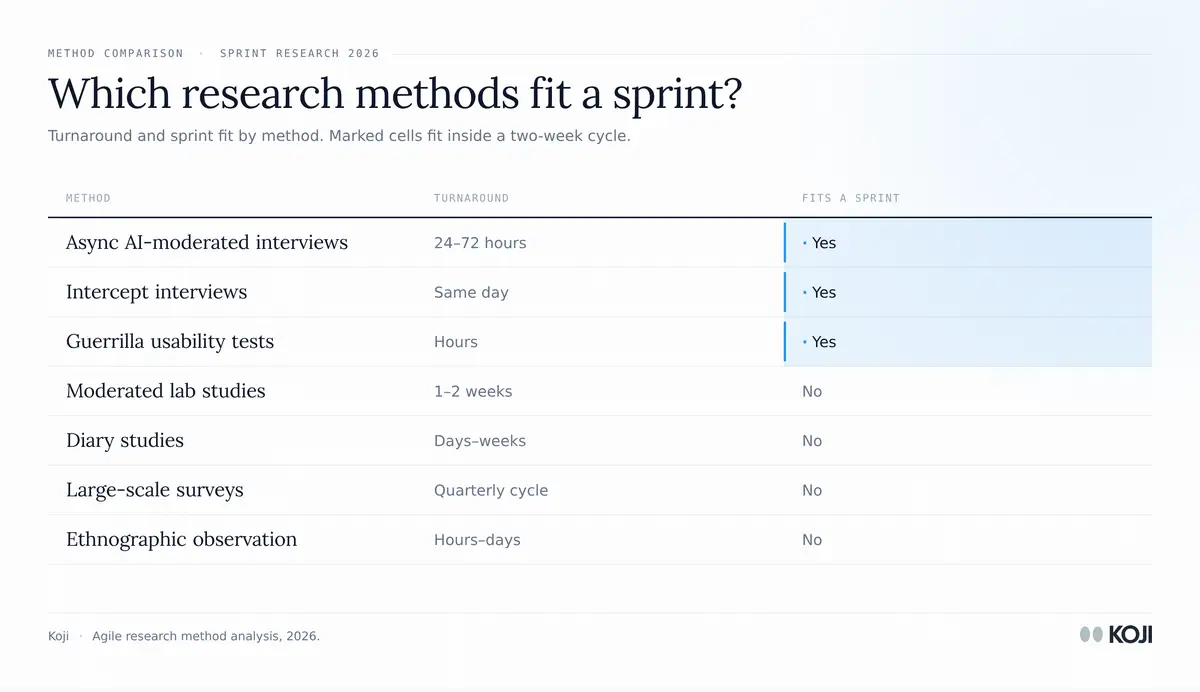
Works in a Sprint
Async AI-moderated interviews (Koji): Participants complete interviews on their own schedule over 24–72 hours. The AI handles moderation, follow-up probing, transcription, and analysis automatically. This is the highest-value method for sprint cadences because it requires almost no researcher time during the sprint.
Intercept interviews: Quick 10–15 minute conversations with users you find in your product, at events, or via Slack/community channels. Low overhead, high immediacy.
Guerrilla usability tests: 5-participant unmoderated tests on a specific workflow. Services like Maze or Lyssna can return results in hours.
Doesn't Fit Sprint Timelines
Moderated lab studies: Require recruiting, scheduling, and a dedicated research session. Minimum 1–2 weeks.
Diary studies: Run over days or weeks of continuous participant self-reporting. Not sprint-compatible.
Large-scale surveys: Require design, distribution, response collection, and analysis. Better for quarterly research cycles.
Ethnographic observation: Deep contextual inquiry over hours or days. Valuable, but planned around sprints rather than in them.
How AI-Moderated Interviews Unlock Sprint Research
The single biggest unlock for sprint research in 2026 is AI-moderated async interviews. Here's why:
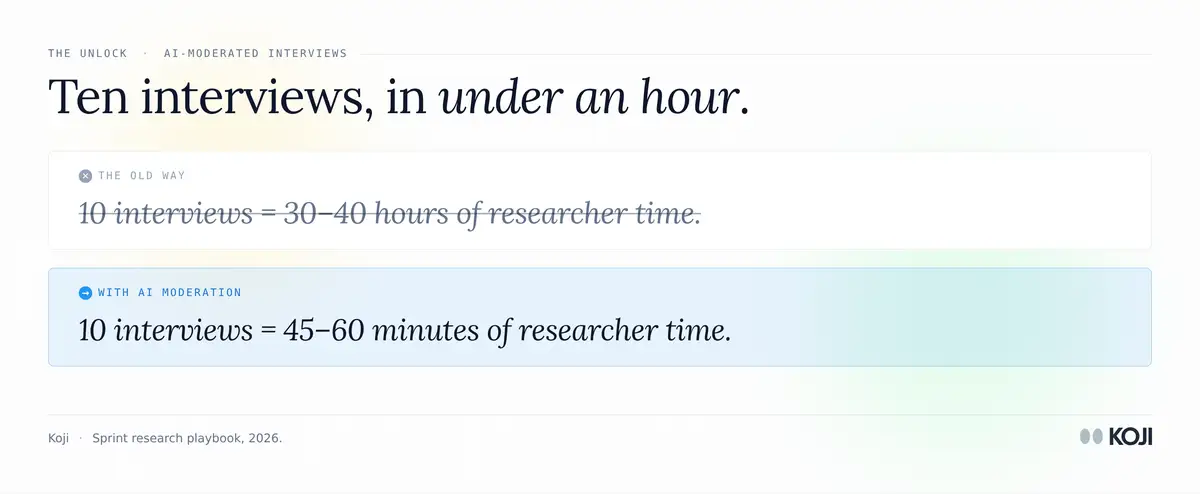
Traditional interview bottleneck: For every 1 hour of interview data, expect 3–4 hours of researcher time (scheduling, moderating, transcribing, coding, synthesizing). 10 interviews = 30–40 hours of work. That's most of a sprint.
With AI-moderated interviews (Koji):
- Launch 10 interviews in 20 minutes (write brief, add questions, share link)
- AI moderates each session — asking follow-up probes, adapting to responses, handling participant questions
- AI transcribes and analyzes automatically
- Researcher reads the generated report in 30 minutes
Total researcher time for 10 interviews: 45–60 minutes, not 30–40 hours. This is what makes continuous discovery actually continuous.
Koji supports all 6 structured question types — open_ended, scale, single_choice, multiple_choice, ranking, and yes_no — in a single interview session. You get both qualitative depth (conversation transcripts) and quantitative distributions (scale scores, choice frequencies) from the same research event.
For voice interviews, Koji's AI moderator conducts natural spoken conversations — making it ideal for topics where tone, hesitation, and vocal cues provide insight that text can't capture.
Building a Research Backlog
One of the most effective agile research practices is treating research like a product backlog item.
Research questions go on the backlog. Every unresolved assumption about your users — "We think users want X", "We don't know why Y happens", "We're not sure if Z is a real problem" — gets written as a backlog item. Research items are prioritized alongside feature items at sprint planning.
Why this works: When research is invisible, it gets deprioritized. When research items are on the same backlog as feature work, product managers and engineers see the assumptions being addressed and understand the value. Nielsen Norman Group notes that research not represented on the backlog "goes unnoticed and is inevitably deprioritized."
What a research backlog item looks like:
- Research question: Why do users abandon the account setup flow at Step 3?
- Method: 8 async interviews with users who recently dropped off
- Decision it informs: Whether to rebuild Step 3 or add an exit survey
- Sprint: Sprint 14
- Owner: [Researcher name]
Staying Ahead: Research Sprint Architecture
The most mature agile research programs operate 2–3 sprints ahead of development. Research informs what's built in Sprint N+2, not what's already being built in Sprint N.
This "offset" architecture works as follows:
| Sprint | Research Activity | Development Activity |
|---|---|---|
| Sprint 12 | Discovery: interview users about workflow pain points | Building features from Sprint 10 research |
| Sprint 13 | Validation: test Sprint 11 concepts | Building features from Sprint 11 research |
| Sprint 14 | Decision: research inputs inform Sprint 16 scope | Building features from Sprint 12 research |
This requires intentional planning but prevents the most common failure mode: making build decisions before the research is done.
Common Mistakes (And How to Avoid Them)
Mistake 1: Trying to fit full research cycles into a sprint Fix: Shift to async, AI-moderated methods that collect and analyze data without researcher time investment during the sprint.
Mistake 2: Doing research after the decision is already made Fix: Plan research 2 sprints ahead of the relevant development work. Research informs upcoming sprints, not current ones.
Mistake 3: Not putting research on the backlog Fix: Every research question becomes a backlog item, prioritized alongside feature work at sprint planning.
Mistake 4: Waiting for perfect data before sharing insights Fix: Share lightweight "working insights" after 5–8 interviews. You don't need 30 participants to see a clear pattern. Perfect data paralyzes; directional data enables.
Mistake 5: Synthesizing everything Fix: Only synthesize what's needed for the current decision. You don't need a comprehensive report for every research activity. A 3-bullet "key findings" summary is enough for most sprint research.
Metrics for Sprint Research Programs
How do you know your continuous research program is working? Track these:
- Research coverage: What percentage of sprints included at least one research activity?
- Decision coverage: What percentage of major build decisions were informed by research?
- Time to insight: How long from research launch to insight delivery?
- Insight adoption: How many sprint planning sessions included research findings in the discussion?
- Assumption clearance rate: How quickly are backlog assumption items being resolved?
A healthy program achieves 80%+ sprint coverage, with an average time-to-insight under 72 hours.
The Bottom Line: Continuous Research Is Now Achievable
Agile user research has historically been a compromise — either you do real research and miss the sprint, or you do fast research and get shallow data. That tradeoff has collapsed.
With AI-moderated async interviews, a researcher can run a 10-participant study in a two-week sprint with less than an hour of their own time invested. The AI handles moderation, transcription, and analysis. The researcher reads, decides, and acts.
88% of researchers in 2026 say AI-assisted analysis is their most critical capability need. The teams that adopt AI-native research tools for sprint cadences will build dramatically better products than those still doing quarterly research sprints.
The sprint has always been the right unit for research. Now the tools have caught up.
Run Continuous Research Every Sprint with Koji
Koji makes it possible to launch AI-moderated interviews in 20 minutes and get analyzed results in under 72 hours — without scheduling a single call. Start free with 10 credits.
Start your first sprint study →
See also: How to Write User Interview Questions That Get Real Answers | The Continuous Discovery Handbook | Product Manager's Guide to Customer Discovery with AI