The short answer: collect customer research answers identified by default, and go anonymous only when the topic is sensitive enough to change what people say. Identified answers let you follow up, join answers to what you already know about each customer, and chase the people who have not replied. Anonymity buys candour, and the evidence says that matters most for embarrassing or risky admissions, not for opinions about onboarding or pricing. When you need both, split the study: personal links for the main questions and a separate anonymous link for the sensitive part. Whatever you choose, tell people which one it is, and never call a study anonymous when it is only confidential.
If you want to try this on a study this week, the setup is near the end under Doing it in Koji. First, the decision.
Anonymous, confidential and identified are three different promises
Most mistakes here start with the words. Researchers often say "anonymous" when they mean "confidential", and participants notice.
- Anonymous: nobody, including you, can tell who gave an answer. There is no name, no email, no personal link and nothing in the answers that points to a person.
- Confidential: you know who said what, but you promise not to share it beyond the research team or to report it in a way that identifies anyone.
- Identified: you know who said what and will use that, for example to follow up or to add the answers to their customer record.
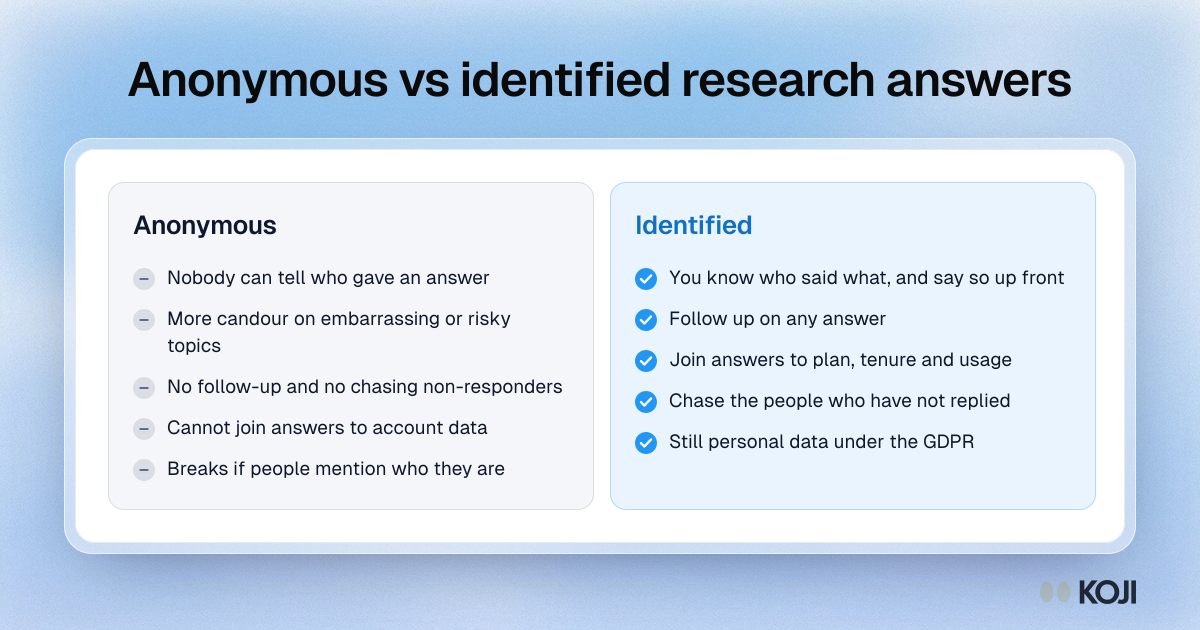
The difference is not just wording. Under the GDPR, data that can be linked back to a person with extra information still counts as personal data, even if you have replaced names with codes. Only information that can no longer identify anyone falls outside the regulation (GDPR Recital 26). A study with a link per person is identified, however carefully you store it. Our guide to GDPR-compliant AI user research covers what that means in practice.
What the evidence says about honesty
Anonymity has a large effect on some answers. In a study of 155 undergraduates, Ong and Weiss had independent evidence for 79 of them about whether they had cheated. Among those who had cheated, 74% admitted it when their answers were anonymous, against 25% when they were only promised confidentiality (Ong and Weiss, Journal of Applied Social Psychology, 2000).
That is a big gap, but look at what was being asked: whether people had broken a rule. Tourangeau and Yan's review of research on sensitive questions concluded that misreporting is fairly common on sensitive topics, and that how much people misreport depends on whether they have anything embarrassing to report (Tourangeau and Yan, Psychological Bulletin, 2007). People without anything to hide answer much the same either way.
Personalising the request also lifts response. Personalised email invitations raised a web survey's response rate by 7.8 percentage points in one experiment, and that study found no effect of personalisation on answers to a sensitive question (Heerwegh, Public Opinion Quarterly, 2005). Other studies have found that a personal greeting reduces disclosure on sensitive items, and some could not replicate that (Richards et al., FCSM, 2015).
So the practical reading is: anonymity matters a lot when the honest answer is embarrassing, risky or against a rule. For "why did you pick us over the other tool?" or "where did setup slow you down?", the cost of being identified is small, and the gain from knowing who said it is large. The bias that does show up in most customer research is social desirability, people being polite about your product, and our guide to social desirability bias covers how to ask around it.
The decision rule
Two questions decide it: how sensitive is the topic for this audience, and how much do you need to know who said what?
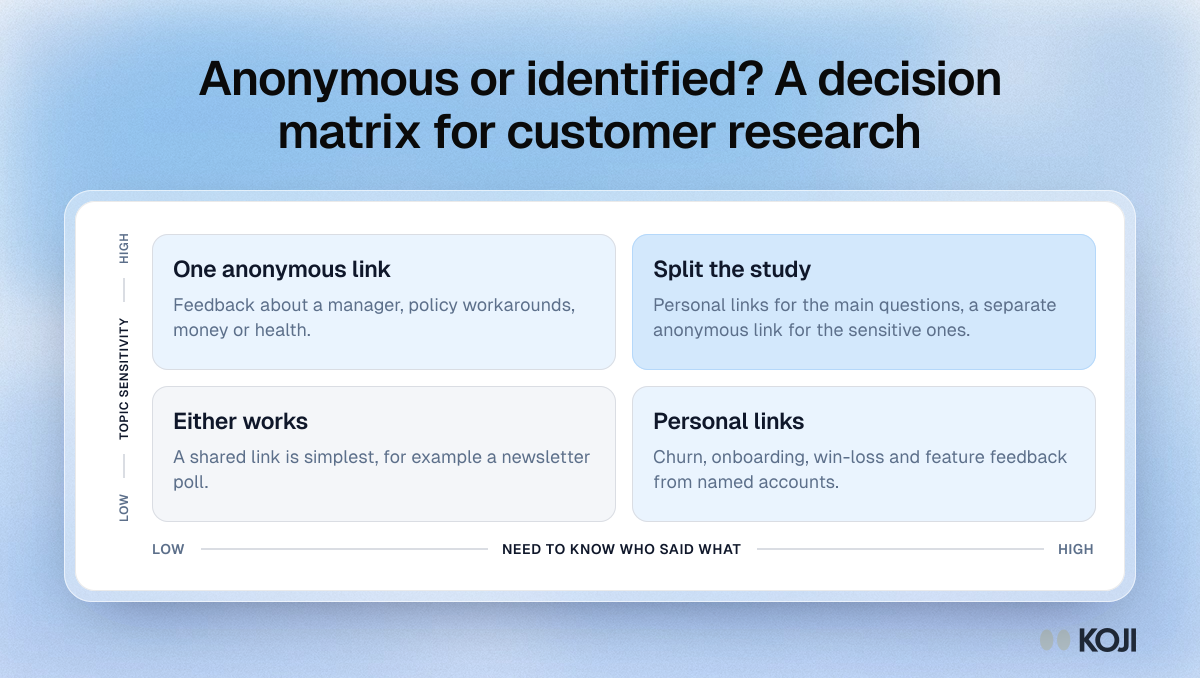
Go identified when you need to follow up on an answer, join answers to plan, tenure or usage data, chase non-responders, or close the loop with each person. That covers most customer research: churn and cancellation interviews, onboarding and activation studies, win-loss calls, NPS follow-ups and feature feedback from named accounts.
Go anonymous when the honest answer could hurt the person if it were tied to them. Feedback about a manager or colleague, how a team really uses a tool their boss bought, workarounds that break a policy, pay and money worries, health, or anything where the person could face consequences. Employee research usually belongs here, which is why we cover it separately in anonymous employee research with AI interviews.
Split the study when you need both. Run the main study with personal links, then send a separate anonymous link for the two or three sensitive questions, and say plainly that the second one is not linked to the first. Do not put an "anonymous" section inside an identified interview. If the link is personal, nothing in it is anonymous.
Either works when the topic is not sensitive and you do not need to know who said what, such as a link in a newsletter asking which feature to build next. A shared link is simpler.
Telling people which one it is
Whatever you pick, say it in the invitation and on the first screen, in one plain sentence.

Photo by Mohit Sharma on Unsplash
- Identified: "This link is just for you. Your answers will be linked to your account so we can follow up and improve things for you. We will not share what you say outside the product team."
- Anonymous: "This link is the same for everyone. We cannot see who answers, so please do not include your name or other details that identify you."
The second sentence in the anonymous version matters. Anonymity breaks easily. People mention their company, their role or a recent support ticket, and a voice recording can identify someone on its own. If you promise anonymity, ask people not to share identifying details, consider text instead of voice, and strip personal details before anyone outside the research team reads the answers. Our guide to anonymizing customer interview data has the steps, and quasi-identifiers explains why removing names alone is not enough.
Common mistakes
- Calling a confidential study anonymous. If you sent personal links or asked for an email, it is not anonymous. Saying so is a broken promise, and in the EU it can be a compliance problem.
- Going anonymous out of habit. You lose follow-up, segment cuts by account data and the ability to chase non-responders, often for topics where anonymity would not have changed the answers.
- Small groups in reports. Even anonymous answers can point to a person when a segment has three people in it. See k-anonymity for segment reporting for minimum group sizes.
- Forgetting the recording. A voice answer to an "anonymous" study still carries a voice.
Doing it in Koji
Koji supports both, from the same study. The setup below is verified in the product as of this writing.
- One shared link. Share the study's normal link. It stays anonymous as long as the pre-interview form does not ask for a name or email. The landing page can show an Anonymous badge, which you can turn on or off in the study's landing page settings, and people choose text or voice.
- A link per person (identified). Open the share sheet, choose "I'll share my own link" and switch from One shared link to A link per person. Upload your list as a CSV or a plain list of emails, download it with an Interview link column, and send from your own email tool. Interviews from a personal link are tied to that person, and the landing page does not show the Anonymous badge, so participants are not told something untrue. Personal links are on the Interviews and Enterprise plans.
- Remove personal details. A per-study privacy setting takes names, email addresses, phone numbers, postal addresses and employers out of each transcript when the interview finishes, replacing them with labels such as [NAME]. Reports and exports see only the cleaned text. It applies to interviews that finish after you turn it on and can miss some details, so still check responses before you share them.
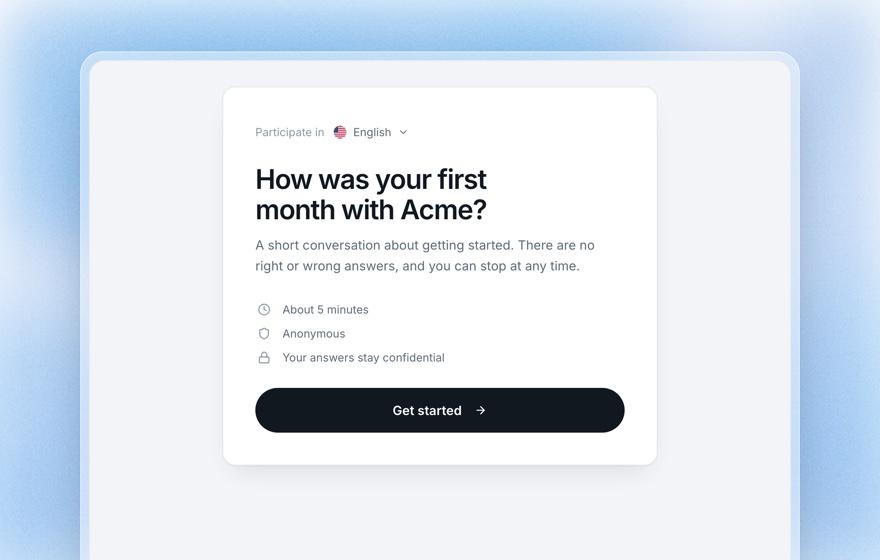
For a split study, duplicate the study from its card menu, keep the main one on personal links, and share the copy with only the sensitive questions as one shared link with Remove personal details turned on. The personalized interview links guide covers the per-person setup step by step.
A quick way to decide on your next study
Write down the one decision the study is meant to inform. If making that decision needs you to know who said what, go identified and tell people. If the most useful answers are the ones people would only give without their name on them, go anonymous and protect it properly. If both are true, split it. Start a study on Koji and pick One shared link or A link per person in the share sheet.