The data room tells you which customers are big and what their contracts say. It cannot tell you whether the ten biggest will still be there after you own the company. Run change-of-control interviews with AI-moderated conversations, one personal link per contact, and you can hear several people at every top account inside the exclusivity window, then match what they say to counsel's reading of each contract. By the end of this playbook you will have the method, a day-by-day plan, a full interview guide to paste, and the setup in Koji.
This is the account-by-account companion to confirmatory customer calls, which samples the whole base. Here the question is narrower and more expensive to get wrong: will the accounts that carry the price keep paying after the sponsor takes over?
Why top-account interviews matter now
You have signed the LOI. The data room shows concentration, contract terms and a retention curve. What it does not show is intent. A customer with no termination right can still leave at renewal, and a customer with a consent right can still love the product. Five numbers set the terms this year:
| Number | What it says | Source |
|---|---|---|
| 49 days | Average initial exclusivity on PE deals in 2025, up from 35 in 2024 | Travers Smith, Private Equity Market Insights 2026 |
| 13 + 9 | A typical B2B purchase involves 13 internal stakeholders and nine external influencers | Forrester, The State of Business Buying 2026 (January 2026) |
| 74% | Share of B2B buyer teams showing "unhealthy conflict" in the decision; groups run from 5 to 16 people (632 buyers surveyed) | Gartner, May 2025 |
| 40.5% | Completion in the AI-interview arm of a randomized panel experiment, against 99.4% for survey open-ends (3,160 respondents) | Verasight, August 2026 |
| 70% / 41% / 28% | Share of Tier 1, large and mid-sized funds using AI consistently in diligence | Alvarez & Marsal, 2026 |
Compiled by Koji from the sources above. Links: Travers Smith, Forrester, Gartner, Verasight, Alvarez & Marsal.
Read them together. The window is longer than last year, but a renewal is rarely decided by one person: Forrester's 13 internal stakeholders and Gartner's groups of 5 to 16 mean that a call with the champion tells you about the champion. And the champion is the person management will put on the phone.
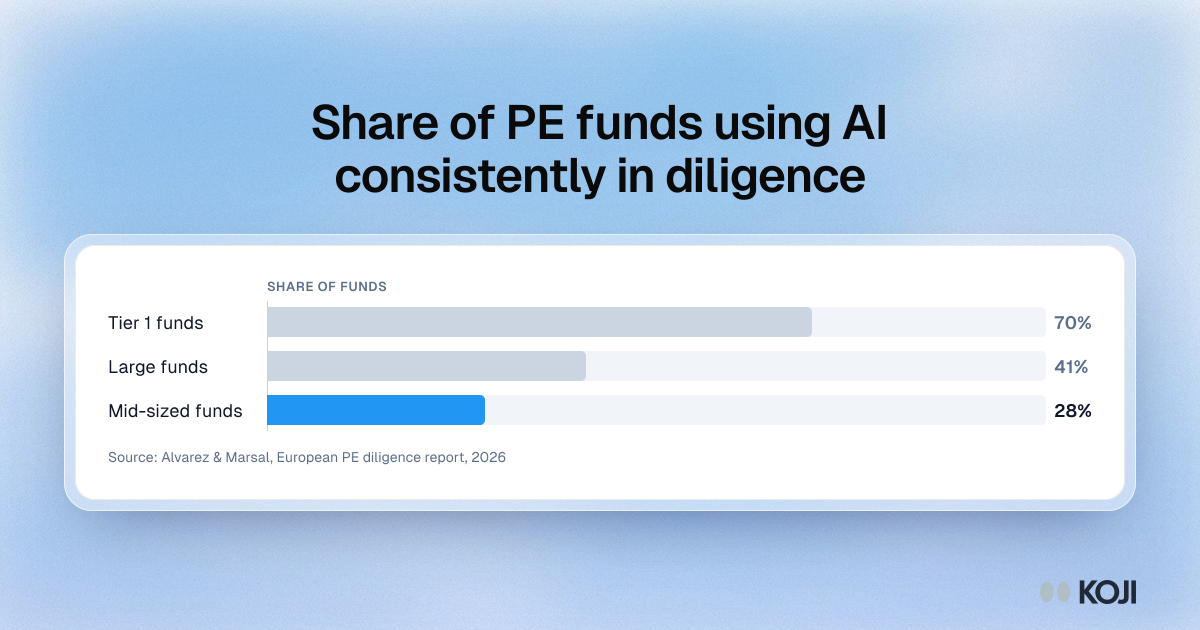
The Alvarez & Marsal split shows who has already moved: 70% of Tier 1 funds use AI consistently in diligence, against 28% of mid-sized funds. A mid-sized team that cannot buy weeks of consultant time can still interview every role at its ten biggest accounts.
What does skipping this cost? Contract analysis tells you whether a customer is allowed to leave. It says nothing about whether they want to. One law-firm write-up argues that a contract a customer can end at will on a change of control is worth less than one with a fixed remaining term (Potomac Law). That is the legal half. The Willamette Management Associates July 2026 piece on measuring customer concentration risk describes two ways to price concentration, adjusting projected cash flows or adjusting the discount rate, and notes that the risk premium stays heavily dependent on professional judgment. Interview evidence is what turns that judgment into something an investment committee can inspect. We found no independent study that gives a rate for how often customers leave after a change of ownership, so do not borrow a churn percentage from a vendor blog. Measure your own ten accounts.
What good looks like: the Stay-Risk Method
The method has one idea. For each top account, put two facts side by side: what the contract lets them do, and what the people there say they intend to do. Neither alone is enough.

Photo by Olena Kholina on Unsplash
Pick the accounts by a rule
Rank customers by revenue. Take accounts down the list until you cover 50% of revenue or reach 10 accounts, whichever is more. Cap it at 15. This is Koji's rule of thumb, not an industry standard. Raise the cap if the top account alone is a quarter of revenue.
Ask counsel for a consent map in the first week: one line per account saying whether the contract needs consent on a change of control, gives a termination right, requires notice only, or has no trigger. Practitioners recommend building this early, and note that a clause can bite in a share deal as well as an asset deal (Peony). Do not rely on a vendor's prevalence figure for how many contracts have such clauses; the ones we found disagree and do not state a method.
Interview three roles per account, not one champion
For every account, aim for three completed conversations:
- The economic buyer, who owns the budget and will be asked about the change.
- The daily owner, who knows how hard the product is to replace.
- Whoever runs the renewal, usually procurement, finance or IT. This person reads the clause.
An account with fewer than two completed roles is unread. Do not score it and do not average it into the others. Chase the missing role.
Run it in two phases
You are bound by confidentiality. Customers must not learn of the deal before it is announced, and whether and how you may contact them before signing is a matter for the seller and counsel; settle it in the process letter or the LOI. This is not legal advice.
- Phase A, before the announcement. Frame the interview as independent research on the product. Test dependence, switching cost and renewal triggers without mentioning ownership. Questions 1 to 6 below.
- Phase B, after the announcement and before close. Now you can ask openly what the change means to them and what they need to hear. Questions 7 to 10.
Do not skip Phase B. Phase A tells you how sticky the product is. Only Phase B tells you how the people there react to a new owner.
Sort accounts on the stay-risk grid
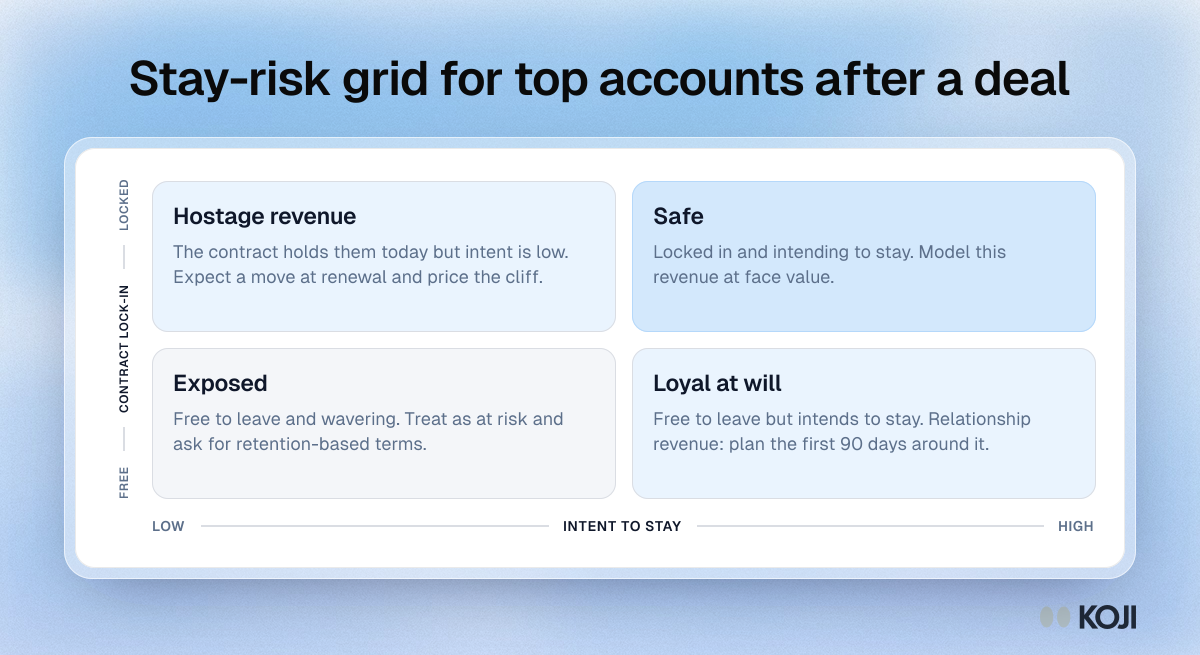
- Safe: locked in and intends to stay. Model it at face value.
- Hostage revenue: locked in but wants out. The contract holds them today, so the risk is a renewal cliff. Price it.
- Loyal at will: free to leave but intends to stay. This is relationship revenue. Plan the first 90 days around it.
- Exposed: free to leave and wavering. Treat it as at risk and ask for retention-based terms.
A decision rule for scoring intent: an account is wavering if any role gives 6 or lower on the 12-month question, or names a reopen trigger that the deal makes likely, such as a price rise, a support change or a product sunset. One wavering role is enough. Buying groups disagree with themselves, and the one who signs is rarely the one who is unhappy.
What do you do with the grid? Use it to argue for structure, not just price: a retention-based element in the consideration, a closing condition on the consents that matter, or a bigger holdback tied to the Exposed accounts. Those are options for you and counsel, not a script.
Common mistakes
- Treating a signed contract as loyalty. Hostage revenue looks identical to safe revenue in the data room.
- Calling only the champion. One role is a story. Three roles are evidence.
- Cold-inviting senior people to an AI interview. Verasight's completion drop is real. Have someone they already know make the introduction, send a personal link, and give a 3 to 5 day window.
- Asking about the contract too early. Question 8 can prompt a customer to read a clause it had forgotten. Counsel decides whether it is asked at all.
- Blending the phases. Report A and B separately. A customer who is calm before the news can change after it.
The timeline from LOI to signing
Count back from the date the committee wants the stay-risk report. The plan below fits an average 49-day exclusivity window with room to spare. Shorten it in proportion if yours is shorter.
- Days 1 to 5. Rank accounts, get the consent map, agree customer access with the seller.
- Day 6. Preview the study yourself and fix the tone.
- Days 7 to 9. Send personal links, each with an introduction from someone the customer knows.
- Day 12. Remind everyone who has not started.
- Day 14. First read. Which accounts have two or more roles completed? What repeats?
- Days 15 to 28. Chase missing roles. For your three largest accounts, add a human call.
- Days 28 to 35. Stay-risk report to committee and into the SPA terms.
- Sign to close. Run Phase B once the announcement is out.
How to set it up in Koji
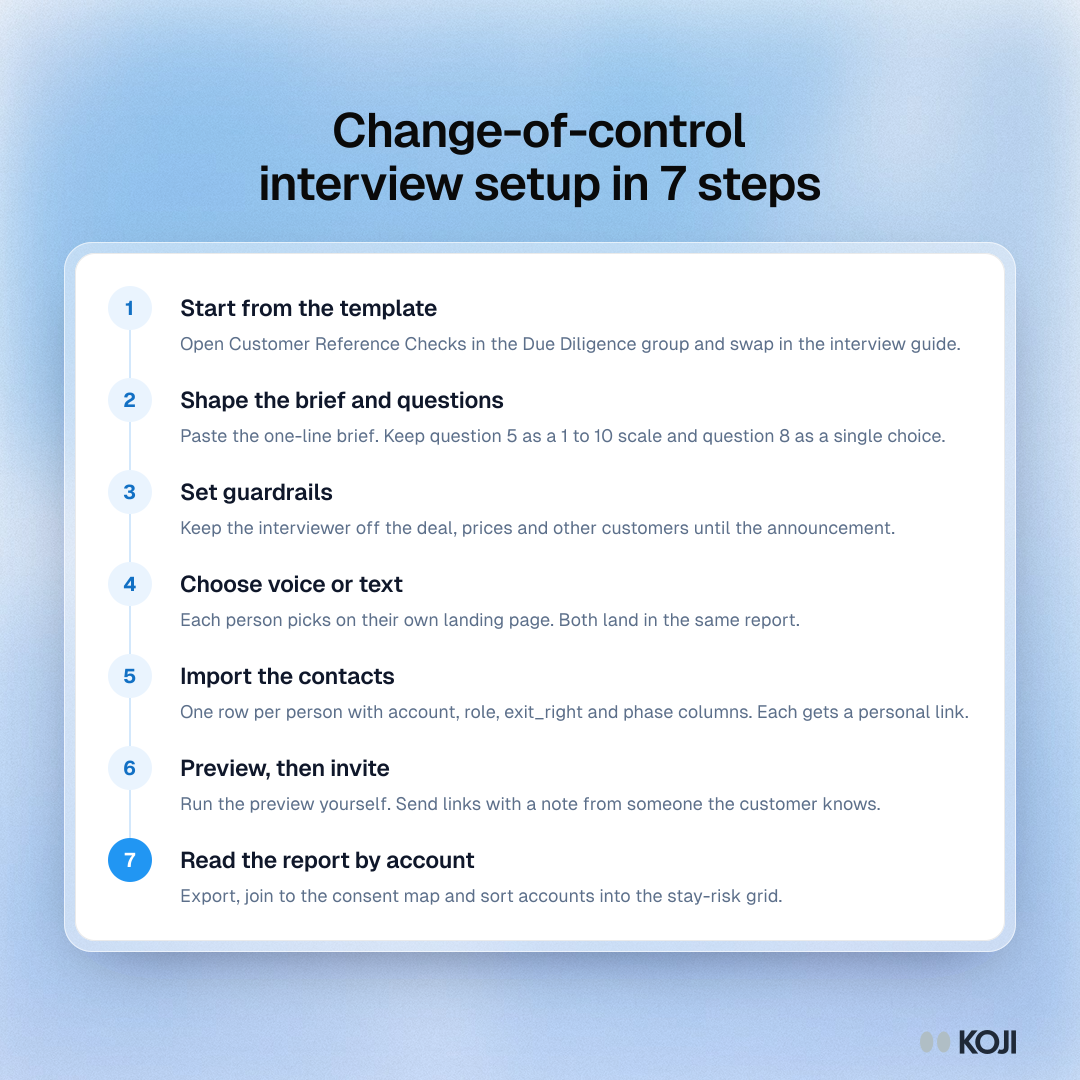
- Start from the template. In the dashboard template gallery, open the Due Diligence group and pick Customer Reference Checks. It ships with a brief and seven questions. Replace them with the guide below.
- Shape the brief and the questions. Paste the one-line brief from the guide into "What do you want to research?" and add the product pages as context files so follow-ups stay specific. Question 5 is a 1 to 10 scale and question 8 is a single choice. Everything else stays open, with one or two follow-ups.
- Set guardrails (next section).
- Choose voice or text. Each person chooses on their own landing page. Voice suits people who would rather talk. Text suits executives who reply between meetings.
- Import the contacts. Use a CSV with one person per row and these columns:
email,name,account,role,exit_right(the consent map's answer) andphase. Every extra column stays with the person and comes back in the export. Each person gets a private link. See importing participants from a CSV and personalized interview links. - Preview, then invite. Run a preview interview as a customer would, then send the links with a short note from someone they know.
- Read the report by account. Export the responses, then sort accounts into the grid using the
exit_rightcolumn and the intent from questions 5 and 6.
Guardrails and personal links
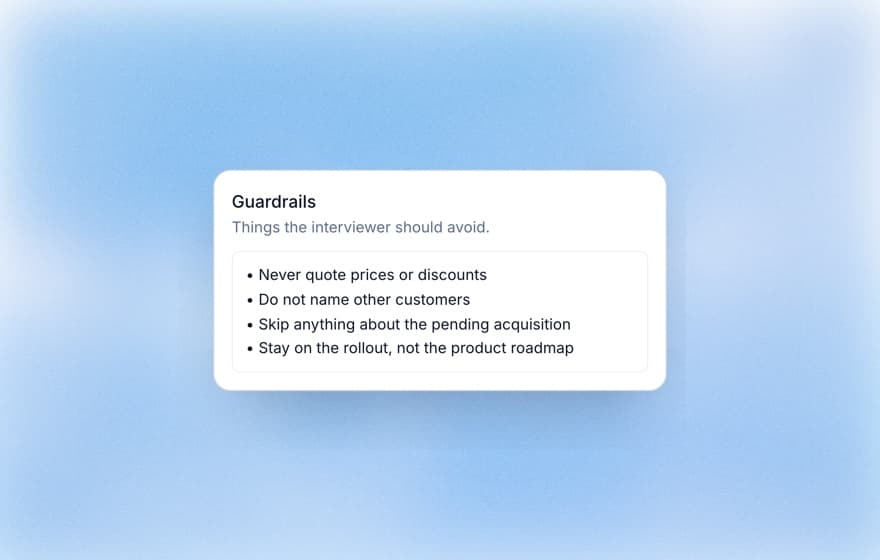
In Phase A, list the topics the interviewer must never touch: the pending transaction, pricing and other customers. See setting interview guardrails. Remove the transaction guardrail only for Phase B, in a separate study, so the two phases never mix.
Which plan. Text interviews and the generic study link work on every plan including Free, so you can pilot on a few contacts. CSV import with personal links and voice interviews are on Researcher, Team, Agency and Enterprise. A text interview costs 1 credit and a voice interview 3, so 30 voice interviews use 90 credits; Researcher includes 70 credits a month and Team 240.
Copy this interview guide
Brief to paste into Koji: Independent research on how [Product]'s largest customers rely on it: who uses it, what it would take to replace, how renewals are decided and what would make them reopen the evaluation.
Opening line: "We are doing independent research on how companies like yours use [Product]. It takes about 10 minutes, there are no right answers, and what you say is used in aggregate."
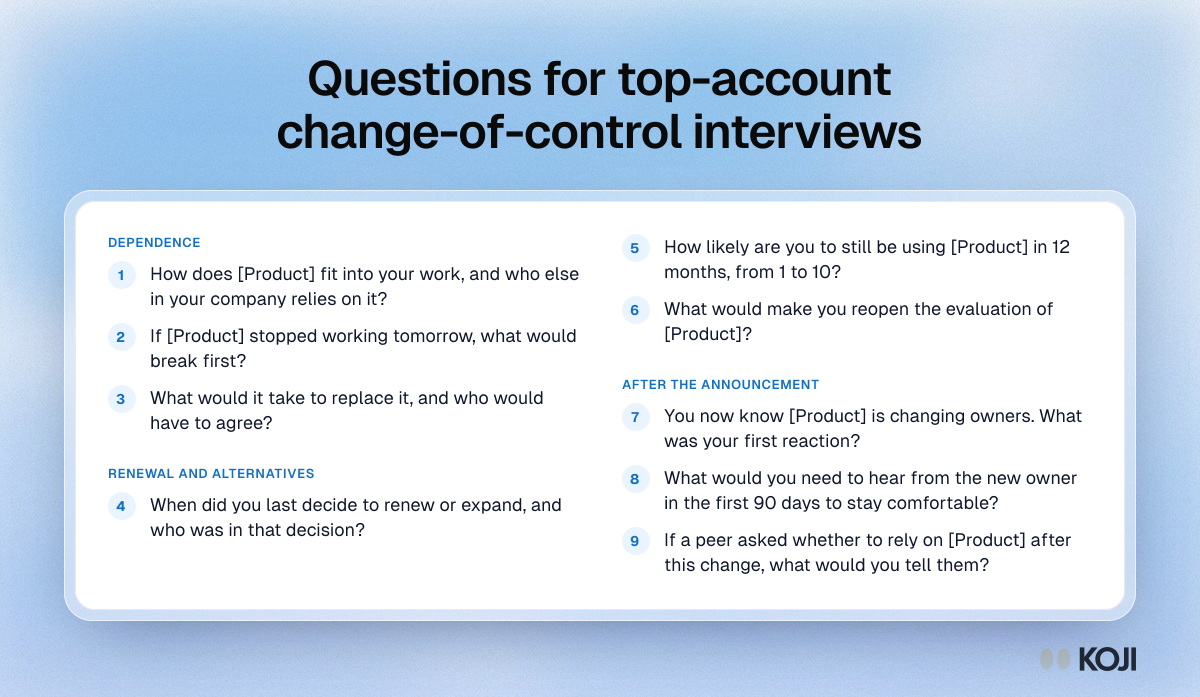
| # | Question | Type | Follow-up probe |
|---|---|---|---|
| 1 | How does [Product] fit into your work, and who else in your company relies on it? | Open | Which team would feel it first if it stopped? |
| 2 | If [Product] stopped working tomorrow, what would break first? | Open | How long could you work around it, and at what cost? |
| 3 | What would it take to replace it, and who would have to agree? | Open | Has anyone looked at that in the last year? |
| 4 | When did you last decide to renew or expand, and who was in that decision? | Open | What nearly changed the outcome? |
| 5 | How likely are you to still be using [Product] in 12 months, from 1 to 10? | Scale | What would move that number by two points? |
| 6 | What would make you reopen the evaluation of [Product]? | Open | Has that happened before? What did you do? |
| 7 | Phase B. You now know [Product] is changing owners. What was your first reaction? | Open | What did you do next, if anything? |
| 8 | Phase B, only if counsel agrees. Does your contract give you any decision to make because of the change? | Single choice: yes, no, not sure | Who on your side is checking? |
| 9 | What would you need to hear from the new owner in the first 90 days to stay comfortable? | Open | Who should say it? |
| 10 | Closing. If a peer asked whether to rely on [Product] after this change, what would you tell them? | Open | Anything we have not covered? |
What you get
You get a report with the themes across the interviews, how many people raised each, and the quotes behind every finding. Open a finding and the supporting responses are one click away, which matters when a partner asks "who said that?" See tracing report findings to the evidence. The export carries your account, role and exit_right columns, so a simple pivot gives one row per account.
What you do with it the next day:
- At committee: a table of the top accounts sorted into the four boxes, with a quote for each.
- In the SPA: the Exposed and Hostage accounts become the case for consent conditions, retention-linked consideration or a holdback.
- In the 100-day plan: the Loyal at will accounts get the first visits. The 100-day customer baseline picks up where this study ends.
The same playbook elsewhere
Customer Success runs this from the other side of the table: renewal risk interviews ask the same three roles whether an account will renew. Sell-side founders face the other end of these calls, and investor-ready customer evidence shows how they prepare. GTM teams use a close cousin when a deal goes quiet: no-decision loss interviews. If you want the whole base rather than the top accounts, start with confirmatory customer calls. And for add-ons, the same method works on the acquired company's customers after close.
Why Koji for change-of-control interviews
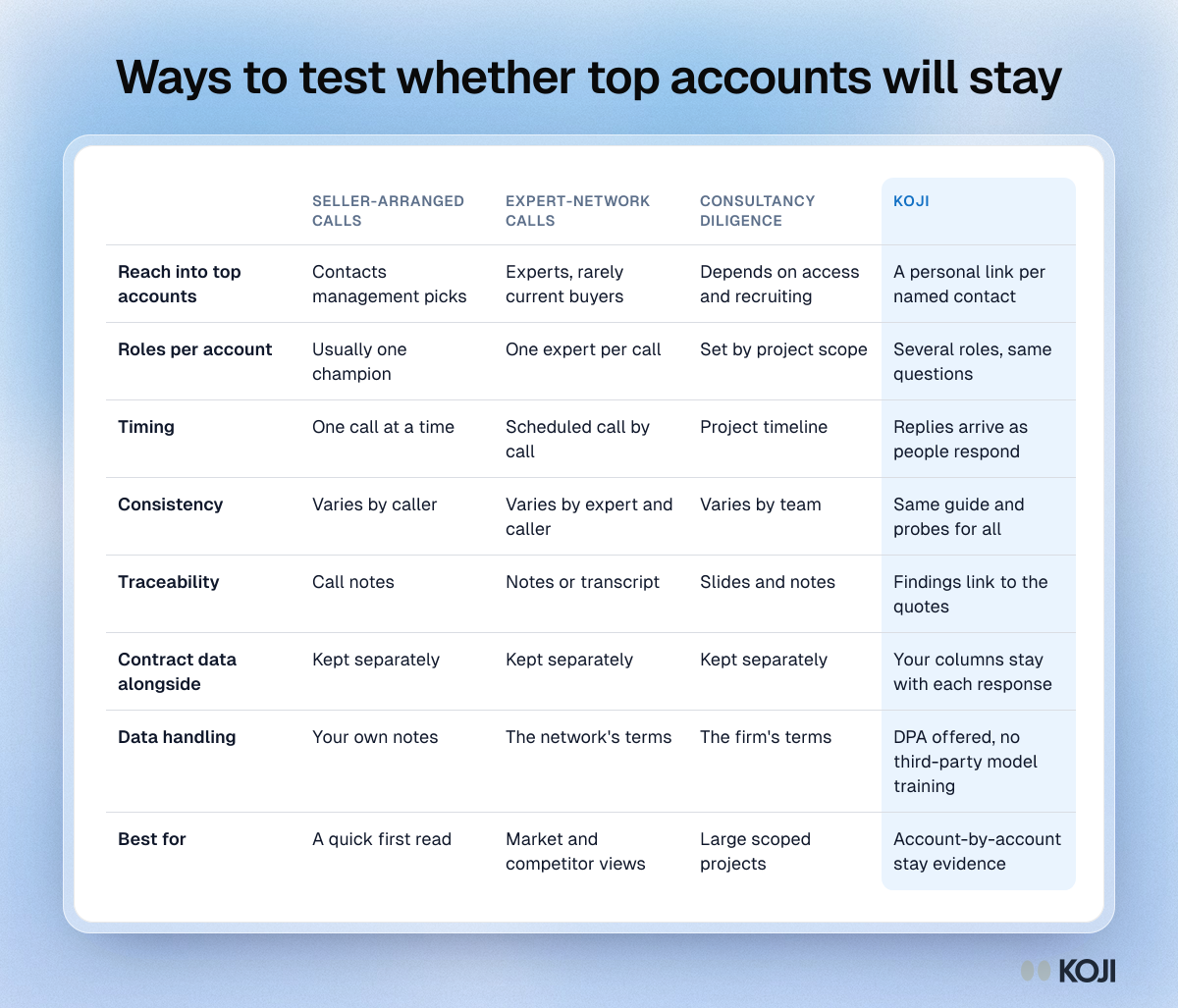
Seller-arranged calls are the easiest to get, and a fair place to start a relationship. Expert networks are strong on market and competitor views; see expert networks vs customer interviews for the detail. Consultancies bring judgment and scale to a scoped project. AI voice-agent services such as DiligenceSquared, which announced a $5 million seed round in March 2026, are also entering commercial diligence; we have not compared their feature sets here. Where Koji fits:
- One guide, every role. The same questions and probes run for each contact, so the economic buyer's answer and the user's answer can be compared.
- Personal links with your own columns. CSV import keeps
account,roleandexit_rightnext to every response, so the grid is a pivot. - Findings you can trace. Every theme links back to the quotes behind it.
- Guardrails and a preview. You control what the interviewer will not discuss and test it before a customer sees it.
- On the customer's time. Text or voice, any hour, inside a 3 to 5 day window.
Questions you might have about AI interviews
Will a senior customer talk to an AI? Some will not. In Verasight's experiment, completion in the AI-interview arm was 40.5% against 99.4% for survey open-ends, though free-response answers carried 4.8 times as many words, and the report cautions that those who finished were a narrower group than the whole sample. That is a panel study, not a top-account invitation, but take it seriously. Use a human introduction, a personal link, a short ask and a 3 to 5 day window. Add a human call for the three largest accounts and use the AI interview for the other roles.
Can we show how a finding was reached? Yes. In the report, open any finding and see the participants and quotes behind it. Keep the export with your consent map as the audit trail.
Is our data safe, and will the customer learn of the deal? Data is encrypted in transit and at rest, a data processing agreement is available to business customers, and interview data is not used to train third-party foundation models. See AI interview data privacy and security. Guardrails keep the interviewer off the transaction in Phase A.
Is it independent if the seller supplies contacts? The seller supplies contact details, not the accounts. You pick the accounts from the revenue ranking and ask for every role. If the seller will not give you a role, note that in the report.
When Koji may not be the right fit
If you have fewer than five material customers, call them yourselves. If the seller forbids any customer contact before signing, you can only run Phase B and should say so to the committee. If the deal needs expert views on a market you do not know, an expert network still beats customers for that. And if a customer will only speak to a named executive, send the executive.
Metrics to track
- Coverage: the share of top-account revenue with at least two roles completed.
- Completion: completed over invited, by role.
- Grid: accounts in each box, and revenue in each box.
- Phase gap: accounts that moved boxes between A and B.
- Deal impact: terms changed because of the grid.
FAQ
How many top accounts should we interview? Cover half of revenue or ten accounts, whichever is more, capped at 15, with three roles each.
Can we run this before the LOI? You can run Phase A as independent product research if the seller agrees. Settle access first.
Should we tell customers about the deal? Not before the announcement. After it, ask openly in Phase B.
Which Koji template should we start from? Customer Reference Checks in the Due Diligence group, with the guide above replacing its questions.
What if a top account refuses? Record the refusal as a finding. An unread account is not scored and not averaged away.
Does this replace the legal review? No. It adds intent to the consent map.
Start now
Open the Due Diligence group in the template gallery and start from Customer Reference Checks, or paste the brief above into a new study. See the due diligence page or the use-case library for due diligence for more playbooks.