

Most win/loss programs start from a competitor's name. The deals that hurt just as much have no name attached: the buyer agreed there was a problem, took the demos, then did nothing. This playbook shows how a GTM team can run AI-moderated interviews with the buyers and stakeholders behind those deals, so you can see why they stalled and which part of your process, not a rival, let them go cold.
Why no-decision losses matter now
Your CRM probably says "closed lost: no decision" and nothing more. That label hides the biggest unknown in your funnel, and four shifts make it more expensive this year.

Photo by Rodeo Project Management Software on Unsplash
Buyers decide before you are in the room. In 6sense's 2025 B2B Buyer Experience Report, which surveyed 3,744 buyers, the winning vendor was already on the buyer's Day One shortlist 95% of the time. If you are not on that list, your reps are fighting for a deal that was mostly decided already, and a stalled deal often means the buyer never believed the case for change. Source: 6sense, 2025 B2B Buyer Experience Report.
Buyers now check AI answers with your reps. Gartner surveyed 645 B2B buyers in August and September 2025 and reported in May 2026 that 69% prefer to validate AI-generated insights with sales reps, while 45% had used generative AI during a recent purchase. The rep is still part of the decision, but as a fact-checker for a story the buyer has already half built. Source: Gartner, May 2026.
More people have to agree. Coverage of Forrester's 2026 State of Business Buying reports that buying groups roughly double when the purchase includes generative AI features: 14 members against 7. Every extra person is another chance for the project to lose to "not now". Source: Digital Commerce 360, January 2026.
Status quo is a named cause, and it is not about your product. Corporate Visions' 2025 Stalled Deals analysis, drawing on feedback from more than 120,000 B2B buyers, attributes about 32% of no-decision outcomes to status quo bias driven by internal organisational dynamics. Solution misalignment (20%) and sales process gaps (19%) follow. Only some of that is fixable with a better demo. Source: Corporate Visions, Stalled Deals Winsight, 2025.
Add the pressure on cycle length: in RAIN Group's 2026 Sales Challenges & Priorities study of more than 250 sales leaders, 48.4% reported a longer sales cycle. Source: RAIN Group via SalesTechStar, 2026.
The cost of not asking: you keep coaching reps on competitive objections for deals nobody competed for, and your forecast keeps counting opportunities whose buyers had already gone back to the spreadsheet.
What good looks like
Experienced revenue teams treat no-decision interviews as a separate programme from competitive win/loss. The questions, the people and the output are different. (For the competitive side, see our win/loss interview questions.)
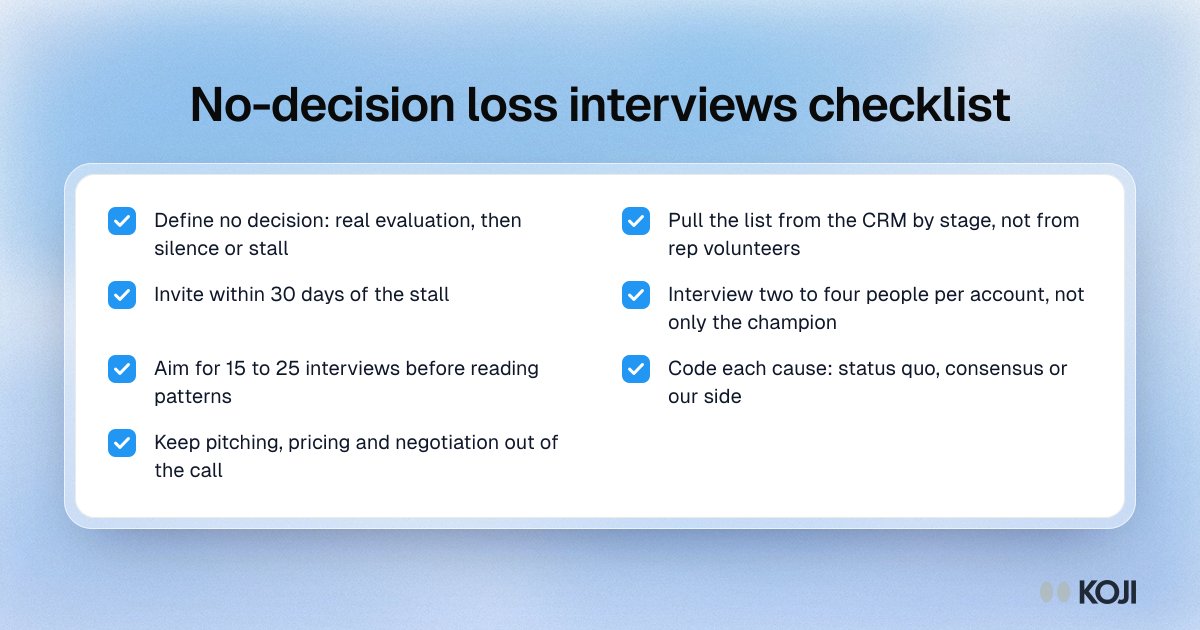
Define "no decision" tightly. Include only opportunities where the buyer had a real evaluation (a discovery call and at least one demo or proposal) and then went silent, postponed, or chose to keep the current process. Leave out unqualified leads and deals that were lost to a named vendor.
Interview soon, within 30 days of the stall. Memory of who said what fades quickly. A stalled deal is usually flagged at a stage change, so trigger the invite from that stage.
Talk to more than the champion. The champion will tell you the project is "paused for budget". The finance lead, the IT reviewer and the person who inherited the work will tell you what actually happened. Plan on two to four people per account where you can.
Aim for 15 to 25 interviews before you read patterns. That is a working rule from practitioners, not a law. Fewer than ten and you are reading anecdotes. Past 25, new themes become rare unless you segment by deal size or stage.
Separate three causes. Code every conversation as one of: the case for change was weak (status quo), the buying group could not agree (consensus), or something about our process or fit got in the way (our side). Each has a different owner: marketing and enablement, the champion plan, and sales ops or product.
Take the seller out of the room. Buyers soften what they say to a rep they might still meet. A neutral interviewer tends to hear more candid answers, and the buyer controls when and how they respond.
Common mistakes:
- Treating "no budget" as an answer. Ask what else got the budget.
- Interviewing only deals the rep volunteers. Pull the list from the CRM by stage instead.
- Using the call to revive the deal. Buyers can tell, and it ends the honesty.
- Reading one quarter and acting. Compare cohorts by stage, segment and rep.
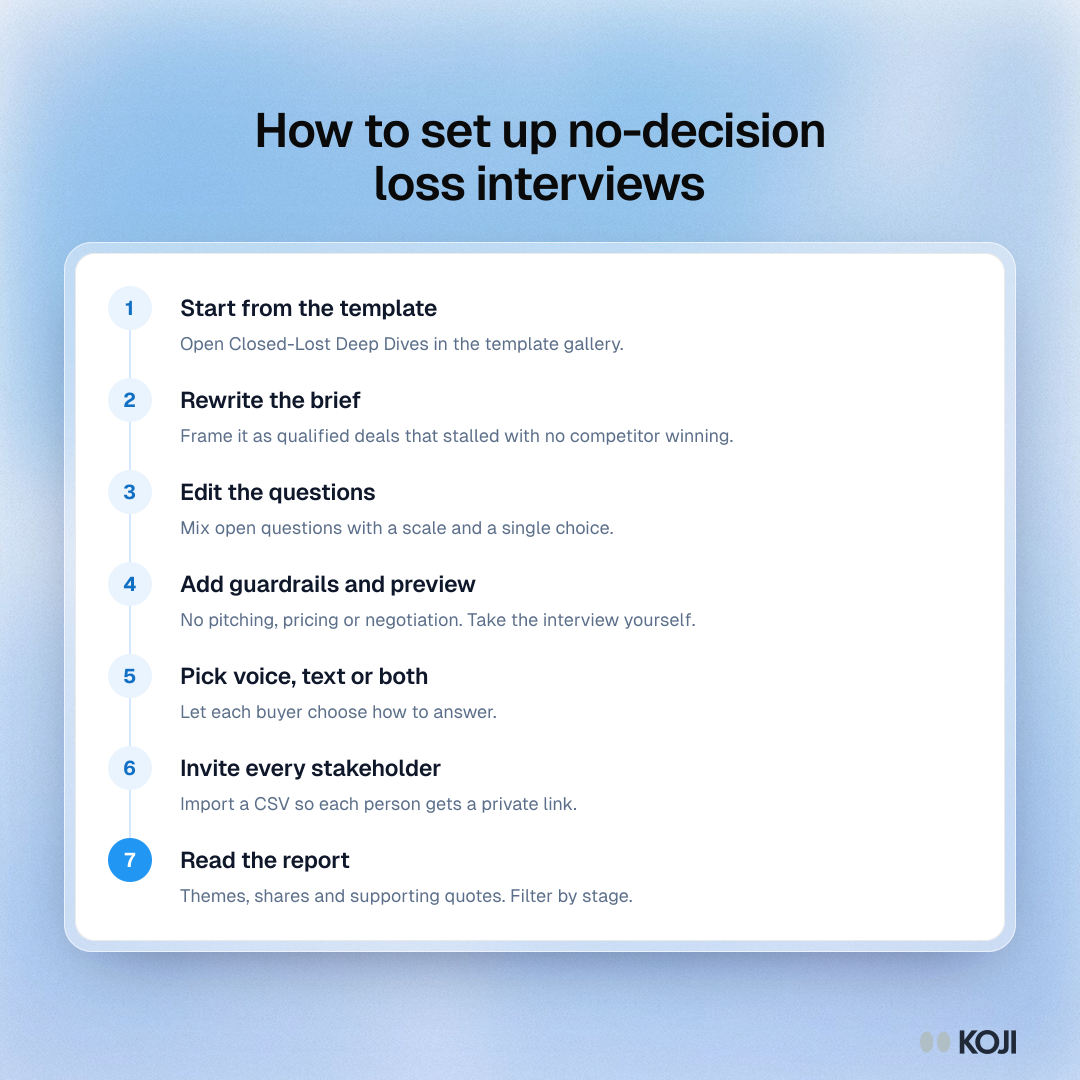
How to set it up in Koji, step by step
You can run this on the Free plan with your signup credits to try it, or on Insights if you share one open link. Sending each stakeholder their own private link from a CSV needs the Interviews plan. A text interview uses 1 credit and a voice interview 3, and only interviews with a quality score of 3 or more use credits or reach the report.
- Start from the template. From the dashboard's template gallery, filter for GTM teams and open the Closed-Lost Deep Dives template. It gives you a research brief and structured questions to edit.
- Rewrite the brief for no-decision deals. Change the problem statement to: "We lose a share of qualified deals without any competitor winning, and we do not know why." Describe the participant as someone who evaluated your product within the last 90 days and did not buy from you or anyone else.
- Edit the questions and add structured ones where you need numbers. Mix open questions with a scale and a single choice so the report can chart them. Examples below.
- Add guardrails. In the guardrails box, tell the interviewer not to pitch, not to negotiate and not to quote prices. Use the preview tab to take the interview yourself, which never uses credits.
- Pick voice, text or both. Voice suits senior buyers who will not type. Text works for buyers who answer between meetings. Let participants choose.
- Invite the people on the stalled deals. Export the stalled-deal contacts from your CRM and use Import CSV on the Self-recruit tab so each stakeholder gets a private link. Send it from a person, not a bot, with a two-line reason for asking.
- Read the report. Findings come with the share of participants behind them and the supporting quotes. Filter by stage or segment before you share.
Example questions written for this use case:
- "Before you talked to us, what was happening that made you start looking at this?" (open)
- "How urgent was fixing this at the start, from 1 to 10? And right now?" (scale, asked twice to see the drop)
- "What happened to the project?" (single choice: postponed, kept the current process, built in-house, budget went elsewhere, still deciding)
- "Who else had to agree, and what did each of them need to see?" (open)
- "What would have had to be true for this to go ahead?" (open)
- "After our last call, what did you tell your team about us?" (open)
What you get
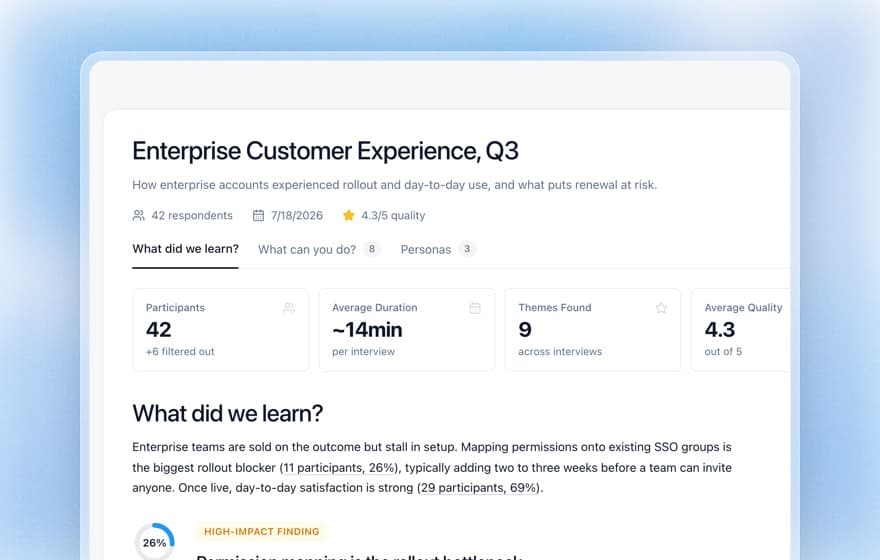
The report gives you themes with the percentage of participants behind each one and the quotes that support it. In practice a GTM team uses it in three places the next day.
In the pipeline review, you can split stalled deals into status quo, consensus and our-side causes, and stop treating them as one line item. In enablement, you can write a champion kit for the consensus cause: the one-pager the finance lead asked for, the security answers IT needed. In forecasting, the scale answers show how urgency changed between the first call and the stall, which tells you which open opportunities are likely to follow.
The same playbook elsewhere
The method carries over. Customer success runs it as renewal risk interviews, asking customers who went quiet before renewal what changed. Founders run a lighter version on their first lost deals, and product teams run it on abandoned trials. Across all three you are asking someone who was interested and then stopped, so the same rule holds: neutral voice, soon after the stall, no selling.
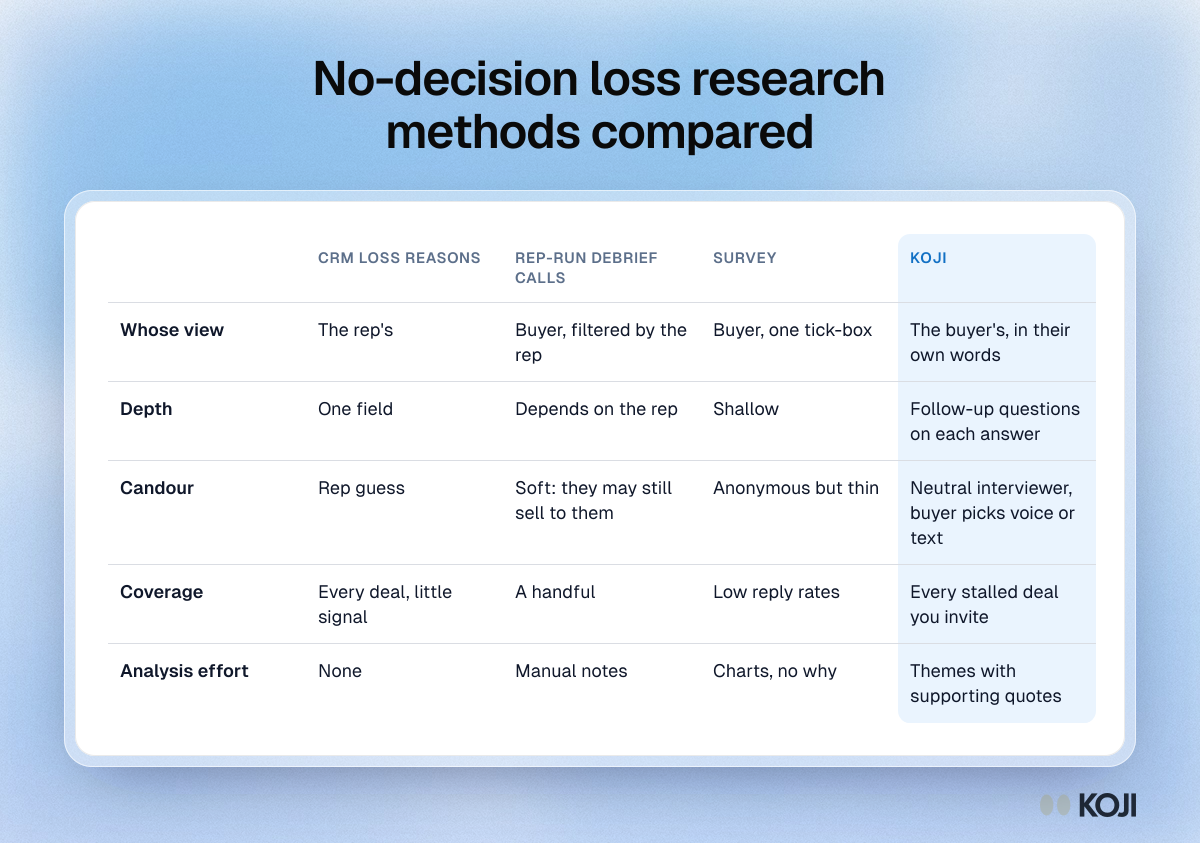
Why Koji for no-decision interviews
| CRM loss reasons | Rep-run debrief calls | Survey | Koji | |
|---|---|---|---|---|
| Whose view | The rep's | Buyer, filtered by the rep | Buyer, one tick-box | The buyer's, in their own words |
| Depth | One field | Depends on the rep | Shallow | Follow-up questions on each answer |
| Candour | Rep guess | Soft: they may still sell to them | Anonymous but thin | Neutral interviewer, buyer chooses voice or text |
| Coverage | Every deal, little signal | A handful | Low reply rates | Every stalled deal you invite |
| Analysis effort | None | Manual notes | Charts, no why | Themes with supporting quotes |
Five reasons, each tied to something Koji does today:
- Follow-up questions on every answer. Each question can be set to probe, so "budget" becomes "what else got the budget".
- Structured and open questions in one interview. Scale and choice answers are charted, and open answers are themed.
- Private invite links from a CSV. Interviews and Enterprise plans can send each stakeholder their own link and see who has not started.
- Quality scoring. Interviews are scored from 1 to 5 and only those scoring 3 or more use credits or enter the report.
- Evidence behind each finding. Findings show how many participants support them, with the quotes in a side panel.
For tools that analyse your own sales calls instead of asking buyers, see Koji vs Gong and the win/loss software comparison.
Questions you might have about AI interviews
"Will a buyer who went quiet talk to an AI?" Some will, because there is no rep to manage on the other end, but we cannot promise it. Participants pick voice or text, and the invite should say who sent it and how long it takes. Test with a small batch first to see your own response rate.
"Will it sound like another sales call?" Not if you set the guardrails. You can tell the interviewer to avoid pitching, pricing and negotiation, and you can take the interview yourself in preview, free of charge and uncounted, before anyone else sees it.
"What happens to what buyers tell us?" Read our GDPR guide for AI user research and decide how long you keep transcripts before you invite anyone.
When Koji may not be the right fit
If a deal is worth seven figures and has three stakeholders, a senior human conversation will outperform any interviewer and relationships matter more than coverage. Koji is built for the middle: dozens of stalled mid-market and commercial deals where nobody has time to call everyone. If you have fewer than ten stalled deals a quarter, a few personal calls are enough.
Metrics to track
- No-decision rate: no-decision opportunities as a share of all closed opportunities.
- Cause split: status quo, consensus and our-side, as a share of interviews.
- Response rate by stage and segment.
- Days from stall to interview.
- Stakeholders reached per account.
- Share of no-decision deals that reopen within six months.
FAQ
How many no-decision interviews do I need? Aim for 15 to 25 before reading patterns, more if you want to compare segments.
Should I interview the champion or the whole group? Both. The champion explains what they tried; other stakeholders explain why it did not move.
When should I send the invite? Within 30 days of the stall, triggered from the stage change.
Do I need the Interviews plan? Not to start. Sharing one link works on Insights. Private links per stakeholder from a CSV need Interviews or Enterprise.
Is this different from win/loss analysis? Yes. Win/loss focuses on why a competitor won. This asks why nobody did.
What do I do with the findings? Split the causes, assign each to an owner, and re-run the same study next quarter to see if it moved.
Start your first study
Open the Closed-Lost Deep Dives template in Koji and adapt it for stalled deals, or see how other GTM teams use Koji on the GTM teams page. The full set of playbooks for this audience is at /use-cases/gtm-teams. For the research behind the method, read our guide to win/loss analysis and the voice interview setup guide.


