Confirmatory customer calls are the last chance to test the customer story before you sign. They are also the call most likely to be rigged by accident: management hands you the list, and the list is made of friends. Run them as AI-moderated interviews on three lists you control, and you can hear 30 customers inside the exclusivity window instead of a handful, with every finding traceable to a quote. By the end of this playbook you will have the method, the 21-day timeline, a full interview guide to paste, and the exact setup in Koji.
Why confirmatory customer calls matter now
You have signed the LOI, the clock is running, and the data room says retention is strong. Confirmatory diligence is where that claim either survives contact with customers or it does not. Four numbers set the terms this year:

Photo by Dylan Gillis on Unsplash
| Number | What it says | Source |
|---|---|---|
| 49 days | Average initial exclusivity on PE deals in 2025, up from 35 in 2024, and often extended | Travers Smith, Private Equity Market Insights 2026 |
| 31% | Share of GPs with AI somewhat or fully integrated into diligence, the highest of any workflow | S&P Global Market Intelligence, April 2026 |
| 27% | Share of GPs who call AI effective at creating value in diligence | S&P Global Market Intelligence, April 2026 |
| Over 80% | Senior European PE professionals using AI in diligence consistently or experimenting, from a survey of 80-plus | Alvarez & Marsal, 2026 diligence report |
Compiled by Koji from the sources above. Links: Travers Smith, S&P Global, Alvarez & Marsal.
Read them together. The window is longer than it was, but in most processes it is spent on financial and legal work, and customer evidence arrives last. AI is already normal in diligence, yet only a minority of GPs say it creates value there, which suggests many teams use it for documents and not for the part that needs people to talk. Funding follows the gap: in March 2026 DiligenceSquared, a startup backed by Y Combinator that runs customer and expert interviews with voice agents, raised a $5 million seed round.
The cost of getting it wrong is concrete. If five hand-picked customers say they love the product and the base does not, you pay for retention you will not get, and you find out in year one of the hold period. Concentration risk, a quiet downgrade wave or a dependence on one champion all sit in the customers management did not suggest.
What good looks like: the Three-List Method
Management reference lists are biased by structure, not by dishonesty. Management thinks of the accounts it talks to every week, which skews to the largest and happiest, and it protects relationships that could derail or reprice the deal. Practitioner guides say the same, though the strongest write-ups come from vendors who sell independent recruitment, so treat the size of any quoted gap with caution. The fix is not to distrust the list. It is to cap its weight.
Build three lists and keep them separate in the report:
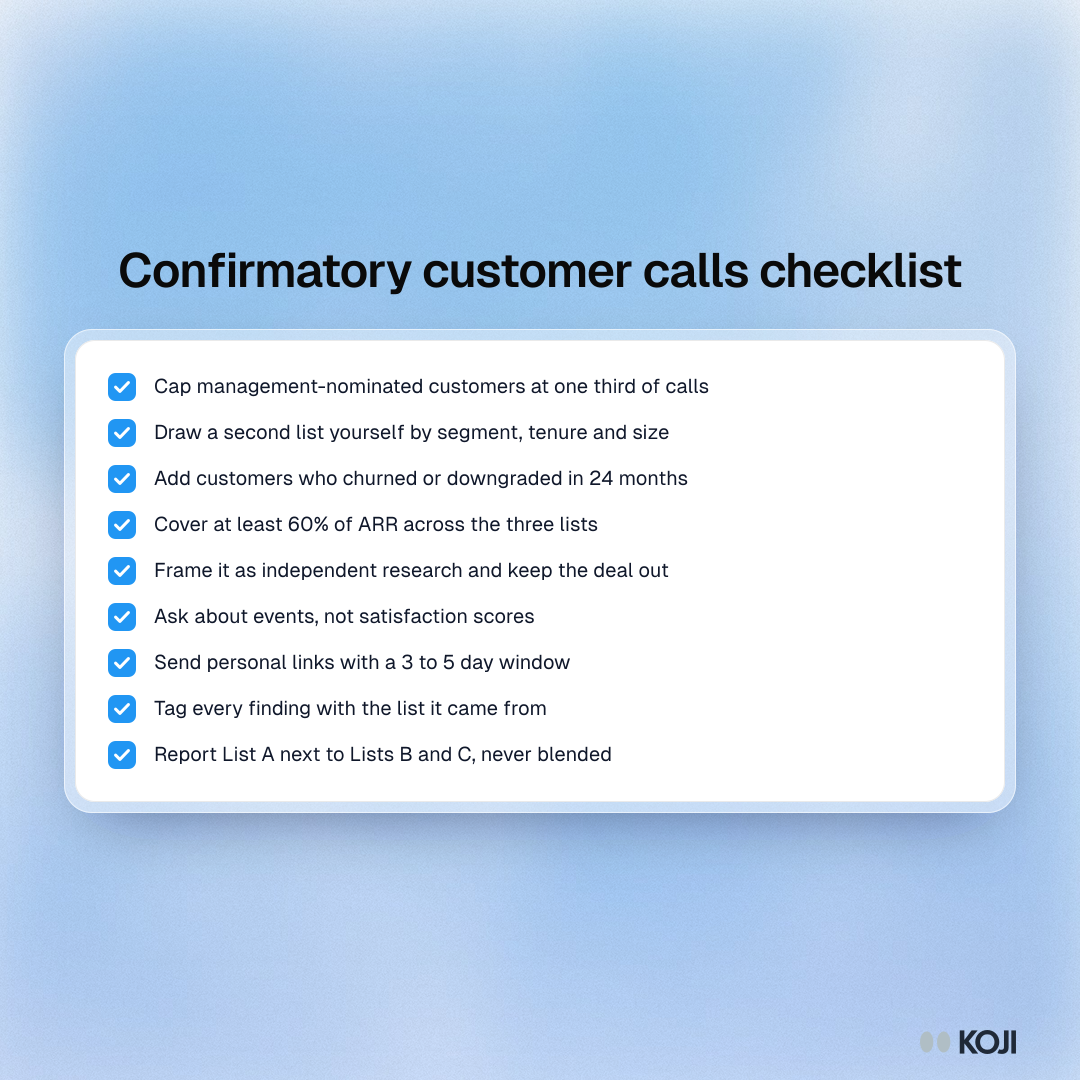
- List A: management nominated. Keep them, because management knows things you do not, and a customer who refuses is also a signal. Cap this list at one third of your calls.
- List B: deal team drawn. You pick from the customer export in the data room, stratified by segment, tenure and size. This is your honest sample.
- List C: left or shrank. Customers who churned or downgraded in the last 24 months. Nobody volunteers these, and they hold the answer to "why".
Decision rule for sample size. Fewer than 30 customers: speak to every one. 30 to 100: aim for 15 completed. 100 to 1,000: aim for 30 completed. Whatever the base, make sure the three lists together cover at least 60% of ARR, then fill the long tail by random draw. This is Koji's recommended rule of thumb, not an industry standard. Move it up if the base is concentrated, down if every customer is the same shape.
Common mistakes
- Reading satisfaction scores aloud as findings. A 9 out of 10 from a nominated customer is a sentence, not evidence.
- Interviewing the economic buyer only. The daily user knows whether the product is sticky or just hard to leave.
- Telling customers about the deal. Frame it as independent customer research and leave the transaction out, as the template's own guidance does.
- Mixing the lists in the average. Report List A next to Lists B and C, not blended into one number.
- Starting on day 30. If calls begin late, they can only confirm. Start in week one.
Check with the seller and your counsel on whether customers may be contacted before signing and on what terms. Lists B and C need contact details that sit with the seller, so agree that access in the process letter or the LOI.
The 21-day timeline
Count back from the date the investment committee wants customer evidence. Here is a plan that fits inside the average 49-day exclusivity period with room to spare.
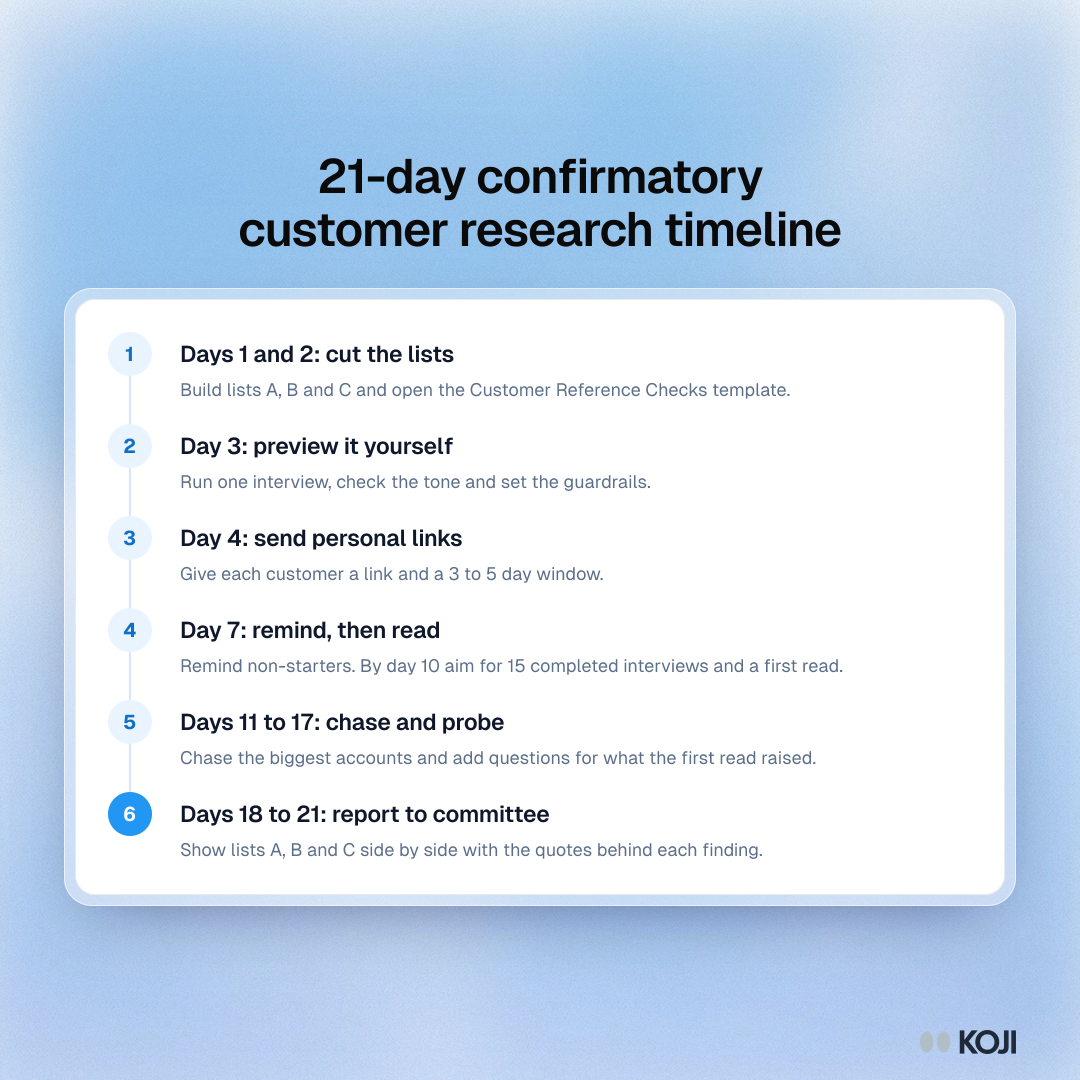
Days 1 and 2 are for the lists and the template. Day 3 is the preview, where you run the interview yourself. Invitations go on day 4, each person gets a personal link and a 3 to 5 day window, and a reminder goes on day 7. By day 10 you should have 15 completed, enough for a first read: which themes repeat, where Lists A and B/C disagree. Use days 11 to 17 to chase the top accounts by revenue and to add questions for what the first read raised. The report goes to committee between days 18 and 21.
How to set it up in Koji
- Start from the template. In the dashboard template gallery, open the Due Diligence group and pick Customer Reference Checks. It ships with a brief written for this job and seven questions. Add question 7 from the guide below.
- Shape the research brief. Type one line into "What do you want to research?" (the brief to paste is below) and add the target's product pages and your hypotheses as context files so the interviewer can follow up on specifics.
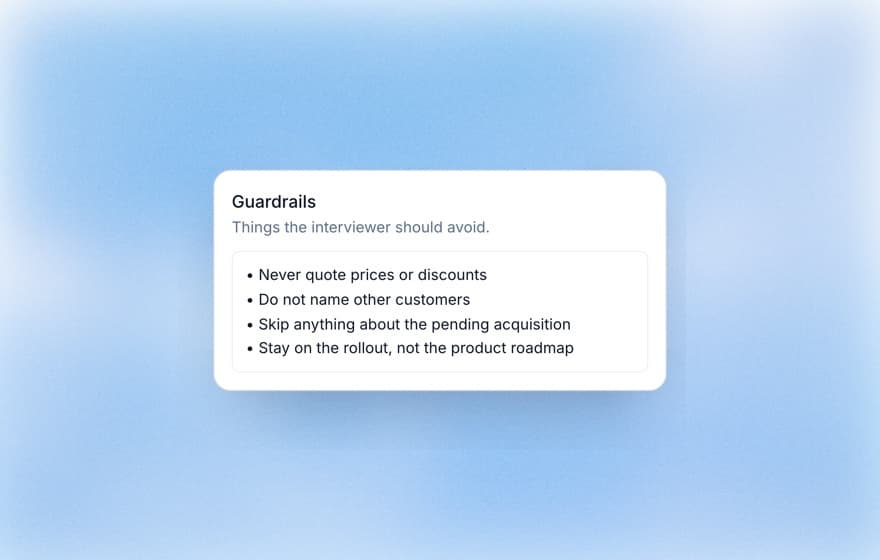
- Set guardrails. List the topics the interviewer must never touch: the pending transaction, pricing and other customers. See setting interview guardrails.
- Choose structured questions where you need a number. Keep the 1 to 10 satisfaction scale and the yes/no question on whether they seriously evaluated alternatives at renewal. Leave everything else open-ended with one or two follow-ups.
- Choose voice or text. Each customer chooses text or voice on their own landing page. Voice suits people who would rather talk; text suits executives who answer between meetings.
- Create personal links. Import the three lists on the Self-recruit tab with a segment column set to A, B or C. Each customer gets a private link, and the column stays next to every response so you can split the results by list. See importing participants from a CSV and personalized interview links.
- Preview, then send. Run a preview interview yourself, check the tone, then send invitations from your own mailbox with a short note.
- Read the report. The report groups themes, shows how many customers support each, and opens the quotes behind a finding.
Which plan. Text interviews and personalised links work on every plan, so you can pilot on a small list for free. CSV import and voice interviews need the Interviews plan or Enterprise. Panel recruitment is available from Insights if you also want lookalike users of the product with no contact from the seller.
Example questions
- Walk me through how you came to use this product and what it replaced. (open)
- If it disappeared tomorrow, what would break first? (open)
- Tell me about the last time it let you down. What happened next? (open)
- When the contract last came up, did you seriously look at alternatives? (yes/no, then probe what they weighed)
- If a peer asked you honestly whether to buy it, what would you say? (open)
Copy this interview guide
Brief to paste into Koji: Independent customer research on [Product]: how customers came to use it, how essential it is, what has gone wrong, how renewals were decided and what would make them leave.
Opening line: "We are doing independent research on how customers experience [Product]. It takes about 10 minutes, there are no right answers, and what you say is used in aggregate."
| # | Question | Type | Follow-up probe |
|---|---|---|---|
| 1 | How did you come to use [Product], and what problem were you solving? | Open | What did you use before? |
| 2 | How central is it to your day-to-day work? | Open | What would break if it went away tomorrow? |
| 3 | Tell me about a time in the last six months when it delivered or let you down. | Open | What was the cost, and who did you escalate to? |
| 4 | How satisfied are you overall, from 1 to 10? | Scale | What would move that number by two points? |
| 5 | When the contract last came up, did you seriously evaluate alternatives? | Yes/no | How far did you get, and what brought you back? |
| 6 | What have you asked for that still has not shipped? | Open | How are you working around it today? |
| 7 | Compared with a year ago, is your use growing, flat or shrinking? | Single choice | What drove that? |
| 8 | If a peer asked you honestly whether to buy it, what would you say? | Open | What would you warn them about? |
Closing question: "Is there anything about your experience we should have asked and did not?"
What you get
Within days you have a report you can take into committee. Each finding states how many customers support it, split by list, and opens the transcript lines behind it. You can show that List A said one thing and Lists B and C another, and that the gap sits in one segment. Typical uses: adjusting the price, writing a specific warranty or indemnity ask, setting a first-100-days retention plan, or walking away. If you win the asset, the same questions repeated 90 days after close give you a baseline to compare against.
The same playbook elsewhere
Founders face the other side of this call. Their investors will phone customers, and the founder-side preparation is covered in investor-ready customer evidence. Customer success runs the same logic when a renewal is at risk, covered in the renewal risk playbook. Sales teams use it to find out why deals stalled in the no-decision loss playbook. The common thread: ask the people management did not pick.
Why Koji for confirmatory customer calls
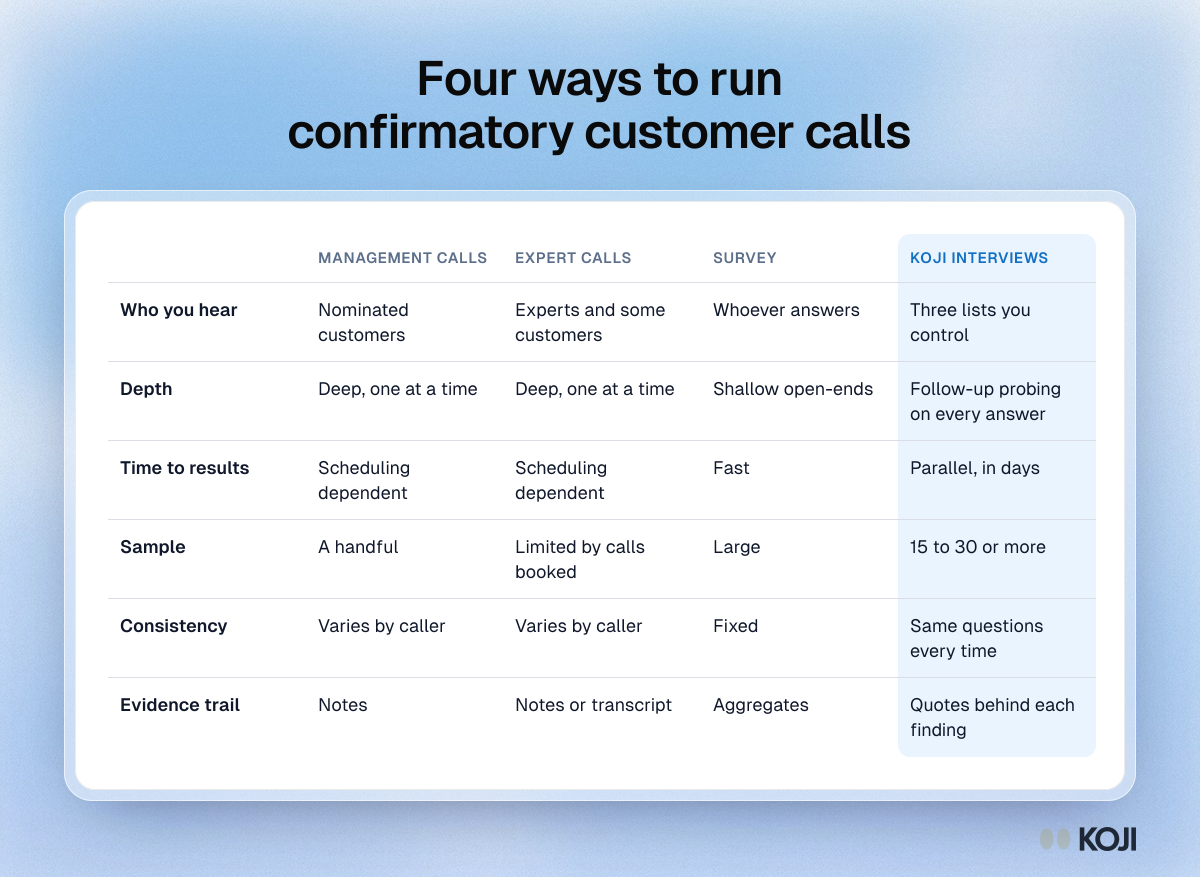
| Criterion | Management reference calls | Expert-network or consultant calls | Survey | Koji AI interviews |
|---|---|---|---|---|
| Who you hear | Nominated customers | Experts and some customers | Whoever answers | Three lists you control |
| Depth | Deep, one at a time | Deep, one at a time | Shallow open-ends | Follow-up probing on every answer |
| Time to results | Scheduling dependent | Scheduling dependent | Fast | Parallel, in days |
| Sample | A handful | Limited by calls booked | Large | 15 to 30 or more |
| Consistency | Varies by caller | Varies by caller | Fixed | Same questions every time |
| Evidence trail | Notes | Notes or transcript | Aggregates | Quotes behind each finding |
I could not find public pricing for expert networks, so ask for a quote before you compare cost.
Reasons to use Koji for this specific job:
- Parallel interviews. All 30 customers can answer at once, in voice or text, on their own time, so an executive who cannot find 45 minutes still answers.
- Personal links per customer. The CSV import gives each person a link, so you know which list each answer belongs to.
- Same structure every time. Open questions with follow-ups and a few structured questions, so List A and List C are comparable.
- Evidence panel. A finding opens the supporting quotes, which is what an investment committee asks for.
- Guardrails and EU storage. You list topics the interviewer must avoid, and interview data is stored in the EU. See the GDPR guide.
Questions you might have about AI interviews
Will a senior customer talk to an AI? Some will not. In an August 2026 randomized experiment on a 3,160-person panel, Verasight found AI-moderated interviews produced 4.8 times as many words as written open-ends, but completion fell from 99.4% to 40.5%. That was a general-population panel, not named B2B customers, yet plan for it: invite more people than you need, use personal links, give a 3 to 5 day window and let them choose text. Report the response rate by list, because who declines is also data.
Can I trust the analysis? Every finding opens the interview lines that support it, and each interview carries a quality rating, so you can check the claim yourself and drop weak interviews.
Is it confidential? Guardrails keep the interviewer off the transaction, and participants see an interview framed as independent research. Interview data is stored in the EU. Read AI interview data privacy and security.
When Koji may not be the right fit
If the deal turns on three customers worth 60% of revenue, skip the interview tool and have a partner call each of them. If the customers are regulated bodies that only speak through counsel, or the seller will not release contact details at all, you are limited to panel lookalikes and expert calls. Koji is strongest when the base is broad enough that a handful of calls cannot represent it.
Metrics to track
- Completed interviews by list, and response rate by list
- Share of ARR covered by completed interviews
- Satisfaction score and "evaluated alternatives" rate, List A against Lists B and C
- Number of findings supported by 20% or more of completed interviews
- Days from LOI to first read
FAQ
How many customer calls do I need in confirmatory diligence? Speak to every customer if there are fewer than 30, aim for 15 completed up to 100, and 30 up to 1,000. Cover at least 60% of ARR. This is Koji's rule of thumb.
Can I contact customers before signing? Only with the seller's agreement and your counsel's view. Agree the access in the process letter.
How is this different from commercial due diligence from a consultant? A consultant brings judgment and sector knowledge. This playbook adds broad, consistent customer voice. Many teams use both.
Should I tell customers about the acquisition? No. Frame the interview as independent research and set a guardrail against discussing the transaction.
What does it take to start? Pick the Customer Reference Checks template, paste the brief and import your lists. A pilot of text interviews runs on any plan.
How long should each interview be? Aim for about 10 minutes. The template has seven questions.
Ready to run it? Sign up, start from the Customer Reference Checks template, or read more on the due diligence page and the due diligence use-case library. Deeper background: commercial due diligence customer interviews.